As James pushes local control on data centers, past congressional votes sought to limit just that
Sep 02, 2026 | 5:00 am ET
Description
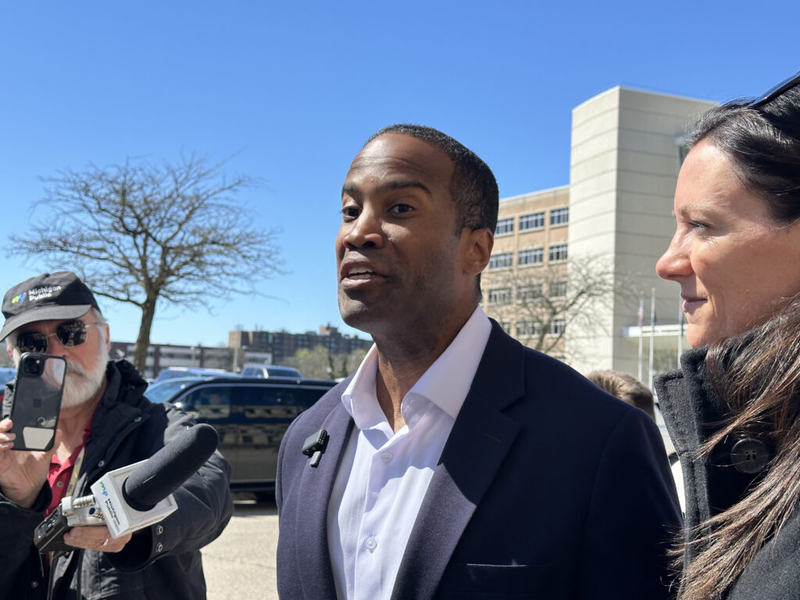
U.S. Rep. John James speaks to reporters after submitting his nominating petitions to the Michigan Bureau of Elections in Lansing in his bid for Republican nominee for governor. April 20, 2026. | Photo by Katherine Dailey/Michigan Advance.
U.S. Rep. John James of Shelby Township, the Republican nominee for governor, has staked his campaign’s data center platform on local control. But in Congress, he voted for legislation that would expressly prohibit state and local governments from regulating artificial intelligence systems — including data centers.
“My priority is frankly local control, protecting our water, protecting and preventing pollution, making sure that electricity bills do not go up, and also making sure that we prioritize blighted and brown fields over productive green farmland,” James said of data centers at a gubernatorial debate in early July. “That would be my moratorium, that would be our standard. We absolutely cannot have an additional data center until we protect the people and communities. That’s no NDAs, that’s making sure we don’t have the ground, air, and water, also the noise pollution, and making sure that, again, we protect local control.”
However, James voted in May 2025 for the U.S. House’s version of H.R. 1, the One Big Beautiful Bill Act, which included an explicit 10-year moratorium stating that “no State or political subdivision thereof may enforce any law or regulation regulating artificial intelligence models, artificial intelligence systems, or automated decision systems.”

That moratorium, part of a $500 million investment in an “artificial intelligence and information technology modernization initiative,” did not make it into the final version of H.R. 1 that became law. However, as a member of the House Committee on Energy and Commerce, James voted in favor of the specific moratorium three times: twice voting to advance it out of committee, and once voting against an amendment that would have removed it from the bill.
“John James voted for H.R. 1 to deliver historic tax relief to working families across the country. His approach to data centers has been clear: no new data centers until we protect our people,” Alyvia Bailey, a spokesperson for the James campaign, wrote in a statement to the Michigan Advance. “He will re-establish local control, ensure no utility rate increases for residents or secret deals, protect our water and air, prioritize brownfields, and preserve farmland.”
Bailey did not directly address questions about James’ votes for the moratorium within the House version of H.R. 1.
The National Conference of State Legislatures, a bipartisan organization representing the interests of state legislatures, cautioned against a vote in favor of that provision, writing that it would “circumvent their authority to regulate the permitting, construction and operation of data centers within their borders” for states.
“This will severely limit the ability of states and localities to make decisions regarding the siting and operation of these large-scale projects, raising costs for ratepayers, jeopardizing zoning decisions that protect our mutual constituents and impacting existing infrastructure such as power grids and generating facilities,” Tim Storey, the group’s CEO, wrote in a letter.
Meanwhile, James, who has aligned himself closely with President Donald Trump and received his endorsement in the primary election, must now navigate Trump’s enthusiastic support for data centers.
In a post Monday on Truth Social, Trump said that the United States should “let Data Reign” and that if communities push back against data centers, they “want to end up being backwards and poor.”

But data centers remain unpopular in Michigan. A survey conducted Aug. 22 through Aug. 28 by EPIC-MRA found 73% of respondents were opposed to “current federal tax breaks and other federal policies that were put in place to encourage and speed up the development of data centers.” Meanwhile, a Detroit Regional Chamber poll conducted in May 2026 found that while an overwhelming majority opposed data centers in their regions, with regulations in place, “a plurality of Michigan voters would shift to consider a data center within 25 miles of their homes.”
James has continued emphasizing his messaging in favor of local control in the lead-up to the primary and in the weeks since, even as the head of his party has publicly disagreed.
“My position is we need to have a plan to protect our communities. Until we do, then we have to make sure that we have local control,” James said on CBS Face the Nation on Saturday. “Our electricity bills can’t go up. We must protect our water. We have to prevent pollution, that includes land, air, and noise pollution, and then we need to make sure that we prioritize blighted brownfields over productive green farmland.”
The push for local control in data center development crosses party lines — James’ Democratic opponent, Secretary of State Jocelyn Benson, said at the Michigan Democratic Party nominating convention on Saturday that “there needs to be a moratorium on data centers unless we know that we have those guardrails in place.”
“If any corporation, be it a data center or anyone else, wants to come to Michigan, they have to play by our rules,” she said. “They cannot use or abuse our natural resources. They cannot drive up energy costs, and they have to have the will of the people and the welcoming of their community on their side if they want to set up shop in any community in the state.”
Lansing, MI