Joint Finance Committee votes to release PFAS settlement funding
Sep 01, 2026 | 5:35 pm ET
Description
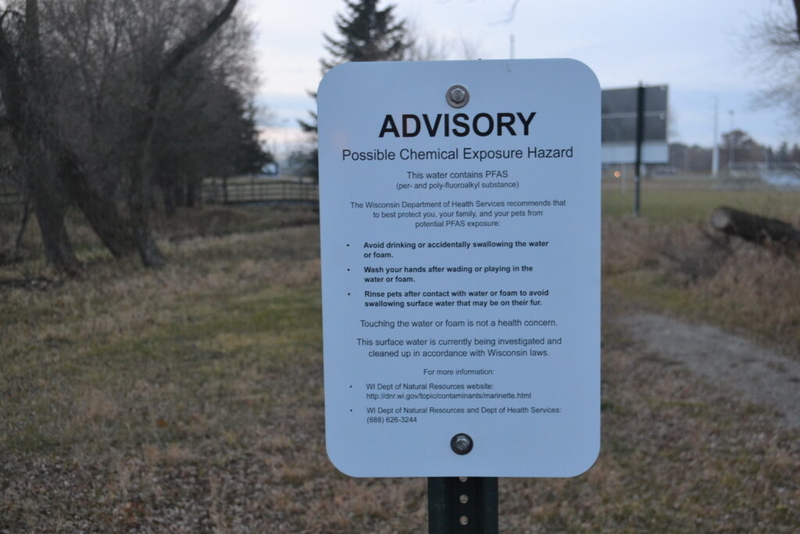
A sign warning people not to drink water contaminated with PFAS chemicals in Marinette. (2019 photo by Erik Gunn/Wisconsin Examiner)
The Wisconsin Joint Finance Committee approved the release of nearly $10 million in PFAS settlement funds to the Department of Natural Resources Tuesday, concluding a years-long process to offer help to residents of Marinette County whose drinking water was contaminated with PFAS chemicals
In June 2026, the Marinette County Circuit Court approved a settlement in the State of Wisconsin v. Tyco Fire Products LP. The agreement marked one of the first efforts to hold polluters accountable for PFAS “forever chemical” contamination in Marinette.
Under the settlement, Tyco agreed to provide safe drinking water to households including by installing new deep wells, maintaining associated treatment of new and existing wells and providing bottled water or treatment to households without a deep well.
Tyco also agreed to provide more than $9.9 million to the state’s PFAS fund, which was established in the state’s 2023-25 budget and holds funding for the mitigation of PFAS contamination. The settlement did not specify how the funds should be used, but a legislative committee had to sign off before the DNR could use them.
The DNR held two listening sessions in Marinette to get input on how to use the settlement money and used the feedback to come up with a plan, which includes using the funds for activities that provide safe drinking water and health information to impacted residents.
Settlement money in the state of Wisconsin has to be approved for use by the Joint Finance Committee under state law. Gov. Tony Evers had urged the budget committee last month to release the funds so they could be put to use as soon as possible.
“I’m glad that these critical investments will be getting out the door to get PFAS out of our water for good and ensure every Wisconsinite has access to clean, safe drinking water,” Evers said in a statement after the committee voted. “This is a big step in the right direction, and the DNR will continue to collaborate with local leaders and communities to ensure we get these funds out the door and to the impacted communities to address their most urgent needs in a timely fashion.”
The committee unanimously approved the release of the funds to the DNR’s general program operations appropriation in 2026-27 to provide PFAS-free drinking water and health information to residents of the City of Marinette and the Town of Peshtigo affected by PFAS contamination.
The transfer of the funds to the general operations will allow for “expeditious allocation of the settlement funds to the impacted community in accordance with preferences expressed by local residents,” according to papers prepared by the Legislative Fiscal Bureau.
Between $6 million and $9.2 million, or about 90% of the funds, will be used to provide safe drinking water to owners of private wells contaminated by PFAS. Up to $1 million will be used for private well testing, up to $7 million will be used for deep well installation and up to $1.2 million will be used for in-home PFAS treatment installation. Some of the funds will also be used for long-term operations and maintenance, though that cost is to be determined.
Between $20,000 and $50,000 will be used to offer blood serum testing for PFAS to residents of the city of Marinette.
Between $500,000 and $750,000 will be used to support a community liaison consultant to help residents access settlement funds. Sen. Eric Wimberger (R-Gillett), who voted for the release of the funds, expressed concerns about the use of funds for that purpose.
“We’re talking about 500 people, and we’re going to be paying upwards of that amount to essentially fill out your forms,” Wimberger said. “The bulk of what you’re doing is great. You got to deal with these immediate problems with the wells which it focuses on, but there are also long-term problems up there, which is keeping biosolids out of the environment to begin with.”
Biosolids are the byproducts of municipal wastewater treatment utilities that are sold or given away to farms to be used as fertilizer. The DNR grants permits that allow for the spreading of them, but biosolids from places with PFAS contamination in the water are contaminated and could pollute the water near the field where they’re spread.
As Evers and lawmakers, including Wimberger, have worked on PFAS issues, Wimberger expressed concerns about farmers being held responsible for spreading PFAS through contaminated biosolids. The issue created gridlock that held up funding to address PFAS contamination for years.
“I hope that in the future, you at least focus a little bit on maybe some treatment plants located at the landfill site, so it doesn’t get into the municipal treatment facilities and onto our farms,” Wimberger added.
Madison, WI