Rollins unveils project to improve farmer data reporting and accuracy
Sep 01, 2026 | 7:05 pm ET
Description
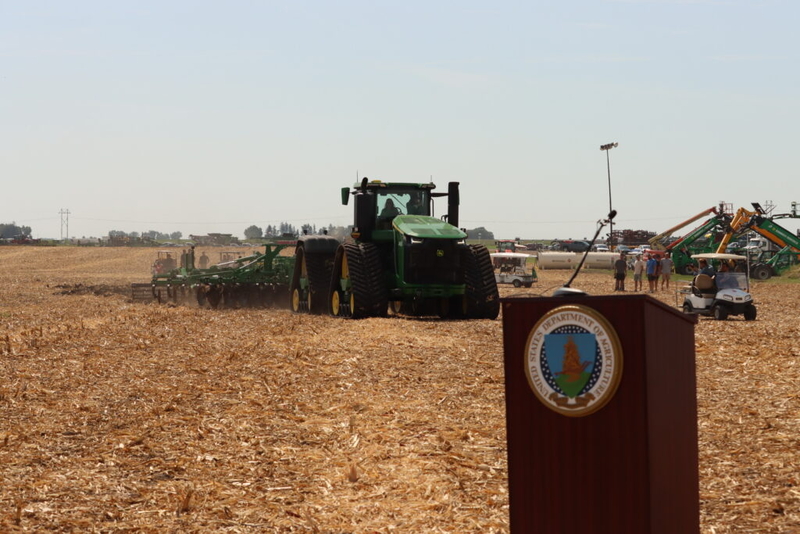
Secretary of Agriculture Brooke Rollins rides up to a press conference in a tractor at the Farm Progress Show in Boone, Iowa Sept. 1, 2026. (Photo by Cami Koons/Iowa Capital Dispatch)
BOONE – U.S. Secretary of Agriculture Brooke Rollins spoke to producers Tuesday at Iowa’s Farm Progress Show and announced plans to “modernize” agricultural data reporting with the goal of making it more accurate and less burdensome for farmers.
Rollins traveled to state fairs and farm shows across the country in August, speaking with farmers about the surveys and other reporting tools they currently use and asking how they can be improved.
“You deserve administrative support that makes your lives simpler, more rewarding, and easier, not harder,” Rollins said.
She said her announcement Tuesday in Iowa reflects the feedback she received from speaking with farmers about the issue.
The U.S. Department of Agriculture’s Data Modernization Plan has four pillars aimed at updating reporting systems, enhancing acreage and yield estimates, expanding data sharing capabilities and continuing to “protect” producer privacy.
The USDA collects data from farmers through surveys and other methods as a way to build reports on crop acreage, yields, herd sizes and more complex reports that help markets estimate the supply and demand of various commodities.
The first pillar of the data modernization plan seeks to update reporting the reporting “experience” by allowing farmers to respond to USDA surveys on mobile devices, for example, and by reducing “duplicative” information farmers are asked to submit.
As part of the plan, the USDA will also conduct a pilot program to evaluate how various data collection sources, including satellite imagery, geospatial tools and precision agriculture tools used by farmers can interact with producer-reported information to improve things like yield estimates.
The accuracy of the USDA reports and forecasts have been scrutinized in the past, despite their widespread use in the industry. When asked how the program would improve accuracy, Kip Tom, a former U.S. ambassador who has been working with the USDA on the data modernization project, said part of the solution will come from the “portfolio” of data sources.
The additional sources of data, as opposed to just farmer surveys, will allow the department to “triangulate” and check the accuracy of various reports. Tom said the USDA also plans to issue an annual “scorecard” where the department will demonstrate how their forecasts on things like corn yield, for example, held up to actual numbers.
The modernization plan includes steps to integrate USDA technology platforms and expand data-sharing capabilities that will allow, for example, data that a farmer has already submitted to the USDA to be populated into a new report.
As part of this effort, the department also said it would evaluate how artificial intelligence tools can help in this effort. Tom said farmers will soon be able to access more data visualizations, made with USDA reports, on mobile and tablet applications.
The final pillar of the plan includes a commitment to protecting producer privacy and explaining to producers why certain information is requested — something Rollins said was a problem farmers elevated when she spoke with them.
Sam Berry, the USDA’s chief information officer, said the old information systems will be “completely shut off” by spring 2027 as the modernized forms roll out.
He said the agency was successful in implementing some of the updates when it rolled out farmer bridge payments, a $12 billion federal package to offset farmer losses at the end of 2025.
“We already have a track record of massive wins in our farmer-facing systems,” Berry said. “In everything that we’re doing, we’re moving at such a fast pace, every day, it’s getting better.”
Tom said the data modernization project is something that will “change the game.”
“We are constantly being consulted around the world on how to do this, but we have a lot of improvements that we can make,” Tom said. “The time is right with the technology, the time is right for the purpose, and the time is right, right now with the leadership of Secretary Rollins.”
Rollins said the announcement is just “chapter one.”
“We still have a lot of chapters to go, so really looking forward to continuing to build this out,” Rollins said.
Des Moines, IA