SC governor moves to oust Charleston school board member after report found possible fraud
Sep 01, 2026 | 6:55 pm ET

Description
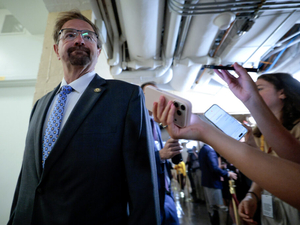
Gov. Henry McMaster, pictured Tuesday, March 31, 2026, asked a Charleston County school board member to defend her spot on the board in front of a panel, the first step toward removing her from office. (File/Photo by Jessica Holdman/SC Daily Gazette)
COLUMBIA — Gov. Henry McMaster took the first step Tuesday toward removing a Charleston County school board member after a state inspection found she may have broken multiple laws.
The inspector general’s office found evidence board member Darlene Dunmeyer-Roberson may have violated board policy and state law, according to the report released last Thursday. The office referred its report to the State Law Enforcement Division and the Department of Revenue for further investigation.
McMaster pointed to three potential violations of board policy and state ethics law noted in the inspector general’s report. The investigation found evidence Dunmeyer-Roberson divulged information the board discussed behind closed doors, shared confidential emails, and got her campaign manager a contract with the district, according to the report.
Dunmeyer-Roberson did not respond to a call from the SC Daily Gazette requesting comment Tuesday.
McMaster’s order doesn’t immediately remove Dunmeyer-Roberson, who was first elected in 2022. She will first have a chance to go before a three-person panel the governor appointed and make her case for why she should remain on the board.
Dunmeyer-Roberson has until Sept. 10 to tell the governor whether she would like to speak to the board. The panel will then tell the governor by Oct. 5 whether its members believe he should remove Dunmeyer-Roberson or not.
If she doesn’t meet the deadline, McMaster can remove her immediately, according to the order.
The investigation also found potential fraud in Dunmeyer-Roberson’s tax filings, residence and district invoices through her company. Inspector General Brian Lamkin recommended the governor consider removing Dunmeyer-Roberson from the board.
“Taken together, the actions demonstrate willful misconduct in office and persistent neglect of Trustee (Dunmeyer-Roberson’s) fundamental obligations of loyalty, confidentiality, and impartial governance,” the report reads.
Confidential information and conflict of interest
The report doesn’t name the board member accused of breaching board policy and state law. Instead, Lamkin referred only to “Trustee X.”
However, the governor’s executive order and property records indicated in the report identify the unnamed trustee as Dunmeyer-Roberson.
The investigation found Dunmeyer-Roberson forwarded confidential emails and information that fell under attorney-client privilege to news outlets 10 times, and she forwarded proprietary information to a business she ran, which had a contract with the district, 28 times, according to the report.
That information may have “afforded the vendor an unfair advantage in a contractual matter with the District,” Lamkin wrote.
McMaster asked for the investigation after another board member, Kevin Hollinshead, was indicted in March on charges of bribery after sharing confidential board information with an outside company. The grand jury in that case noted that another board member also disclosed details from closed-door meetings but didn’t name that person, according to the report.
The inspector general also found a potential conflict of interest involving Dunmeyer-Roberson’s campaign manager. In 2023, Dunmeyer-Roberson emailed a district principal to set up a meeting with her campaign manager to discuss a contract for services, according to the report.
The campaign manager’s nonprofit, Circle of Life Foundation, ultimately became a district vendor and charged the district $216 per pupil per hour to meet with a social worker, according to the report.
That could create a conflict of interest in violation of board policy and the state’s ethics laws, which prohibit elected officials from using their office for financial gain, either for themselves or anyone associated with them, the report found.
The inspector general also questioned whether that was the best use of funds, considering some district staff said they believed the schools already had people to do the same duties and the cost came in far above the standard for similar mental health-based services, according to the report.
Potential fraud
The investigation found that Dunmeyer-Roberson failed to file correct taxes for herself or her company, Next Level Educational Services, which contracted with the district. Between 2019 and 2024, the inspector general found $248,000 in income unreported on her income tax returns, according to the report.
The report also raised concerns about payments through Dunmeyer-Roberson’s company, which is listed as an educational consultant on invoices.
Before her election to the board, Dunmeyer-Roberson received more than $239,000 from the district for her work through Next Level.
The company stacked unnecessary late fees onto its invoices, exploiting a weakness in the district’s payment system and racking up costs in violation of law, according to the report. The district paid the invoices using Title I funds, which are meant to help children from low-income families, despite those not applying in this case, the report found.
In many cases, the district had paid the invoices on time, according to the report.
The procurement manager responsible for paying the invoices is on leave while the district investigates the payments, Lamkin wrote.
“Next Level’s potential fraudulent submission of the invoice(s) and the resulting payment using Title I funds caused a direct waste of educational funds,” the report reads. “Next Level caused the District to improperly disburse these funds and deprived eligible low-income students of critical services such as targeted tutoring, instructional materials, and smaller class sizes.”
Another source of potential fraud was Dunmeyer-Roberson’s address, Lamkin wrote.
Dunmeyer-Roberson may not have lived in Charleston County during at least part of her time as a board member, the inspector general found.
She filed to run in 2022 with an address in Charleston County. But documents she filed for a mortgage loan through Veterans Affairs listed her address in 2023 as being in Summerville, which is in Dorchester County.
That means Dunmeyer-Roberson “either committed VA mortgage loan fraud by attesting (she) resided in Dorchester County,” or she moved out of Charleston County while on the board, at which point she should have given up her seat, the report reads.
Altogether, the investigation found “acts of malfeasance, misfeasance, conflicts of interest, policy violations, misconduct in office, and neglect of duty in office,” the report reads.
Columbia