3 candidates now face a criminal probe over public campaign funding fraud allegations
Sep 01, 2026 | 7:08 pm ET
Description
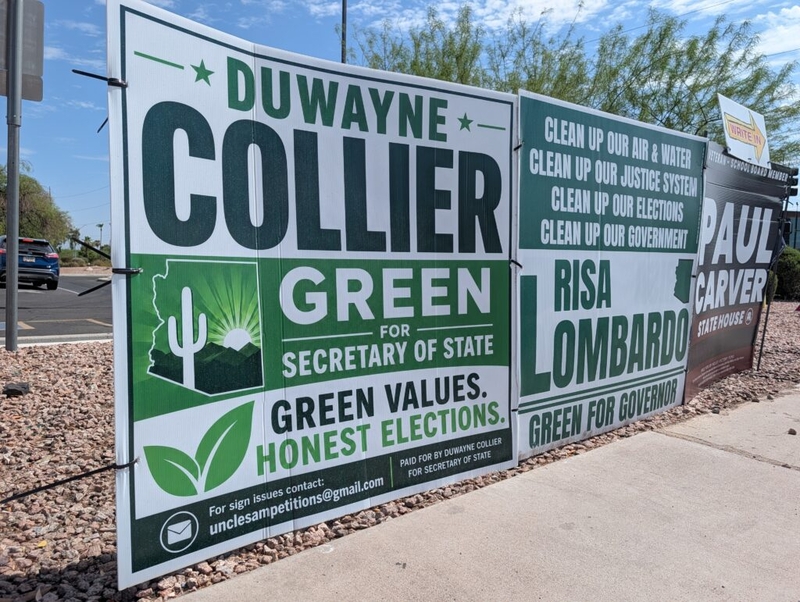
Green Party candidates Risa Lombardo and Duwayne Collier are running for statewide office using Clean Elections money. At least six voters say that they have no idea why they are listed as having made small-dollar donations to help Lombardo, Collier and GOP gubernatorial candidate Scott Neely qualify for the public campaign funding. (Photo by Jim Small/Arizona Mirror)
The Arizona Attorney General’s Office is investigating three fringe candidates for statewide office facing allegations that they falsely used voters’ information alongside fraudulent $5 donations to qualify for millions of dollars in public campaign funds.
Richie Taylor, spokesman for Attorney General Kris Mayes, told the Arizona Mirror that the office had opened a criminal investigation into reported campaign finance fraud by Green Party candidate for governor Risa Lombardo, Green Party candidate for secretary of state Duwayne Collier and Republican candidate for governor Scott Neely. Taylor said that he couldn’t comment further.
Last week, the Mirror published an exclusive report that six Arizonans said their names and signatures had been used falsely by the three candidates so they could qualify for a total of more than $4.7 million in public campaign funding. The voters also denied they had given any of the candidates money.
The Arizona Green Party has disavowed Lombardo and Collier, accusing the two candidates, who have extensive ties to the Arizona Republican Party, of being Republicans in disguise who are attempting to pull progressive votes from Democratic Gov. Katie Hobbs in the general election in order to benefit her GOP opponent, Andy Biggs.
In separate investigations, the Arizona Citizens Clean Elections Commission and the Mirror found that the three candidates reported collecting Clean Elections qualifying contributions from nearly 4,000 of the same voters, including more than 2,600 who were listed as giving to all three.
Those $5 qualifying contributions are a requirement for candidates who wish to access public campaign financing. Every candidate participating in Clean Elections must gather a set number of the small-dollar contributions — the exact number depends on what office the candidate is seeking — from voters to unlock the larger sums of money. This year, candidates for governor had to gather 4,000 of those small donations to qualify while secretary of state candidates had to get 2,500.
The Mirror and the Clean Elections Commission analyzed the contribution history of hundreds of the people who supposedly made those contributions, and the vast majority had never donated to any other candidate.
Six of the people whose names and addresses were submitted alongside $5 contributions to all three candidates told the Mirror that they didn’t make the donations, even though what looked like their signatures, and in some cases their handwriting, were on the forms submitted to the Secretary of State’s Office. None of the voters the Mirror spoke with said the contributions listed in their names were legitimate.
During its Aug. 27 meeting, the members of the Clean Elections Commission voted unanimously to order Executive Director Tom Collins to finish his investigation and to issue his recommendation for or against repayment, and the repayment amount, by as soon as Sept. 24 and no later than Oct. 29.
Tim La Sota, a veteran Republican election attorney who is representing Lombardo and Collier, characterized the investigations and accusations as conspiracy theories cooked up by Collins, during the Aug. 27 meeting.
“It’s clear he’s gotten all hopped up on this conspiracy theory, and it’s caused him to basically ignore reality and try to take everyday things and turn them into something nefarious, which they’re not,” La Sota said.
If the Clean Elections Commission determines the candidates shouldn’t have received public campaign funding, it can impose civil penalties, including ordering the candidates to repay the money.
In letters sent Aug. 25 to the three candidates, Collins advised each of them to seek legal counsel and to prepare to be required to return the public campaign funds.
Lombardo could be ordered to repay up to $2.8 million, Collier might have to give back $739,000 and Neely could be on the hook for $1.1 million. Collier and Lombardo both received public funding for both their primary and general election campaigns, but Neely only received funding for the primary that he lost to Biggs.
Neely told the Mirror in a brief interview that he knew nothing about any false donations and that the people who recruited him to run for office had collected the donations on his behalf. He refused to identify those people, however, and said he was unaware that the same people who are recorded as collecting donations on his behalf also collected donations for Collier.
The same four people are in the record as collecting the majority of $5 contributions for Neely and Collier. Lombardo was listed as collecting all of her qualifying contributions. During the Aug. 27 meeting, La Sota indicated that Lombardo actually hadn’t collected them herself, but instead falsely signed more than 4,000 forms detailing the qualifying contributions because she mistakenly thought she was required to sign all of them.
Clean Elections candidates are barred from paying people to collect $5 donations, making it unlikely that the same people would volunteer to collect donations for candidates from different parties.
If the Attorney General’s Office finds evidence of fraud, it could criminally charge the candidates as well as their campaign treasurers and the people who signed their names on the forms attesting — under penalty of perjury — that they collected the supposed contributions.
If the signatures on the $5 contribution forms are found to be forged, that could include class four felony charges.
They could also face additional class six felony charges if they “knowingly permit(ed) a person’s name to be used to effect a contribution in the name of another person or knowingly accept(ed) a contribution made by a person in the name of another person.” The candidates and others involved in their campaigns could also be hit with misdemeanor charges for violating campaign finance reporting rules outlined in the Clean Elections Act.
Phoenix, AZ