Expanded Epic program gives students, including Afghan refugees, ‘second chance’ at high school
Sep 01, 2026 | 6:30 am ET
Description
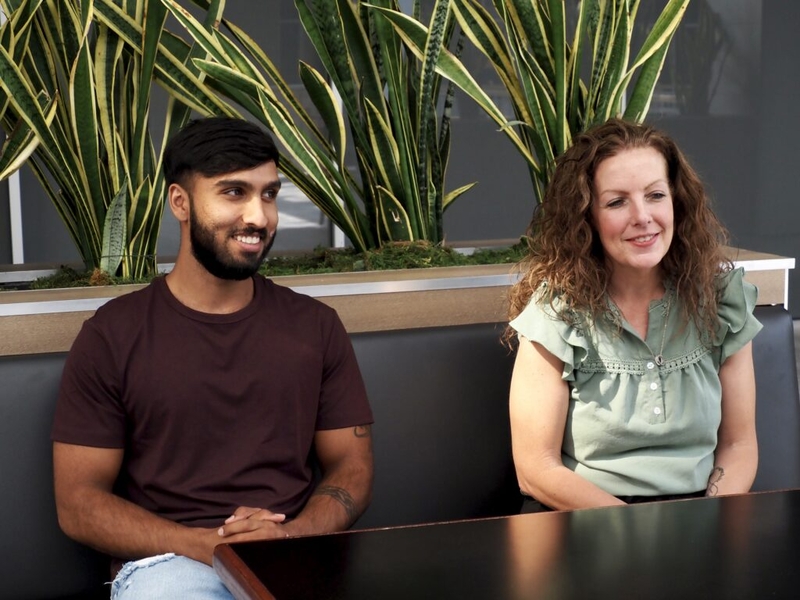
Misty Kline, language and culture services coordinator at Epic Charter School, right, and Behroz Bashari, the school's Pashto and Persian language liaison, left, are pictured at Epic's headquarters in 50 Penn Place in Oklahoma City on Aug. 3. Kline and Bashari helped launch Epic's Pathways program, which helps Oklahoma students age 21 to 30 complete a high school diploma. (Photo by Nuria Martinez-Keel/Oklahoma Voice)
OKLAHOMA CITY — Parwana Nazari once lived as a “very open and free girl back home” in the Jowzjan province of Afghanistan.
She was studying Uzbek literature at a university when the Taliban took control of the country in August 2021.
Nazari, who used to go to work and school by herself, suddenly was prohibited from leaving her house unaccompanied by male relatives. She became one of millions of girls and women in Afghanistan barred from attending secondary school and higher education.
Her life changed again in 2024 when she won a “golden chance” to move to America through a visa lottery.
She arrived last year in Oklahoma City alone with no documents proving her level of education.
A program Epic Charter School created, called Pathways, has given Nazari and other Oklahoma students age 21 to 30 the chance to earn a U.S. high school diploma — an opportunity she said she never knew would be possible. Recent changes the Oklahoma Legislature enacted in state law have helped the program grow significantly.
Although she started with zero high school credit, Nazari said Epic is providing “enough support and help for me that I could finish.”
“I want to be as independent as I can because I live here on my own,” Nazari said in Dari through an interpreter. “I want to reach a level of speaking English that I would be able to run my life on my own without needing help of translation or someone else to help me.”
Since leaving Afghanistan and resettling in Oklahoma City, Nazari and other Afghan women have set their sights on earning a high school diploma, something largely impossible in their home country under ultraconservative Taliban rule. Each woman is completing free online courses — like English, U.S. history and algebra — through Epic’s Pathways program.
The program serves Oklahomans of all nationalities and genders, but administrators at Epic said it wouldn’t exist had local Afghan refugees not pushed for an opportunity to earn an American diploma.
“These few people that were calling me daily, they changed the trajectory for thousands of Oklahomans that didn’t get the chance to finish their education in the first place,” said Misty Kline, Epic’s language and cultural services coordinator who helped found the program.
The initiative has helped almost 500 students graduate high school since it was established in 2023 and now enrolls 1,020 students so far this school year, Epic officials said. The school spends $3.1 million annually on Pathways for the cost of curriculum, devices and staff compensation.
A high school equivalency test, like the GED, for years has been the traditional option available to adults 21 or older wanting to earn a diploma.
Kline said Pathways is a better fit for students who have gaps in their education. Each student is assigned an individualized learning plan and a one-on-one teacher, who is “their guide, their cheerleader,” she said, and there’s no make-or-break exam at the end of the process.
Pathways started with 20 students, all from Afghanistan, and a budget of $100,000 from payment card refunds. The unusual funding source was necessary because Oklahoma law at the time forbade state dollars from supporting most high school students over the age of 20.
But, recent legislative changes created a dedicated funding stream and enabled more students to enroll.
Oklahoma lawmakers in 2024 permitted state funds to support free public high school courses for students age 21 to 25. A year later, the state Legislature raised the age limit to 30 and required these courses to be delivered online.
When Asia Stanikzai arrived in Oklahoma from Afghanistan, she was older than the maximum age of 20 to enroll in a traditional high school program. She said it left her feeling “hopeless” and “frustrated.”
Stanikzai already had finished high school in Kabul, but her family left the country without most of her education records. Pathways offered an opportunity to prove her level of learning and to study English.
“I (found) out that Epic school is offering such a program for us, and I got really excited and happy,” she said in Dari through an interpreter. “Since the day I started, I’m getting better every day. The way I’m speaking, my communication, and I’m so happy.”
She’s been taking classes for two years and expects to graduate in May. Stanikzai and her sister, Saria, also a Pathways student, said they hope to study cosmetology and own their own makeup styling businesses once they finish their high school credits.
Many of the original 20 Pathways students similarly lost their education documents in the rush to evacuate from Afghanistan. Tens of thousands of people, including many who cooperated with the American military, were quickly airlifted out of Kabul when U.S. troops withdrew and the Taliban took control in 2021.
Nearly 2,000 Afghan refugees have since settled in Oklahoma. Although initially welcomed, these refugees have faced recent calls for removal by some politicians in the state.
Tabasum Hussaini, one of the original Pathways students, said she and other Afghan refugees never wanted to have to leave their homes, but her life under the Taliban would be “scary” if she had stayed.
“We had no choice except coming here, and we want to build a better life for our kids, for their future,” she said in an English interview with Oklahoma Voice. “We don’t want them to go through the same thing that we went (through).”
Hussaini was in her fifth semester of law school and was working as a teacher when her family fled from Kabul five years ago. She hasn’t given up on her dream of earning a law degree.
Earning her high school diploma through Epic has enabled Hussaini to enroll in pre-law courses at Oklahoma City Community College. Hussaini, who was working as a Walmart stocker when she first learned of Pathways, now has a job supporting other refugees at The Spero Project, which aids in resettlements.
Multiple Afghan women who spoke with Oklahoma Voice recounted similar stories of interrupted schooling and lost academic transcripts.
Others said they already had dropped out of school in Afghanistan because of marriage.
Malaika Ander never finished her schooling after getting married at the start of 12th grade, but she said “the flame of my passion for learning and my dream of graduating never died in my heart.”
She enrolled in Epic’s Pathways program this year to finish her education.
“This great initiative gave us a second chance to reclaim our academic identity,” she said in English.
Oklahoma City, OK