More than a dozen Texas school districts close to triggering state takeover law in 2027
Sep 01, 2026 | 6:00 am ET
Description
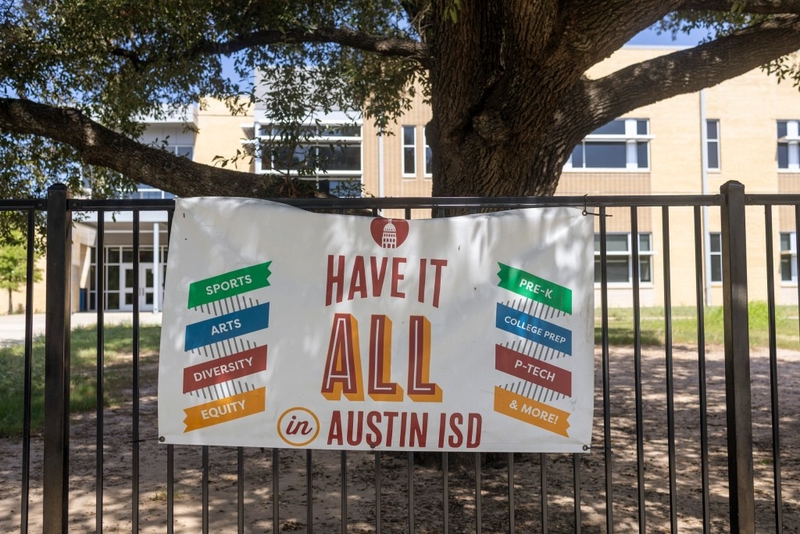
Brentwood Elementary School in Austin on Aug. 8, 2026. (Leila Saidane for Austin Current)
More than a dozen Texas public school districts are at risk of triggering a potential state takeover if they do not improve student academic performance before the next year’s A-F accountability ratings, data shows.
At least 14 districts had at least one campus with a fourth consecutive failing grade, according to the preliminary 2026 ratings. That includes the Clarksville, Cleveland, Coldspring-Oakhurst, Elgin, Judson, Kingsville, Manor, Nacogdoches, Poteet, Runge, San Angelo, San Antonio, Spring and Waco school districts.
The majority of the at-risk districts are concentrated in the Austin, Houston or San Antonio metro areas, with an average enrollment of about 11,700 students. Nearly every school eligible to trigger future state action has a larger percentage of low-income students than the state average, as well as higher rates of Black and Hispanic students.
Under state law, the Texas education commissioner must take over a district after a campus earns five consecutive unacceptable ratings from the TEA or close that failing school. During a takeover, the commissioner replaces the district’s locally elected school trustees with a board of managers for at least two years.
Additional districts closed campuses that failed state standards for multiple years or partnered with an outside provider to run struggling schools. Those moves paused the risk of severe sanctions.
Austin ISD met the criteria to trigger a potential takeover with two campuses failing for a fifth year, according to the preliminary 2026 ratings. The district also had nine other campuses with four consecutive failing ratings, meaning those schools could trigger state action in the future if the state doesn’t intervene this year.
Districts have until Sept. 11 to appeal a school’s rating.
A handful of districts avoided state intervention this year after they improved ratings. For example, Spring ISD, which enrolls about 32,300 students, bumped up the chronically failing DeKaney High School by 21 points, increasing its rating to a C.
However, the Houston-area district remains at risk due to other campuses missing standards for a fourth year. Academic performance at Salyers Elementary and Bammel Middle schools must improve to prevent future state sanctions.
On average, less than a quarter of students at each campus met grade level on the State of Texas Assessments of Academic Readiness this year, according to state data. Accountability ratings are largely based on STAAR results.
Spring ISD officials did not respond to multiple requests for comment. However, Superintendent Kregg Cuellar has highlighted academic progress on this year’s ratings, including the rise in the district’s overall grade from a D to a C and the reduction of campuses earning consecutive failing ratings.
“We will celebrate the gains, learn from what worked, and continue to provide the support our campuses need to move even further,” Cuellar said in a media release. “The goal is not simply to improve a rating. The goal is to improve outcomes for all students — and that work continues.”
School districts are required to submit “turnaround” plans outlining efforts to improve academic achievement at any campus earning at least two consecutive failing ratings and must implement the plans if that school earns another F grade.
Leaders of multiple districts that are at-risk of triggering state action next year said their schools have already seen improvements after implementing turnaround plans. Some leveraged new reading and math materials or instructional coaching for teachers. Several expressed confidence that their schools will continue progress and earn passing ratings in 2027.
“Kingsville ISD recognizes the seriousness and urgency of our accountability results. We will not minimize them or make excuses for them,” Superintendent Luz Martinez said in a statement. “The consecutive unacceptable ratings at Gillett Middle School and Harvey Elementary School are not the outcomes our students deserve, and we understand the importance of demonstrating significant and sustainable improvement.”
In some small districts, the only elementary or middle school earned its fourth consecutive failing rating. This means that students living in those areas had to choose between attending a campus with a history of failing ratings or leaving the district.
In Coldspring-Oakhurst CISD, for example, the district’s only junior high has never earned a passing grade since Texas began issuing A-F ratings to schools in 2019. The district, located an hour north of Houston, enrolls approximately 1,600 students, including about 360 at its junior high school.
Superintendent Bryan Taulton said Coldspring-Oakhurst CISD educators have made a deliberate, data-driven effort to improve ratings at its campuses, but the “heavy lifting” required to continue progress remains. The junior high campus must increase its score by three points to earn an acceptable rating next year.
“With the momentum we have across the district, that’s going to produce those measurable gains to get us those three additional points — and then some — to be able to have that campus be satisfactory by the conclusion of this current school year,” Taulton said.
A district can avoid triggering the state’s takeover law if they improve the school’s rating or opt to pursue a partnership under Senate Bill 1882, which pauses certain accountability-related sanctions for two years.
Local leaders can close a campus before it earns its fifth failing accountability rating, although the state has recently limited that option. If a failing school closes, TEA can reassign its assigned state campus number — and history of unacceptable ratings — to the school that receives the majority of its students.
Four schools in San Antonio ISD earned their fourth consecutive failing grade this year. District officials entered into SB 1882 partnerships for two of them and successfully closed a third.
However, TEA officials denied the closure of the fourth campus’ state ID number, and the school’s ratings history transferred to Barkley-Ruiz Elementary School. Officials from the 42,548-student district said they are focused on ensuring that all students at the campus have access to a consistent, high-quality educational experience.
Three additional districts that would otherwise be at risk of triggering a state takeover in the 2027 ratings have opted for partnerships at all their eligible campuses. Under SB 1882, a district has a charter network, higher education institution, nonprofit or government entity managing a campus.
The Edgewood, Everman and Texarkana school districts partnered with the charter network Third Future Schools. Waco ISD also partners with Third Future Schools to manage two campuses that earned four consecutive failing ratings. However, the district has a third chronically failing campus — G.W. Carver Middle School — that doesn’t have a 1882 partnership.
Waco ISD spokesperson Jill Anderson said district officials are confident the middle school will improve its student performance after reporting its lowest teacher turnover in years and growing its rating score from a 45 to a 57 this school year. A 60 is needed to earn a D from the state.
Austin, TX