Alabama high schools earn national recognition — but some rural schools miss out
Sep 01, 2026 | 5:59 am ET
Description
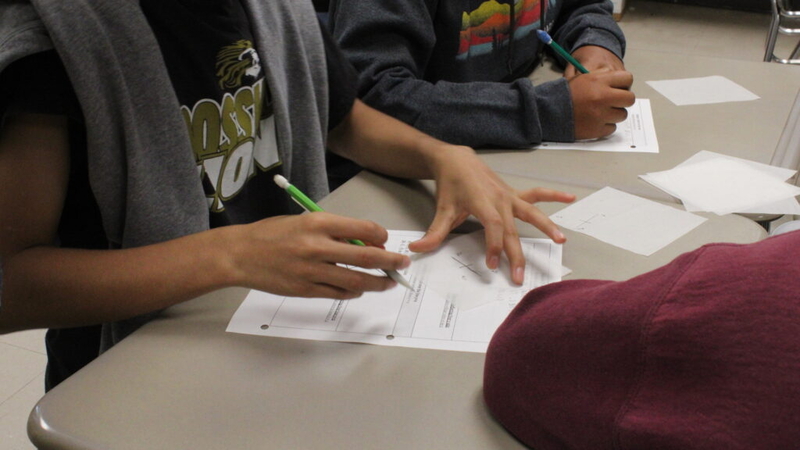
A student working on a "reflections" worksheet in their ninth grade math class at Crossville High School in Crossville, Alabama, on Aug. 28, 2025. Eight Alabama high schools are in the top 5% of high schools in the country, according to U.S. News and World Report. (Anna Barrett/Alabama Reflector)
I’ve heard the same thing, over and over, for as many years as I’ve lived here. At some point during a discussion about K-12 education in Alabama, someone will say something complimentary about a school’s performance, and someone else will feel moved to chime in: “Yeah, they’re doing well. For Alabama.”
I heard it again two weeks ago, at a Fairhope High School community forum. When principal Jon Cardwell held up a summary of the highest-ranked schools in the state and pointed to Fairhope’s spot near the top, someone in the crowd invoked that reflexive caveat: “Sure, we’re near the top,” they said. I could feel the next part coming.
“For Alabama.”
It’s not breaking news that nationally, Alabama has been stuck at the bottom of the educational pile since the early ’90s, when the federal government started tracking state-by-state test scores via the National Assessment of Educational Progress (NAEP). Our reading and math results aren’t usually dead last — there’s a reason people say “Thank God for Mississippi” — but we’re always in the mix.
So it felt like sweet validation when on the same day as that community forum, word got around that U.S. News and World Report had just released its fresh list of public high school rankings. Eight Alabama schools had made the top 5% nationally. Including Fairhope.
Here I’ll add a caveat of my own: There should have been nine schools on that list, but the state’s top-ranked high school, Loveless Academic Magnet Program (LAMP) High School in Montgomery, appears to have been left out because the Alabama State Department of Education (ALSDE) didn’t send U.S. News the school’s ACT scores.
LAMP’s snub notwithstanding, Alabama Daily News tallied up the totals and found that nine more high schools in the state landed between the top 5% and 10% nationally.
Overall, in a horse-race comparison against the other states, Alabama’s stats put us in a respectable position in the middle of the pack — a welcome change for a state accustomed to eating everyone else’s dust.
But never satisfied with simply accepting good news and moving on with my day, I decided to compare the U.S. News rankings to the ALSDE 2025 state report card to see how closely they align — or don’t.
When ALSDE released the 2025 state report card last November, they highlighted all the findings that showcased progress: higher graduation rates, improved math and science outcomes, greater academic growth, fewer schools getting Ds and Fs. State officials’ upbeat remarks from that time made it sound like all systems were pointing in the right direction.
But I found myself wondering how those cheerful projections measured up against U.S. News’ analysis.
The state report card and the U.S. News rankings are never going to align perfectly, because they measure different things. The state measures six variables, including academic achievement, graduation rate, college and career readiness, and attendance.
U.S. News measures college readiness, state assessment performance, and graduation rate. I’m simplifying it a little bit, but those are the broad strokes. The point is that it’s a bit of apples and oranges.
Filtering the state report card to show only academic achievement — the metric most directly tied to students’ knowledge — the eight high schools that made U.S. News’ elite top 5% list are indeed all clustered near the top.
But several other high schools that scored the highest marks in academic achievement on the state report card are missing from U.S. News’ best-of list. I counted 15 other high schools with top-tier report card scores that U.S. News assigned a low ranking or no ranking at all.
For example: Kinston School in Coffee County falls right below Huntsville’s New Century Technology High School on the state report card. But while New Century Technology took Alabama’s number-one spot in the U.S. News rankings, Kinston was relegated to the bottom half of Alabama schools.
The common denominators among the schools that didn’t get any love from U.S. News? They’re generally small and rural, with higher percentages of economically disadvantaged students. Many serve not just high school, but lower grades as well.
But that alone doesn’t explain the disconnect, because some schools fit that profile and received high rankings.
So what gives?
I can’t speak to any one school’s results, but looking at the bigger picture, a pattern emerges: The schools that offer AP classes shoot to the top of the rankings, and those that don’t sink to the bottom.
This aligns with how U.S. News measures college readiness: not through SAT and ACT tests, but through AP and IB tests. The tests account for a full 40% of a school’s overall ranking, and if a school doesn’t offer AP or IB, it gets a score of 0 on those metrics. U.S. News says it adjusted schools’ scores so that schools without AP or IB offerings wouldn’t plummet to the bottom of their list, but it clearly weighed heavily on them.
The schools that offer AP classes shoot to the top of the rankings, and those that don’t sink to the bottom.
You can hardly blame small-town schools for not offering AP or IB; they must staff essential units first, and if they have low enrollment, they might not have enough resources left over for extras.
Lack of access is a known problem nationwide. A report published last year by the Center for American Progress found that “only 50% of rural school districts offer AP courses, compared with 76% of urban districts and 85% of suburban districts.”
So, on the one hand: Don’t sweat the mismatched rankings. U.S. News pinned almost half its scoring to a single metric that half of rural schools across the country can’t provide. No one data set is ever going to paint the full picture of a school anyway, so it’s not worth losing any sleep over.
On the other hand: It is illuminating, even if it isn’t the end-all, be-all. AP and IB offerings help bright students meet their potential, and it’s a shame not everyone has access to them.
But what if they did? In a world of seemingly infinite technological possibility, it doesn’t feel like a huge stretch to imagine an equitable solution.
At least we don’t have to solve that riddle on our own. It’s a challenge for communities across the country to tackle — not just “for Alabama.”
Montgomery