End of rental aid creates uncertainty for Little Rock area families facing eviction, homelessness
Sep 01, 2026 | 6:00 am ET
Description
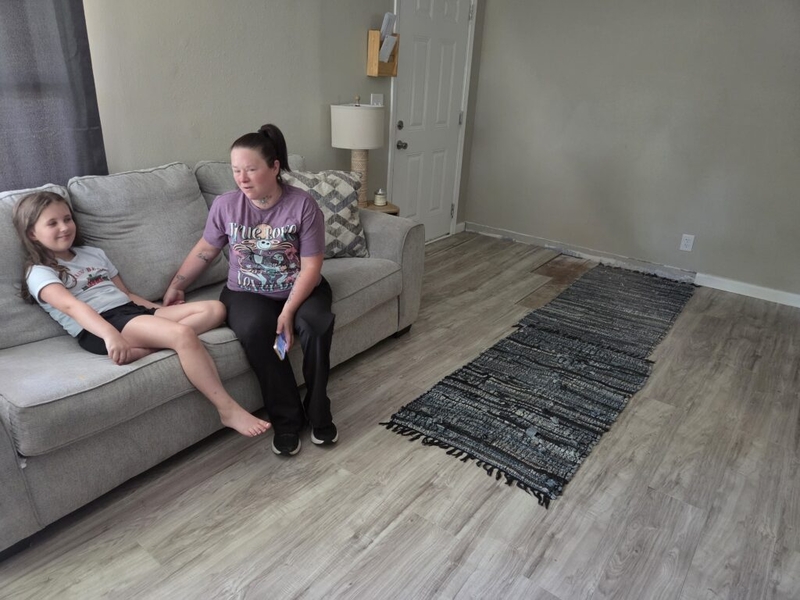
Brittany Robinson (right) sits on the couch with her daughter Tessleigh (left) in the North Little Rock house their family of six rents on Aug. 18, 2026. The family will have to move by Sept. 10 after being evicted. The rental assistance program that kept her family housed has no one to administer it, leaving much of Robinson's rent unpaid. The house also has livability issues including loose floorboards Robinson covers with rugs to avoid tripping on them. (Photo by Tess Vrbin/Arkansas Advocate)
Alexis Mitchell’s teenage nephew and son took a recent day off from school to help move the family’s laundry machines, bed frames and mattresses from their southwest Little Rock house into a storage unit.
They brought bags of clothes to the hotel where they’ve stayed for over a week after being evicted from the place they called home since 2020. Mitchell saved some photos of herself and her children, and her 8-year-old son kept his stuffed animals.
“Pretty much all of the stuff that was important but not absolutely necessary, we had to leave,” Mitchell said.
The family lost their home after the People Trust Community Loan Fund stopped administering the rental assistance program that had supported them and dozens of other families in the Little Rock area.
The U.S. Department of Housing and Urban Development paid the entirety of Mitchell’s rent until January, when the National Credit Union Administration took control of the credit union behind the loan fund. The credit union liquidated in April, according to the NCUA.
While the future of the rental aid programs has been in limbo, landlords and property management companies still needed and expected rent payments the programs’ tenants can’t afford to pay in full.
About a quarter of the state’s more than 400,000 renting households have incomes at or below the poverty line or 30% of their area’s median income, according to the National Low-Income Housing Coalition. The state would have to add more than 55,000 rental homes in order to meet the housing needs of this population.
Two out of every 100 renting households received eviction filings between Aug. 1, 2025 and July 31, 2026, according to the Eviction Lab data hub. Arkansas landlords made 10,213 eviction filings over the same time period.
We did have a little bit of means to move the first time, but now all that money has been put into this new place, and we don’t have any money to move again.
‘Administrative circle’
The federal funding that had kept Mitchell’s family housed came from HUD’s Continuum of Care Program, which is designed to help communities end homelessness. Her rent increased from $880 per month to $967 per month in the six years the program served her, but she was never expected to pay any of it until People Trust relinquished the program this year, she said.
On Aug. 4, the Pulaski County Sheriff’s Department ordered Mitchell and her family to vacate their house in 20 days. By Aug. 12, she was facing more than $2,200 in legal fees, so she sought emergency housing assistance from the city of Little Rock, according to emails she provided to the Advocate.
The city could not provide assistance without a copy of the most up-to-date housing assistance contract from the People Trust Community Loan Fund, and the fund’s administrator did not have the document when asked for it, according to the emails.
“The consequence of that administrative circle is that my three children and I may become homeless,” Mitchell wrote to city officials Aug. 12.
City officials “tried to work with HUD on a temporary solution” after People Trust stopped administering rental assistance, but city and HUD officials disagreed on the terms of issuing temporary aid and did not come to a consensus, city spokesperson Aaron Sadler said. He did not specify which of HUD’s terms the city found unacceptable.
“We remain committed to assisting affected Little Rock residents, and the City allocated and distributed $300,000 to support those impacted while at the same time working to reach an agreement with HUD,” Sadler said.
People Trust did not respond to calls or emails requesting comment. HUD’s Departmental Enforcement Center is investigating People Trust, according to an agency spokesperson.
People Trust told KATV in June that it was “working cooperatively with HUD to address any outstanding administrative matters and to ensure that community members do not suffer unintended consequences” during HUD’s investigation.
Around the same time, Arlo Washington, founder of the now-defunct People Trust Community Federal Credit Union, told the Arkansas Democrat-Gazette that the loan fund “never got into this to hurt anybody” but would have been better off not participating in HUD programs.
Layers of instability
HUD’s Continuum of Care initiative aims “to quickly rehouse homeless individuals, families, persons fleeing domestic violence, dating violence, sexual assault, and stalking, and youth while minimizing the trauma and dislocation caused by homelessness,” according to HUD’s website.
Brittany Robinson’s rental aid came from a different People Trust-sponsored initiative, the Community Housing Program, which serves people with chronic illnesses and physical disabilities. The threshold for acceptance into the program was high, and most enrollees are under a doctor’s care, said Robinson, who has a prosthetic leg.
The Community Housing Program ensured that Robinson only had to pay $244 per month for the Little Rock house where she lived with her five children and her service dog. She said she always paid her share of the rent on time, but the family moved to North Little Rock at the end of April to avoid a potential eviction after HUD’s dispute with People Trust left the rest of her rent unpaid.
Robinson said her former landlord didn’t return her security deposit, and she had to pay an $1,800 deposit for the new house. On top of that, the new house has livability issues, such as wires creating a fire hazard in the attic, a sewage spill in the backyard and loose floorboards that Robinson struggles daily not to trip over.
In 2021, Arkansas became the last state to pass a law requiring minimum livability standards for rental housing. Tenants’ advocates have said the law doesn’t sufficiently incentivize landlords to provide basic necessities such as electricity and potable water.
Robinson said it’s unclear whether the new landlord’s refusal to fix the house is a coincidence or a response to not receiving full rent payments since the Community Housing Program still has no host entity.
Mitchell and Robinson both said the stress of their unstable housing situation has worsened their disabilities. Mitchell told Little Rock city officials in an email that her mental health and “ability to manage prolonged stress” have been deteriorating due to the “constant calls, documentation searches, agency referrals” and other bureaucratic obstacles she’s faced.
Mitchell also said she doesn’t know where she and her children will go after they have to leave their hotel Wednesday, since they don’t have extended family in the Little Rock area.
Meanwhile, Robinson and her family will have to move by Sept. 10 after she lost her eviction court case last week. Her mother and aunt live in North Little Rock but don’t have enough space for their relatives.
Additionally, Robinson said her work cleaning houses is too infrequent to be a steady source of income.
“We did have a little bit of means to move the first time, but now all that money has been put into this new place, and we don’t have any money to move again,” she said.

Little Rock