ISU gets federal funding to support Watershed Innovation Farm in Ames
Aug 28, 2026 | 4:38 pm ET
Description
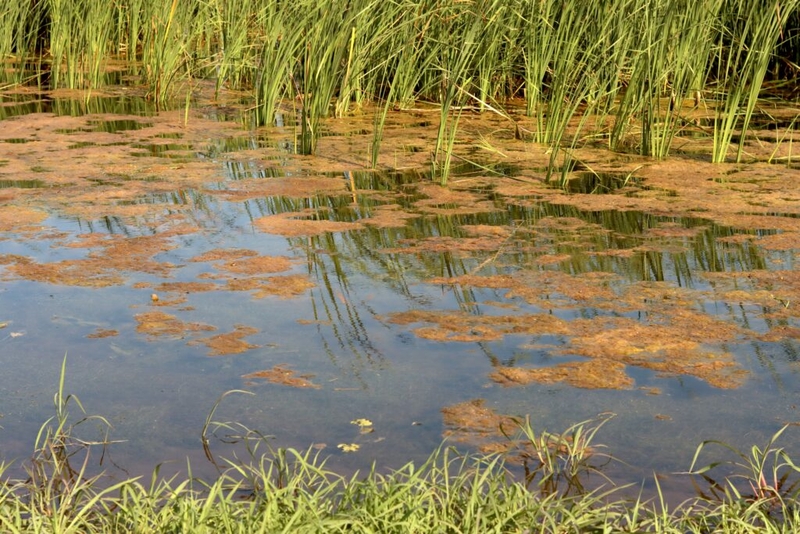
Wetlands are an edge-of-field strategy used to try to improve water quality near farmland. (Photo by Cami Koons/Iowa Capital Dispatch)
Iowa State University, in collaboration with Iowa Learning Farms, is working to build out water quality practices on and around its dairy farm in Ames as part of the Watershed Innovation Farm, which will include trails and signage for Iowans to learn about the practices.
The project was recently awarded nearly $1 million from the U.S. Environmental Protection Agency as part of a funding package for “innovative” solutions that improve water quality in the Gulf of Mexico watershed. The Watershed Innovation Farm also has funding from the Iowa Department of Natural Resources and Iowa Department of Agriculture and Land Stewardship.
Jacqueline Comito, the director of Iowa Learning Farms, said the project will have bioreactors, saturated buffers, wetlands, grassed waterways and signage throughout that explains the practices and their benefits.
Comito said water quality solutions involve a “suite” of different practices, and the innovation farm will “help explain” that to farmers, professionals, lawmakers, students and everyday Iowans who visit the “walking, scientific laboratory.”
“Water quality is important, and hopefully, people can see what some of the solutions are,” Comito said.
Many of the projects, like several saturated buffers, a water quality improvement wetland and bioreactors that are already deployed at the farm were installed with cost-share funding from IDALS, according to Comito.
While these practices have been installed at various farms across Iowa, Comito said the Watershed Innovation Farm will serve as a central area for folks to visit. The project will also showcase how the practices interact with one another and with an urban environment as the site sits alongside the city of Ames.
“Most of these practices were either initiated at Iowa State or developed here, so we’ve been cutting-edge with so much,” Comito said. “Now, one of our research farms is going to be like the ideal location to go out and really learn how these all connect and how they relate.”
In addition to more common water quality improvement practices, Comito said the innovation farm will also explore woodland management practices in part of the existing wooded areas of the property.
Comito said ISU Extension Forestry Specialist Billy Beck will work on managing the wooded areas to show how the right interventions can make for a healthy woodland area. She said the EPA funding will help support drones that will help monitor woodland canopy and water quality in the area.
“We know how each individual practice is effective,” Comito said. “This farm gives the opportunity to be able to look at it from the bigger picture.”
Many of these practices “don’t look like anything” from the surface. A bioreactor, for example, is a trench of wood chips buried along a drainage tile outlet to help filter out nutrients from the water. A saturated buffer, to the untrained eye, looks like an area of native or tall grasses.
Comito, who is an anthropologist, said that’s why she is focused on making sure the signs throughout the farm “make sense” to visitors who walk or eventually bike on paths through the area. The signs will have illustrations explaining the agricultural, water quality and habitat benefits of the deployed practices and QR codes linking to additional information.
“The idea of this is that you should be able to go out there and understand what’s going on without somebody telling you,” Comito said.
Des Moines, IA