Voting rights struggle continues, advocates say at March on Washington anniversary
Aug 28, 2026 | 6:46 pm ET
Description
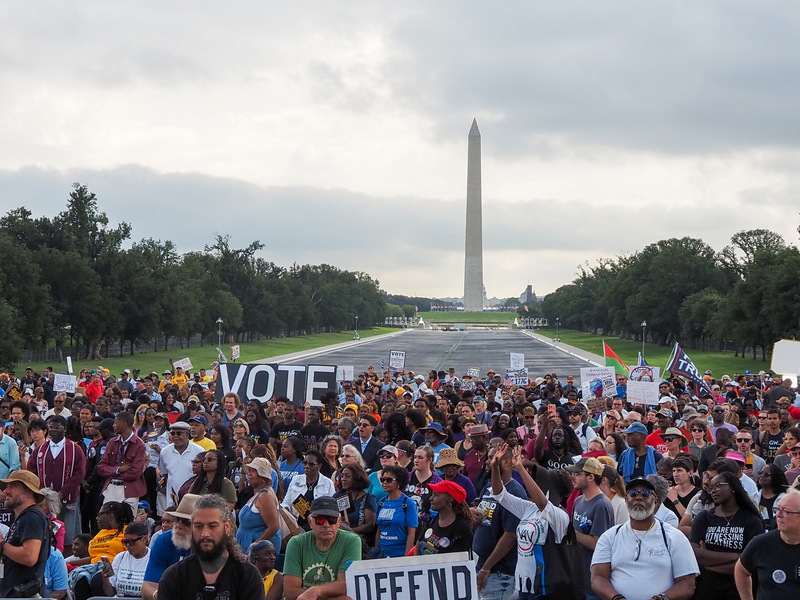
Demonstrators gathered at the Lincoln Memorial Reflecting Pool in Washington, D.C., on Friday, Aug. 28, 2026, marking the 63rd anniversary of the March on Washington for Jobs and Freedom where the late civil rights leader Rev. Martin Luther King Jr. delivered his "I Have a Dream" speech. (Photo by Ashley Murray/States Newsroom)
WASHINGTON — Just over two months from midterm elections and four months removed from a U.S. Supreme Court decision that gutted Voting Rights Act protections for majority Black U.S. House districts, and 63 years after Martin Luther King Jr. delivered his “I Have a Dream” speech there, thousands gathered again at the Lincoln Memorial Friday.
Organizers focused the anniversary march around a “Defend the Vote” message.
The event, co-chaired by civil rights leader Rev. Al Sharpton and King Jr.’s son Martin Luther King III and daughter-in-law Arndrea Waters King, featured appearances from union leaders, interfaith organizers, people whose parents attended the iconic 1963 march.
Elected leaders also spoke, including Virginia Gov. Abigail Spanberger, House Minority Leader Hakeem Jeffries, D-N.Y., Vermont independent Sen. Bernie Sanders, and U.S. Rep. Alexandria Ocasio-Cortez, D-N.Y., a possible 2028 presidential contender.
Demonstrators who traveled from across the country with various organizations marched from the Lincoln Memorial to the Martin Luther King Jr. Memorial following a four-hour program of speeches.
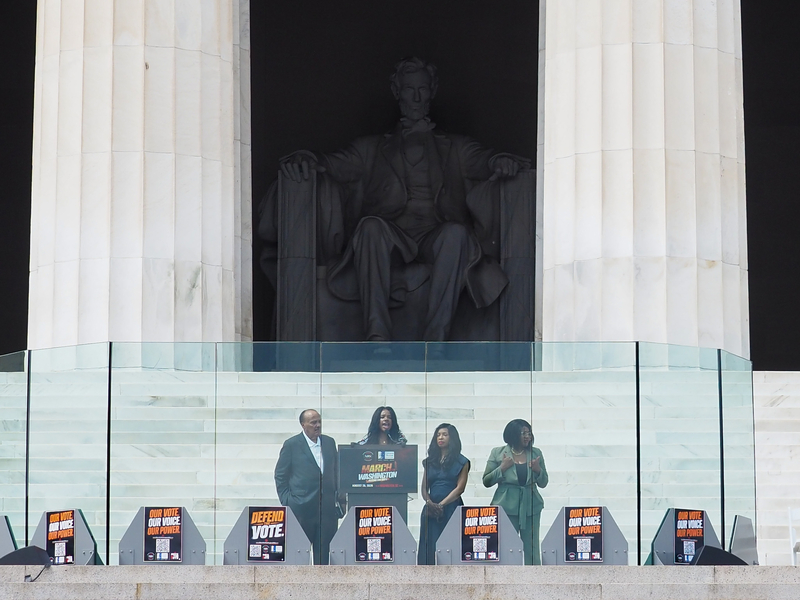
From behind bullet proof glass, King Jr.’s granddaughter Yolanda Renee King, 18, told the crowd she never met her grandfather, or grandmother Coretta Scott King, but she is carrying their legacy forward.
“Sixty-three years ago, my grandfather told America, ‘I have a dream.’ Today, I want my generation to say something back — ‘We hear you,’” she said. “We know the dream was never finished, and we know you were never asking us to simply remember you. You were asking us to continue, so we will. We will pick up the baton.
Yolanda King highlighted Civil Rights Movement icons, including John Lewis, who later represented Georgia’s 5th Congressional District from 1987 until his death in 2020.
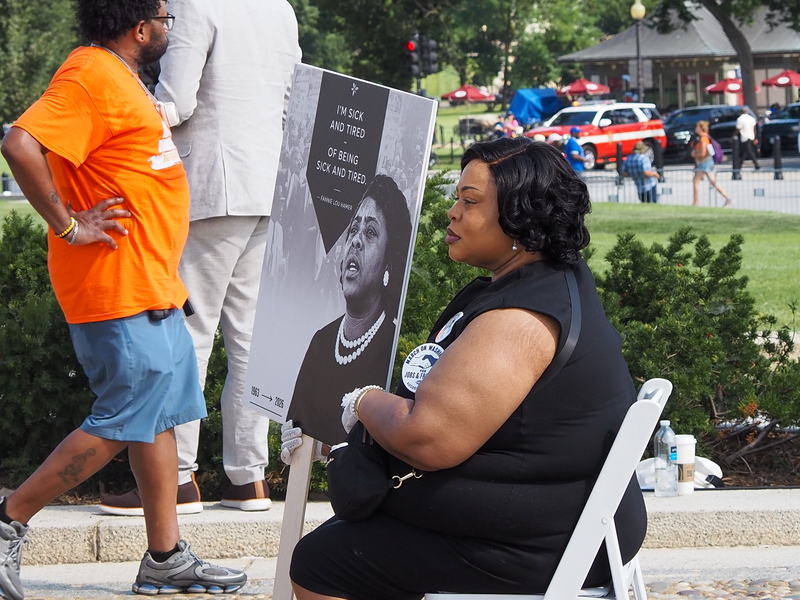
“This is a marathon, run as a relay,” she said. “That means nobody is expected to run the whole race. My grandfather did it. My grandmother did it. John Lewis did it. Fannie Lou Hamer did it. … The countless people whose names we will never know did it. They ran their leg.”
Lewis shared the stage with King Jr. speaking to roughly a quarter-million civil rights demonstrators at the March on Washington for Jobs and Freedom in 1963. Organizers also convened that demonstration to pressure President John F. Kennedy to develop robust civil rights legislation with Congress.
At the time, Lewis was a leader with the Student Nonviolent Coordinating Committee.
King III said his ancestors “woke up with courage and faith to speak truth to power and get into the kind of good trouble that the late John Lewis talked about, that helped to open doors for the marginalized across the country, regardless of race, age, agenda.”
Callais decision
Several speakers criticized the U.S. Supreme Court’s late April decision in Louisiana v. Callais that overhauled Section 2 of the 1965 Voting Rights Act that protected against diluting the voting power of minority citizens.
“The fact that we still have to fight to maintain and renew voting rights in this country is beyond abysmal and a truly national disgrace,” King III said.
Rep. Yvette Clark, D-N.Y., chair of the Congressional Black Caucus likened the ruling to “opening the door to a coordinated attack on the Black political power and fair representation across the South.”
“Since the Callais decision came down, Republicans across the country have wasted no time in their zealous pursuit for unbridled power,” Clark told the crowd, highlighting mid-decade voter map redistricting efforts and a bill, titled the SAVE America Act, that is championed by President Donald Trump and would require proof of citizenship to register to vote.
Marc Morial, president and CEO of the National Urban League, told the crowd, “It's time to send the SAVE (America) Act to the graveyard.”
Postal Service rule
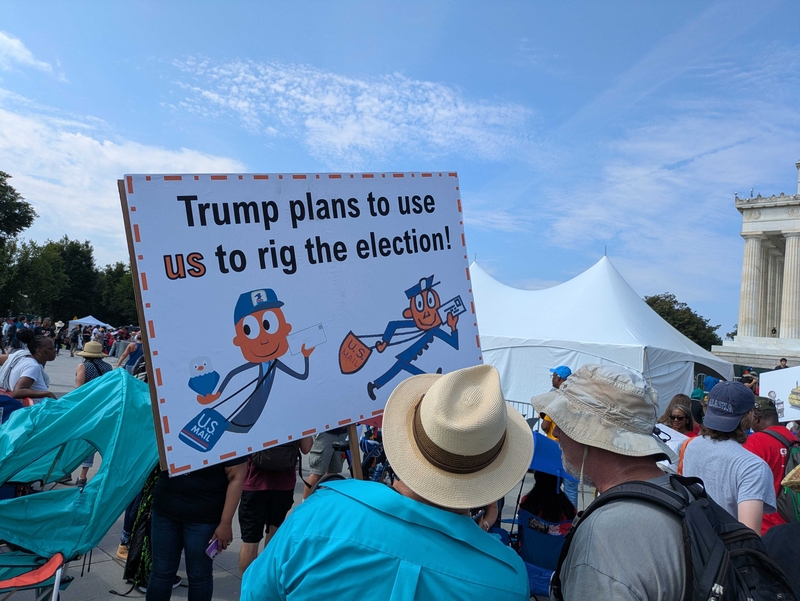
Gary Roush, 73, of College Park, Maryland, carried a sign protesting a new rule issued by the U.S. Postal Service mandating new requirements for mail-in ballot envelopes, which states say would pose serious challenges before November’s midterms.
Additionally, the new USPS rule forbids the agency from delivering or collecting ballots from people who are not confirmed to be eligible voters on lists newly mandated from states by the federal government.
A federal district judge on Thursday night issued a temporary restraining order on the rule after the U.S. Supreme Court on Monday allowed the administration to implement the policy. USPS appealed the order Friday.
Roush, who was among the crowd at the “Defend the Vote” march, said he believes Trump has “made it crystal clear: He plans to use the post office to try to stop most mail-in ballots.”
Roush’s sign featured a USPS promotional character from the 1960s used in ad campaigns to encourage people to write ZIP codes on the envelopes. A message on his sign read, “Trump plans to use us to rig the election.”
“He's going to create as much havoc as possible,” said Roush, who added he’s “extremely worried” about the upcoming midterms.
Building a movement
Sharpton’s National Action Network and the King family’s Drum Major Institute coordinated the day, along with nearly 100 partner organizations including sorority and fraternity chapters from historically black colleges and universities, and other national and local activist groups.
Ocasio-Cortez, who has been on a speaking tour with Sanders ahead of the midterm elections, said, “Brothers and sisters, these drum majors for justice, just as you all and countless others today, were not handed a movement. They have always had to build one.
“And when they came here 63 years ago, they came with demands,” she continued. “They demanded the right to vote, an end to segregation, and fair housing. They demanded a federal jobs program, a higher minimum wage, and an end to discrimination in employment… Freedom is both political and economic.”
Organizers evoked numerous founders of the Civil Rights Movement, and other anniversaries since, including the 37th commemoration of the March on Washington in 2000 when Coretta Scott King, the late widow of the slain civil rights leader, urged attendees to continue her husband’s and other leaders’ missions.
That anniversary march at the turn of the millenium, dubbed “Redeem the Dream,” was also co-organized by Sharpton and King III, and focused on ending racial profiling and police brutality following high-profile abuse cases in the previous decade in Los Angeles, New York City and Philadelphia.
“My mother, Coretta Scott King, said that nonviolence is really the only credible response to the violence that we are seeing around the world. She was right about it both then and now,” King III told the crowd.
Attendees in United Auto Workers t-shirts lined the seats at the foot of the memorial steps, another nod to the history of the movement.
The UAW, including its then president Walter Reuther, was among the coalition of activists, labor unions and religious organizations that supported the landmark 1963 march.
Other speakers and performers at the original march included folk singers Bob Dylan and Joan Baez, and Little Rock, Arkansas, civil rights activist Daisy Bates.
King and other leaders met with Kennedy and Vice President Lyndon B. Johnson following the march to discuss bipartisanship around civil rights legislation, according to the Martin Luther King Jr., Research and Education Institute at Stanford University.
Johnson signed the Civil Rights Act in July 1964, less than a year after Kennedy was assassinated in November of 1963. Johnson subsequently signed the Voting Rights Act in August of 1965.
All States Newsroom content is free to republish. Read our republishing policy for more information.