Brown external review identifies security, leadership gaps in mass shooting response
Aug 28, 2026 | 4:03 pm ET
Description
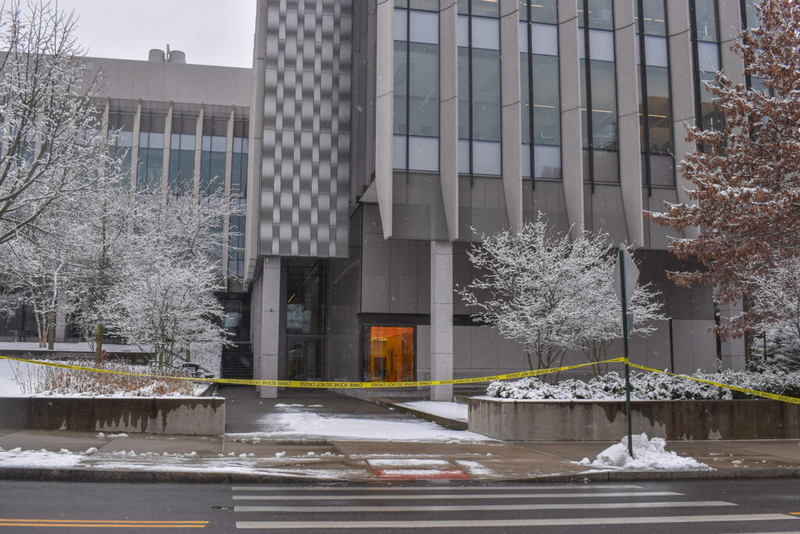
Crime scene tape surrounds Brown University's Engineering Research Center on Sunday, Dec. 14, 2025, a day after a gunman killed two students and wounded nine others in a classroom inside. (Photo by Christopher Shea/Rhode Island Current)
Two campus police dispatchers were on duty at Brown University when reports of gunfire first emerged at 4:04 p.m. on Dec. 13, 2025. Within minutes, they were overwhelmed.
The flood of incoming calls and radio chatter that stunned dispatchers is one of the communication breakdowns described in an independent review of the mass shooting at the Ivy League university on Providence’s East Side, released Friday afternoon by the university.
It’s “highly unlikely” the mass shooting that left two students dead and injured nine others could have been prevented, the global consultancy Teneo Risk, which conducted the review at Brown’s request, concluded.
“The events of Dec. 13 demonstrate that the university, a community of 16,000-plus students, employees and campus area residents and billions of dollars invested in complex and sensitive infrastructure, has need for more robust emergency management staffing and capability,” the executive summary states.
Brown hired Teneo Risk in January to analyze the school’s actions before, during, and after the shooting committed by suspected gunman Claudio Manuel Neves Valente inside the Barus & Holley building. Brown commissioned COSECURE, a Philadelphia-based security consulting firm, to do a separate physical assessment of campus facilities.
The university only released a summary of the outside reviews because they “contain sensitive information relating to injuries and fatalities, safety and security,” according to the university’s action plan containing Teneo’s executive summary.
“We hope it will help our community gain a deeper understanding of the incident, the ways Brown effectively responded to the tragedy, and how our response and level of preparation can be strengthened for the future,” Brown University President Paxson and Chancellor Brian T. Moynihan wrote in a message to the campus community Friday.
The university’s afternoon dossier complements a separate city-commissioned report released Friday morning, which praised Providence’s response to the shooting.
Independent review praises Providence response to Brown shooting but flags communication gaps
Teneo’s assessment found plenty of fault with campus police department’s top leaders, who “failed to provide vital assistance to the unified command at the crime scene” and did not adequately prepare officers for an active shooter incident.
“Stronger leadership by the individuals in question might have improved the investigative process,” the summary states.
The report did not name any specific police officials.
Rodney Chatman, the campus police chief at the time of the shooting, was removed from his position and replaced in December by former Providence Police Chief Hugh T. Clements Jr. Clements assumed the job on a permanent basis in April.
Brown’s own action plan calls for a series of changes, including improvements to emergency communications and coordination with Providence police. Among them is integrating the university’s camera network with the city’s Real Time Crime Center, provided the university and the city can reach an agreement over how the data will be shared and stored.
The city-commissioned report also called for integrating campus surveillance cameras with the city’s system.
The American Civil Liberties Union (ACLU) of Rhode Island has urged Brown and other universities not to give police access to their cameras, a position the organization reiterated in a statement Friday afternoon.
“Meaningful statewide laws must be in place before systems like these are implemented to ensure that the privacy rights of all Rhode Island residents and visitors are protected,” the ACLU wrote.
Teneo’s reviewers called for the university to tighten campus building security, noting Brown’s Department of Public Safety “was aware of non-threatening suspicious activity” in Barus & Holley before the incident. That included frequent trespassing by “John,” a homeless man who later ended up helping police identify the gunman via a Dec. 15 Reddit post.
“Although the frequent trespasser was not the perpetrator and was not himself a threat, earlier trespassing incidents at the building complex showed areas in which security could have been strengthened,” the executive summary states.
Still, Teneo’s assessment reiterated it was “unlikely” that enhanced security measures would have made much of a difference. The report states even if Neves Valente hadn’t had access to Barus & Holley “he might have gone to another building on campus or targeted individuals outside.”
“Thus, nothing about these events changes our main conclusion that nothing in our review suggests that Brown could have prevented the shooting,” reviewers wrote.
Neves Valente, who shot and killed a Massachusetts Institute of Technology professor two days after the Brown shooting, was found dead in a storage locker in Salem, New Hampshire, on Dec. 18.
Federal investigators in April concluded that Neves Valente, who briefly attended Brown in 2000, appeared to be fueled by personal grievances and resentments tied to his own personal failures. Teneo’s assessment found “nothing in Neves Valente’s academic history or records to suggest a propensity for violence or an animus toward the University.
“Nor is there any evidence that he had any contact with Brown personnel prior to the attack,” reviewers wrote.
Reporter Alexander Castro contributed to this story.
Providence, RI