Texas lawmaker wants oil regulators to explain why they ended public comment at meetings
Aug 28, 2026 | 6:23 pm ET
Description
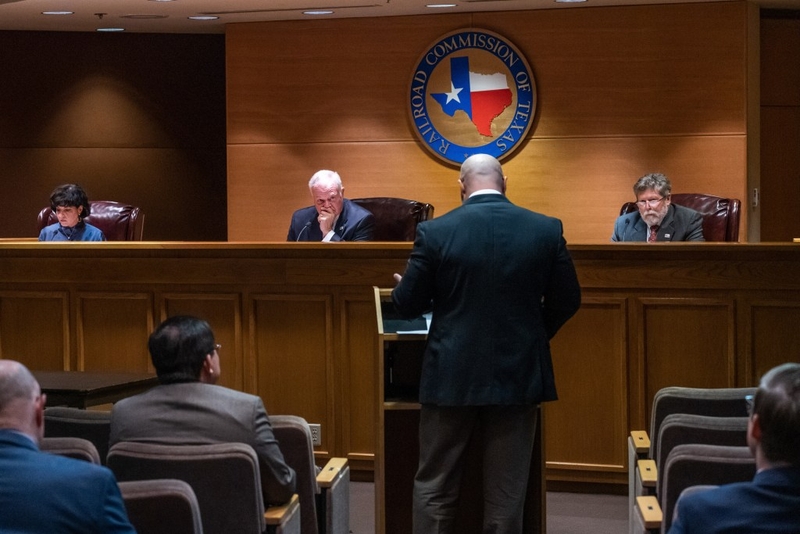
Texas Railroad Commissioners Christi Craddick, Wayne Christian, and Jim Wright listen during an RRC hearing in the William B. Travis Building in Austin. (Dimitri Staszewski for The Texas Tribune)
Subscribe to The Y’all — a weekly dispatch about the people, places and policies defining Texas, produced by Texas Tribune journalists living in communities across the state.
ODESSA — A bipartisan pair of Texas lawmakers say they are concerned about the Texas Railroad Commission’s decision to end general public testimony at its monthly meetings.
A Texas House committee will discuss the matter Sept. 15.
The commission, which regulates the state’s oil and gas companies, eliminated a portion of public comment from its monthly meetings unless a sitting commissioner requests it. At the same time, the commission said it was “committed to providing meaningful, accessible opportunities for public participation and engagement”. It introduced listening sessions and outreach events that elected commissioners are not required to attend.
The changes were first reported by Inside Climate News.
Commissioners have extraordinary sway over the state’s oil and gas industry, ruling on issues concerning fossil fuel production, pollution and regulation. They oversee an industry that, for at least the last six years, has broken production records, including supplying half of all U.S. oil in 2025. It must also usher the industry through one of its greater dilemmas: addressing a sea of wastewater underground that, left unattended, could hinder oil production and create a rash of environmental and public health issues for landowners.
The Railroad Commission is the first known state regulatory agency to revert a policy meant to give the public a dedicated opportunity to engage with its presiding officers. A Texas Tribune analysis found that comparable regulatory agencies offer the public the chance to comment on matters within the agency’s jurisdiction. That includes the Public Utility Commission of Texas, the Texas Water Development Board, and the State Board of Education.
However, the change does not violate the state’s open meeting rules, experts said. That’s because the law doesn’t require government agencies to hold public comment portions at an open meeting.
Now state lawmakers are raising questions about the decision. State Rep. Drew Darby, an influential San Angelo Republican who presides over the House Natural Resources Committee, has scheduled a hearing on the matter.
In a letter to Railroad Commissioner Wayne Christian, who introduced the new policy, Darby commended the agency for expanding its footprint in Texas by hosting listening sessions around the state.
“But they are not a substitute for a guaranteed chance to be heard directly by the commissioners who actually cast the votes. Staff can listen. Only the commissioners can vote, and that is who Texans need to be heard by,” he said, adding that while reasonable guardrails are fine, the new process did not have enough discretion for the new process or input from the public before it was voted on.
“(The Railroad Commission) revoked a 21-year standing guarantee and replaced it with discretion that offers no guarantee at all,” Darby said. “Discretion built into a process from the start is not the same as a sitting majority taking away a commitment the public has relied on for two decades.”
State. Rep. Terry Canales, D-Edinburg, helped rewrite the state’s open meeting laws in 2019. That update made public comment on specific agenda items mandatory for local government officials. But the law carved out state agencies, the legislative and executive branches.
Canales said he pushed the legislation because of concerns about the public’s access to local governments at the time. He called on the Legislature to extend the bill’s provisions to state agencies when lawmakers return to Austin next year.
“Texans deserve the right to address the public officials making decisions on their behalf, no matter which building those officials work in,” he said.
Christian vigorously defended the 2-1 decision in a statement to The Texas Tribune.
“Public input at the RRC has not been canceled, banned, restricted or censored,” he said. “This change is about expanding meaningful access to our agency for the people of Texas while giving the Commission greater flexibility to conduct its meetings. As a former legislator, I’ve long believed we could enhance accessibility by modeling our approach more closely on how public testimony works in the Texas House and Senate.”
Previously, the public could speak about any general matter before the commission during a specific time. Now, the public can only register to comment on specific agenda items before commissioners, or if commissioners invite additional public comment, a similar process at the statehouse.
Under the previous policy, people could only comment in Austin, so people would sometimes drive hundreds of miles. The new policy, he said, makes it so people don’t have to travel to engage the commission through outreach events and listening sessions — but he did not say whether commissioners would be present.
Christian also said the previous policy was narrow. He said since 2022, the Railroad Commission documented 102 public comment registrations across 37 open meetings by 20 people. Nearly 65% of the registrations came from two people, and the other 38% from Commission Shift, a watchdog group focused on the Railroad Commission. And three candidates for Railroad Commissioner used the public comment portion to promote their campaigns in that timeframe, he said.
“State resources should never be used to advance political agendas. That is not the
purpose of public input.” Christian added. “Public input is about hearing directly from
Texans about tangible problems they are facing, identifying areas where the agency can
improve, and getting those concerns in front of the right people to address them, without
requiring someone to drive 500 miles to Austin.”
Responding to Christian, Executive Director Virginia Palacios said that if the Railroad Commission sees the number as small, “then it shouldn’t be a problem to allow public input at every open meeting, take comment on agenda items, and allow remote public input.”
“It’s not hard to do,” Palacios said. “And it’s only fair for people who live in the oil field and are hundreds of miles away from Austin.”
Government transparency experts and one candidate vying for a seat at the commission have also raised concern about the decision.
“The whole reason we passed these (public meeting laws) was so that the public’s business could be done in public, where the public can participate and see it being done, see how they’re spending our tax dollars, and be able to, in this democracy, actually play an active role in government,” said Chip Stewart, an attorney and professor of journalism at Texas Christian University. “And efforts to pull back on public participation, to limit discussion, to limit comment, are exactly the opposite of what a representative government should be doing.”
The century-old agency has undergone particular scrutiny this year after Bo French, a longtime conservative activist running on culture wars, unseated Railroad Commissioner Jim Wright in the Republican primary elections last March. Running against French in the November general election is oil field engineer and four-term state Rep. Jon Rosenthal, D-Houston.
On Tuesday, Rosenthal called the move an “egregious attack on Texans’ right to address their duly elected Railroad Commissioners,” adding that, if elected, he’d seek to reverse the policy.
“This type of unacceptable behavior is why I launched my campaign in the first place,” he said.
French did not respond to a request for comment.
The Texas Open Meetings Act does not require government agencies to include public comment as an agenda item, a vacuum Canales sought to seal in 2019 after hearing concerns about transparency and accessibility with local officials. His bill required local government agencies to allow the public to comment on specific agenda items. State agencies were exempted.
“I think that it’s that the adoption of this statute in 2019 was a mixed bag. I think it was a very good thing from a policy standpoint to require public comment at local governmental bodies’ meetings,” said Jim Hemphill, an Austin-based attorney who specializes on media and open government laws. “Could it have been better from a policy standpoint had it included statewide agencies? Yes, I think it could have been better.”
Disclosure: Terry Canales has been a financial supporter of The Texas Tribune within the past five years. The Texas Tribune is a nonprofit, nonpartisan news organization that is funded in part by donations from members, foundations and corporate sponsors. Financial supporters play no role in our journalism. Find a complete list of them and more information about our financial and disclosure policies here.
Austin, TX