Grand Rapids police, Flock officials face questions over data sharing and ICE
Aug 28, 2026 | 4:00 am ET
Description
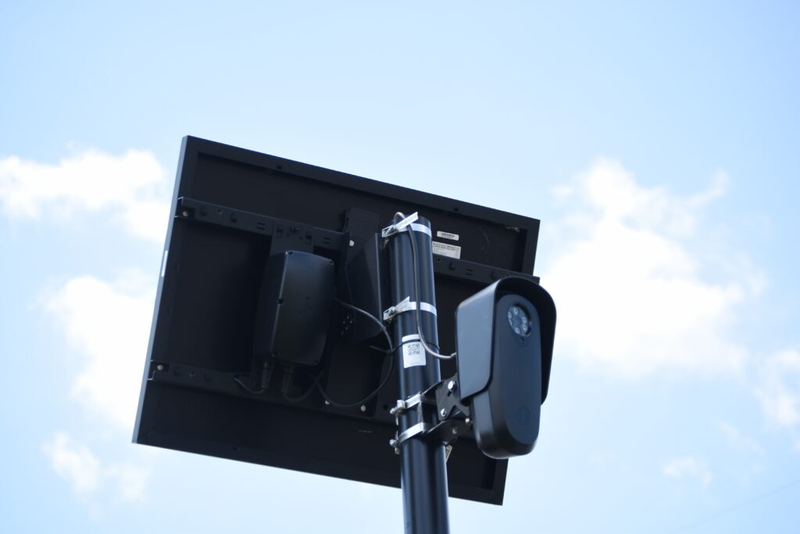
A Flock license plate reader camera in Southfield. July 3, 2026. | Photo by Katherine Dailey/Michigan Advance.
Grand Rapids police officials and representatives from Flock Safety, the company that owns the controversial license plate readers that have come under fire nationwide over privacy and surveillance concerns, spoke to the community at a meeting of the city’s Public Safety Committee on Tuesday, seeking to assuage advocates’ and residents’ concerns about the city’s use of the technology — especially whether the data it collects can be used by federal immigration enforcement.
Kerry McCormack, a member of Flock’s external affairs team, emphasized that they are the only major provider of automatic license plate reader, or ALPR, technology that does not have contracts with DHS or ICE, telling the committee that “You cannot directly share with them in our system.”
Additionally, Grand Rapids Police Department officials emphasized that, under the city’s system, officers are not able to filter their searches specifically for purposes of immigration enforcement or to identify people seeking reproductive healthcare.
Andrew Feikema, a citizen member of the committee, however, shared his doubts about the technology, saying, “I don’t feel convinced that, say, a police officer can run a search with those purposes in mind, but they can mislead about what they provide that query.”
McCormack responded that intentionally lying about the reason that an officer is accessing a law enforcement database is misuse and, depending on the policies of a given jurisdiction, could be illegal.
McCormack also emphasized that data-sharing is left up to the discretion of the agency running the Flock cameras, saying, “Your agency decides if they want to share and with who.”
But the actual list of who has access to the Flock data from Grand Rapids is not public. Though officials have said repeatedly that Grand Rapids does share its Flock data with some federal agencies, they have continued to not answer questions about which specific agencies are included.
Second Ward Commissioner Milinda Ysasi questioned why this was the case during the meeting and asked Deputy Chief Mike Maycroft and Sergeant Adam Host, exactly which agencies GRPD shares its Flock data with.
They can have all the policies they want. The fact is, they admitted that they did an immigration search.
Neither GRPD officer directly responded to that question, but Host did note that the department is working on publishing a page in the Flock Transparency Portal, which in many cases provides a full list of all departments with which an agency shares its data. That page is not yet public, and they did not provide a timeline as to when it might be made public.
Third Ward Commissioner Marshall Kilgore also reiterated concerns from his constituents about potential data sharing, saying that the “current sort of terror that we are seeing from ICE” makes those concerns valid to him.
Liz Balck, a policy strategist for the ACLU of Michigan, also noted that, under the current federal administration, firewalls between federal agencies do not exist in the way they did in the past.
“At this moment, that is cold comfort to a lot of people, hearing that we don’t share with ICE, and what we’ve seen before, in practice, is that ICE seems to be able to get their hands on some of this data through secondhand or third parties. The tricky part about this network design is that we don’t necessarily know,” she said in an interview with the Michigan Advance after the meeting. “I think that’s one of the concerns that the public continues to raise, just because maybe the city’s contract says that we’re not going to share with ICE, doesn’t mean that ICE couldn’t eventually get their hands on it somehow. So it’s not as reassuring, I think, as maybe the company or the city would hope that it is.”
Concerns about the misuse of Flock technology have escalated in recent weeks amid reporting about officers misusing the technology, including to stalk ex-partners — for example, Tempe, Arizona canceled its contract with Flock on Wednesday and said all cameras would be turned off, though city officials said that they had not seen any misconduct around the system in their own city.
In response to questions from Grand Rapids Mayor David LaGrand — who emphasized the inherent risks of any technology, saying, “we all live with the increasing perils of technology all the time” and drawing parallels to an Amazon Alexa speaker listening in on conversations — Maycroft said that there had been no complaints about misuse of Flock technology to Grand Rapids police in the last two years.
Members of the committee expressed a desire for greater transparency in general around the use of the 31 city-owned cameras around the city. Maycroft did not indicate that he or the city would be able to share the locations of those cameras.

One specific criticism that members of the committee, including citizen member Sherlynn James, raised is that all license plate readers, including Flock, are exempt from the city’s annual surveillance reporting requirements, because the city used license plate readers prior to the city’s surveillance policy going into place in 2015.
Oversight and Public Accountability Director Brandon Davis explained that the policy had a “grandfather clause,” where technology already in use “does not have the same reporting requirements pursuant to the surveillance policy as other types of technology.”
However, police officials did say that they would be open to establishing some kind of additional reporting on the use of automatic license plate readers in the city.
City Manager Mark Washington said in response, “What I would like to do is take the police department up on an annual departmental report on license plate readers and use of Flock technology.”
Some in attendance were overall pleased with the police department’s willingness to show up and answer questions from the committee.
“We’re really grateful to hear the openness, the willingness to make a more transparent dynamic with the community, I think we really just have to wait and see what is actually shared,” Balck with the ACLU said.
Meanwhile, Gema Lowe, an organizer with Movimiento Cosecha GR, told reporters after the meeting that she believes the only way to safeguard against the threat posed by Flock — including in concerns about cooperation with ICE — is to eliminate Flock entirely.
“They can have all the policies they want. The fact is, they admitted that they did an immigration search. They call it a mistake. Who knows if that was a mistake or not, but it is concerning,” she said. “This is why we’re here, to continue demanding the sanctuary policies that will prohibit the data sharing, including the ones collected by the Flock cameras. So we don’t want this data sharing to be happening, and we don’t want the Flock cameras in our city.”
Lowe is referring to an incident in early 2025 in which a search of the GRPD’s Flock account by a user identified only as “J. Mar” listed “deportation warrant” as its reason. Records later unveiled by WOOD TV suggested that the Bureau of Alcohol, Tobacco, Firearms and Explosives was responsible for the search.
But during the meeting, police officials repeatedly reiterated the use of Flock as an additional tool for police to use in investigations, highlighting a number of success stories that involved Flock cameras in recent years.
Grand Rapids Police Chief Joe Trigg noted, “I want the best tools here to have the safest city we can have. I want it to be hard for criminals to do a crime in the city.”
“The Flock camera isn’t a substitute for the preliminary investigations our officers and our detectives still have to do,” Maycroft added. “The officers still need to abide by that, and that is in our policy that we need to verify and make sure we are still doing the basically the job that we were paid to do doing that preliminary investigation within the Constitution of the United States. It’s just a tool.”
Lansing, MI