If Va.’s reproductive rights amendment passes, challengers say they’ll fight to overturn it in court
Aug 28, 2026 | 5:27 am ET
Description
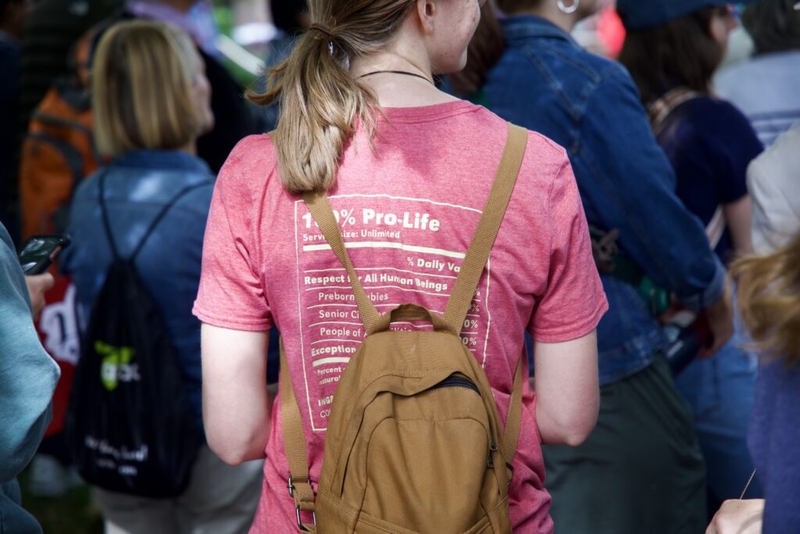
An attendee of the Virginia March For Life on April 22, 2026. (Photo by Charlotte Rene Woods/Virginia Mercury)
A legal challenge to amend the ballot language for Virginia’s pending reproductive rights constitutional amendment has been in limbo since June. Even if no movement on the case happens before Election Day, counsel for the plaintiffs said this week, they will seek to invalidate the vote.
Josh Hetzler, a lawyer with the Founding Freedoms Law Center said, “If the amendment passes, we would seek to be in court as soon as possible to ask the court to overturn the result, similar to how it happened with the redistricting amendment.”
Virginians approved another amendment to redraw congressional maps in a special election that the Supreme Court of Virginia struck down weeks later — an outcome Hetzler would push for if voters accept the reproductive health amendment.
The lawsuit, first filed in April on behalf of Bluefield town council member Meagan Kade and Chesterfield County child psychologist Sheila Furey, calls the ballot language for the amendment misleading and seeks it to be rewritten or the amendment invalidated.
The last hearing about it was in June in Tazewell (where the redistricting lawsuit also originated). An advocacy group called Virginians For Reproductive Freedom has tried to join the case as a co-defendant.
As of Aug. 27, no ruling has been issued.
Hetzler said “the Commonwealth, from our standpoint, has been dragging its feet and has not tried to schedule a hearing for its motions to dismiss our case.”
The office of Attorney General Jay Jones and Tazewell Circuit Court did follow through on inquiries about when a hearing could next take place.
What the case has sought
In their lawsuit, the plaintiffs said the ballot language for the referendum “profoundly misleads by omission and misrepresentation.”
Plaintiffs argued the amendment would eliminate parental consent requirements for minors to receive abortions or surgical birth control procedures and pose safety risks by removing the current three-physician approval threshold for abortions that happen later in pregnancy.
The arguments mirror objections voiced by Republican lawmakers at each step of the amendment’s multi-year approval process so far.
Existing state code requires parental or guardian consent for surgeries on minors, unless a minor successfully petitions a judge for approval.
Democrats, who hold legislative majority and advanced the amendment to statewide ballots, responded by saying it wouldn’t override state law and instead would more firmly protect access to abortion, contraception and fertility treatment.
A remedy for this argument, Hetzler suggested at an April press conference, would be a rewrite of the amendment’s language before early voting begins on Sep. 18.
“We’re saying ‘declare that if this language goes forward, that it would be unconstitutionally deceptive, and it could therefore be declared void after the fact,’” Hetzler later said in a call.
With a declaratory judgement, the legislature “would have every incentive to try to fix the language,” he explained, suggesting a special session could be called to “make it more accurate to what the amendment actually does.”
Other avenues for defeat
Another argument in the Family Foundation case challenged whether the retroactive repeal of contradictory state code outlining additional constitutional amendment requirements was legal.
That case was first filed in March by Bedford County supervisor Charla Bansley and dismissed in July. Bansley has since filed an appeal.
More than abortion: What Va. patients and providers want you to know about reproductive health laws
The repealed code that would have required circuit court clerks post amendment text outside their courthouses — § 30-13 — conflicted with another part of state code outlining the process, which lacked that specific requirement.
When Gov. Abigail Spanberger signed bills to hold a referendum for the amendments earlier this year, she also signed a bill to repeal § 30-13.
Because the Family Foundation’s case also includes arguments involving § 30-13, Hetzler suggests it may lend credence to the Liberty Counsel case. The argument also surfaced in the successful challenge to the redistricting amendment, though it was not the focal point of the Supreme Court’s ruling.
Ahead of the Liberty Counsel case’s dismissal, lawyers debated Article 12, Section 1 of Virginia’s Constitution — which outlines the state legislature’s responsibility to submit pending amendments to voters “in such manner as it shall prescribe.”
Because the constitutional amendment occurred while § 30-13 was still on the books, Bansley and her attorneys said the process should be invalidated.
Though the repeal did not take effect until this summer, Erin McNeil with the state’s attorney general office said lawmakers have authority to adjust the constitution and prescribe how they do it.
“How can the General Assembly have this authority to prescribe a process but not have the authority to change that process?” she asked.
A Campbell County judge ruled from the bench that day in favor of the state.But with the appeal filed, it could be revived.
Liberty Counsel founder Mat Staver said in a release that the case “will ultimately be determined by Virginia’s highest courts.”
While it’s unclear if pro-amendment advocacy group Virginians For Reproductive Freedom can get involved in the Family Foundation case or whether another hearing may occur before Election Day, the group was granted intervention in the Liberty Counsel case.
VRF campaign manager Han Jones called the appeal “desperate” and said the organization is confident the dismissal could stand because “decisions about Virginia’s Constitution belong to the people.”

Richmond, VA