Abortion initiative group sues Idaho state officials over ‘misleading’ ballot language
Aug 27, 2026 | 12:49 pm ET
Description
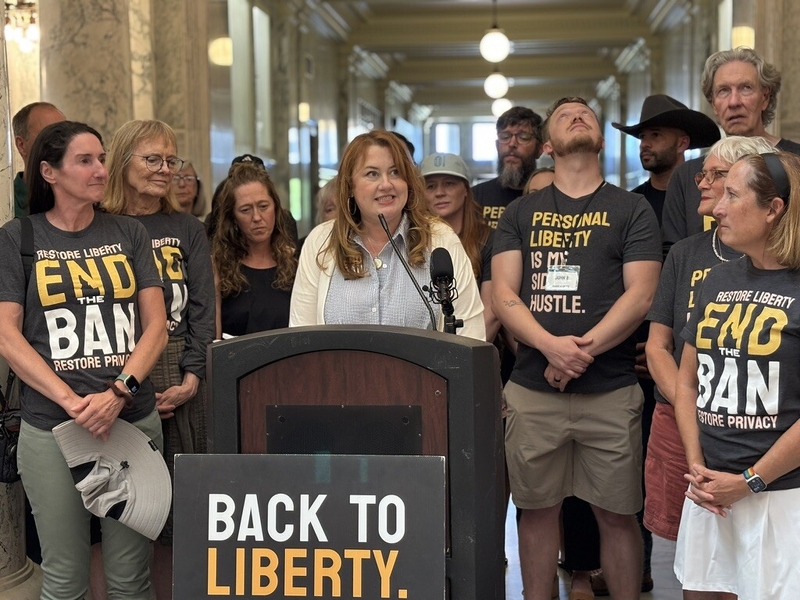
Melanie Folwell, lead organizer for the ballot initiative in Idaho to restore abortion access, speaks to supporters at the Idaho Capitol in July. The nonprofit she leads, Idahoans United for Women and Families, is suing the state over a final segment of ballot language that will also appear in the statewide voter pamphlet. (Photo by Kelcie Moseley-Morris/Stateline)
BOISE, Idaho — The group leading the effort to restore abortion access by ballot initiative in Idaho has filed a lawsuit against state officials over proposed language that will appear on the ballot and in a state-issued voter pamphlet.
Idahoans United for Women and Families, the nonprofit organization that drafted the initiative — now called Proposition 1 — says the “yes” and “no” statements as prepared by Idaho officials violate the law guiding the initiative process and are confusing and misleading. Attorneys filed the lawsuit to the Idaho Supreme Court late Wednesday night.
Idaho Secretary of State Phil McGrane stressed that the issue needs to be quickly resolved to meet upcoming ballot deadlines. The voter pamphlet must be printed by September 25, according to the law, and ballots need to be mailed to military and overseas voters about a week before that. McGrane said the state has paused production amid the litigation on the 850,000 copies of the voter pamphlet that need to be printed and mailed.
“There was a good-faith effort to try and reflect each of the sides of the pro and con statements that were submitted to us,” McGrane told Stateline by phone on Thursday. “I think one of the biggest challenges that we’re going to see with Proposition 1 is that it’s a very complicated issue with a lot of nuance … and this isn’t a simple issue to consolidate down into a short, one-sentence statement.”
Following the law, McGrane developed the language for the statements with Idaho Attorney General Raúl Labrador, who has been outspoken in his anti-abortion views for many years and recently appealed a federal judge’s decision that would protect abortion access in cases of threats to a pregnant patient’s physical and mental health.
Labrador told Stateline in an emailed statement that his duty alongside the secretary was to clearly and concisely explain the effects of a “yes” or “no” vote and to fully inform Idaho voters, and said they applied the same legal standard to every measure that has been on the ballot.
“Idaho voters deserve a straightforward explanation of what their vote will do,” Labrador said.
Idaho Supreme Court orders officials to revise abortion ballot initiative language, impact statement
There have been similar legal fights over abortion ballot language in other states. Activists on both sides of the issue in Missouri, for example, have spent years arguing over ballot language, both on the 2024 citizen-led amendment that restored legal access to abortion, and on the 2026 amendment referred by the legislature that would reinstate the ban.
Similar battles between Republican state officials and initiative organizers played out in Ohio, Arizona and Montana between 2023 and 2024. Voters in all three of those states ultimately approved amendments to protect abortion rights.
It’s also not the first time Idahoans United for Women and Families has sued the state over ballot language. In April 2025, the Idaho Supreme Court heard arguments in the lawsuit, including whether the short ballot title and fiscal impact statement should be revised, and unanimously sided with Idahoans United on those two elements.
Under Idaho law, the ballot must include a clear and concise statement about the effect of a “yes” or “no” vote, and the voter pamphlet must include a complete copy of the initiative text, its fiscal impact, and arguments for or against the measure with rebuttals.
But the ballot won’t include the full text of the initiative or the arguments for and against — just the long and short titles of the initiative, statements about fiscal impacts and the “yes” or “no” statements.
“In the two decades we’ve had a yes/no statement on the ballot, they’ve never looked like this,” said Melanie Folwell, lead organizer for Idahoans United, in a statement. “And it’s not because our initiative is longer or more complex than past initiatives.”
According to a copy of the voter pamphlet pages drafted by the Idaho state officials, a “no” vote “would make no change to Idaho’s current law, which protects the life of the unborn while allowing abortion in reported cases of rape or incest, or when necessary to protect the life of the mother.”
The “yes” side said it would “create reproductive rights, including a right to abortion before a fetus’ ability to survive and after a fetus’ ability to survive in cases of medical emergency, and provide liability protections for healthcare providers.”
The complaint says the “no” statement is not “clear and concise,” and said the “yes” statement is similarly inadequate because it describes viability in a different way than the other parts of the ballot language.
Missouri appeals court rewrites ballot proposal to clarify a ‘yes’ would end right to abortion
They also argue the “no” statement does not adequately describe Idaho’s abortion law, which is a criminal statute that carries felony punishment for providers, and they said it does not accurately describe the exceptions.
The group is asking the court to order that the statements be simplified to say that a “yes” vote means the proposition will become state law, and a “no” vote means state law regarding abortion will remain unchanged.
Attorneys asked the court to make a decision by September 11.
This story has been updated to more accurately reflect the outcome of the Idaho Supreme Court ruling in the first lawsuit over the initiative ballot language in 2025. Stateline reporter Kelcie Moseley-Morris can be reached at [email protected].