A tech-forward future imagined for New Hampshire at ‘Freedom Summit’
Aug 26, 2026 | 5:00 am ET

Description
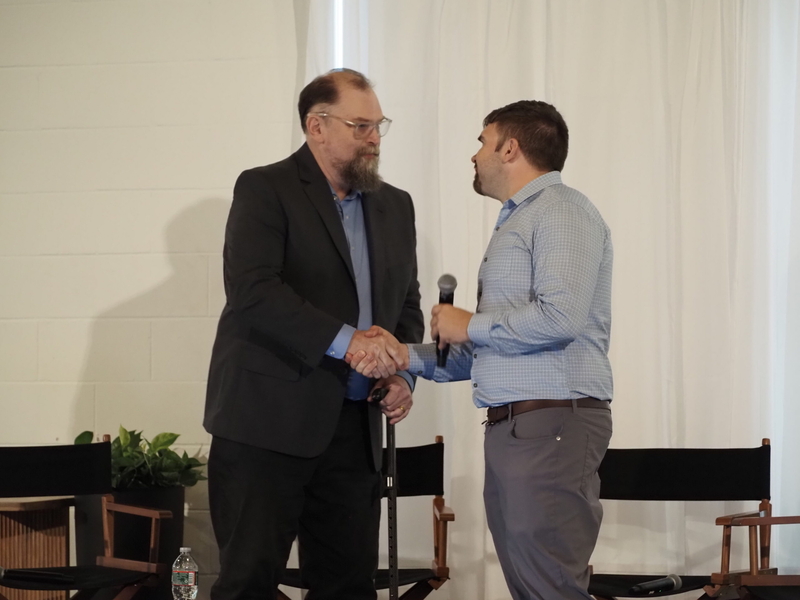
From left: Raechel Lambert, Ryan Lambert, Benjamin Sachs, and Jeremy Hitchcock, prospective developers of a planned community called "Freedom Village," speak during a summit they organized on Friday, Aug. 21, 2026. (Photo by Molly Rains/New Hampshire Bulletin)
More than two decades after the birth of the Free State Project, another group of philosophically united individuals have their eyes trained on New Hampshire, where they envision a home for a new kind of community.
Last week, a gathering of self-described “techno-optimists” drew about 200 attendees to a Manchester event venue to talk about the state’s tech industry and stir interest in a “village” planned by four New Hampshire tech workers and prospective founders.
“Freedom Village” is the name of an exclusive housing and community development imagined for southern New Hampshire “tech people,” according to its designers: entrepreneurs and spouses Raechel and Ryan Lambert; entrepreneur Jeremy Hitchcock, who also chairs the board of a Portsmouth-based nuclear startup; and architect Benjamin Sachs.
After the two-day event wrapped, some details about the planned community remained murky. But other topics were turned over extensively by the array of speakers, most of whom were tech entrepreneurs and a handful of Republican political figures, including representatives of New Hampshire’s executive branch.
The central focus throughout was New Hampshire’s high-tech future. Panelists discussed promoting a New Hampshire biotech industry that pushes regulatory envelopes; embracing AI and tech-forward innovation; and growing New Hampshire’s nuclear power sector.
In addition to those sometimes fraught topics, the agenda featured two big New Hampshire names among its array of speakers. Listed as a headline speaker in the promotional materials for the event was New Hampshire Gov. Kelly Ayotte, though she was ultimately replaced by an adviser. And on the summit’s second day, attendees heard a presentation on New Hampshire innovation from Dean Kamen, a New Hampshire inventor under fire of late for ties to sex offender Jeffrey Epstein.
So what does the techno-optimist vision look like for New Hampshire? Here’s how that question was answered during last week’s Freedom Summit.
Parallels and new ground
Freedom Village is bound to draw comparisons to the Free State Project, a movement founded in 2001 that brought migrants with Libertarian values to New Hampshire and continues to exert political influence in Concord.
But Raechel Lambert, in an early August interview with the Bulletin, asserted that Freedom Village is not aligned with the Free State Project.
“Freedom is for everyone,” she said. “I think we have to take back that word.”
Lambert reiterated the idea that Freedom Village was not political on Friday, when she stated that individuals of all persuasions would be welcomed to the planned community.
The politicians involved in the summit were right-leaning, with multiple Republican members of the New Hampshire House of Representatives in the audience. House technology and cryptocurrency advocate Rep. Keith Ammon, a Republican from New Boston, delivered a talk on the theme of sovereignty. And though Ayotte did not appear, an adviser from her office spoke on the first day, while New Hampshire Department of Business and Economic Affairs Commissioner Lucy Lange delivered a recorded message on day two.
Sarah Scott, deputy state director for the conservative, libertarian-aligned group Americans for Prosperity, also spoke on a panel.
While Lambert denies that the plan is political in nature, she knows the team’s ideas are not for everyone. (“Lots of people will dunk on this plan,” she wrote on a LinkedIn post before the event.) In fact, they’re not intended to be, she said; the community and gathering were intended for a specific type of person, who Lambert and co-founders variously referred to as “builders” and “tech people.”
That specificity is why the team chose New Hampshire, they said. Hands-off government, a rural atmosphere, and proximity to Boston are among the state’s draws, Lambert wrote in a Substack post in January.
She also wrote about the state’s tax leniency as a major factor.
“There are no billionaire taxes or wealth taxes being debated here,” the Substack post reads, citing a proposed asset tax in San Francisco and an “openly Socialist agenda gaining traction in New York City” as reasons entrepreneurs of the sort she envisions for Freedom Village may land in New Hampshire.
Skepticism around government and regulations were common threads among speakers over two days of sessions.
‘Right to Try’
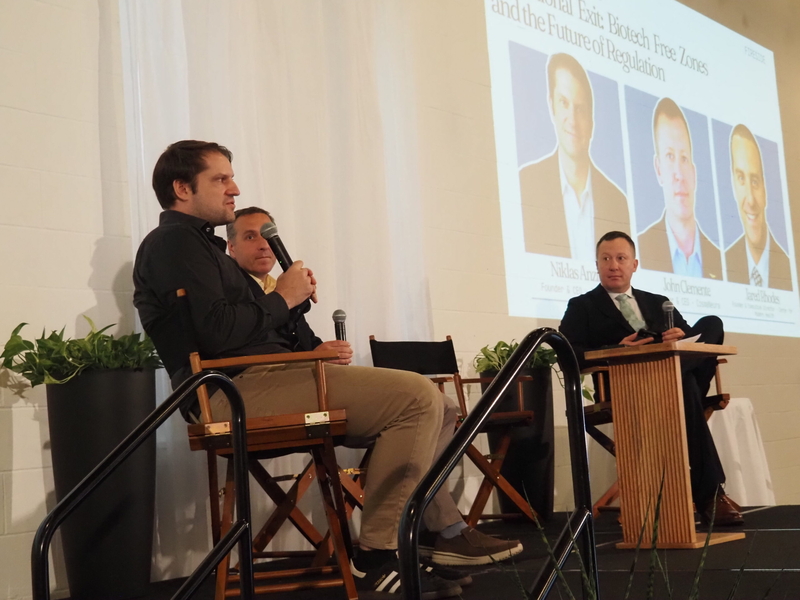
The first day of the summit, organized around the theme of biotechnology innovation, provided an inside look at New Hampshire’s aggressive “right to try” movement.
New Hampshire’s original Right To Try Act was signed into law a decade ago. Modeled after similar laws in other states, it allowed New Hampshire patients suffering from terminal illnesses to receive treatments that haven’t yet been fully approved by the U.S. Food and Drug Administration but are through early stages of the process.
However, in recent years, a group of libertarian-leaning lawmakers have successfully fought to expand the law. In 2025, House Bill 701 updated the Right To Try Act by allowing eligible patients to waive their ability to sue. Proponents argued the fear of medical malpractice lawsuits was scaring pharmaceutical companies from offering experimental treatments.
This year, they went further. Led by Manchester Rep. Brian Cole, Republican lawmakers passed House Bill 1735, which expanded the legal right to try experimental treatments to those with “chronic and debilitating” conditions even if they aren’t dying from the illness. Lawmakers also unsuccessfully attempted to pass House Bill 1734, which would’ve set up experimental treatment centers throughout the state.
At the Freedom Summit, speakers urged lawmakers to go even further yet. A common theme was taking regulatory power away from the federal government and seeking a more industry-driven approach. Speakers challenged mainstream acceptance of the federal pharmaceutical safety system.
“What we’re trying to do is end up changing who is making the decisions around the safeguards,” Jared Rhodes, founder of the free-market think tank Center for Modern Health, said, adding: “It’s OK to ask, ‘Why does this all have to be centralized through the FDA or some sort of other government entity?’”
Ian Huyett, who works for New Hampshire-based conservative advocacy group Cornerstone, decried what he saw as an unfair standard on the biomedical industry where “food additives in the U.S. are largely regulated by after-the-fact remedies like civil liability, whereas drugs and biologics are subject to prospective, pre-market gatekeeping.”
“Food additives are essentially innocent until proven guilty,” Huyett said, in contrast to “biologics and drugs, (which) as we all know, even if there isn’t a big red flag — like ‘this is probably a carcinogen’ — are effectively illegal until proven innocent. Patients can’t get them until they come through a rigorous process, even if there’s nothing alarming in the data. And if you just think about this in first principles, you would expect all of this to be opposite.”
Proponents of “right to try” expansion have often framed their efforts in economic terms. Expansion of the law, they’ve said, will bring economic development to the state by attracting biotech companies interested in the relatively lax regulatory framework.
“Let’s make New Hampshire the best biotech framework in the country and make the Boston companies exit to New Hampshire,” Niklas Anzinger said. Anzinger is the CEO of Infinita, a Libertarian-aligned planned community in Honduras, who has been pushing for this type of legislation in both New Hampshire and Montana.
Speakers evoked countries like China, Japan, and Australia, which they said have adopted more lax regulatory landscapes that they’d like to see adopted in the U.S. and they fear are chipping away at U.S. pharmaceutical dominance.
Organizers had promised a visit from Ayotte Thursday morning. However, at the time of her scheduled visit, they announced that the governor couldn’t make it due to a “last-minute schedule change.”
“I just want to emphasize that the governor is behind you,” Alex Holderith, one of Ayotte’s policy advisers who spoke in lieu of the governor, said. “She’s ready to build. She wants to get out of the way. She wants to support you, and she recognizes just how important it is what you’re doing.”
Building housing, scoping energy
Discussion on the summit’s second day was framed around the idea of “built futures,” featuring presentations on robot-built modular housing, artificial intelligence, and nuclear energy.
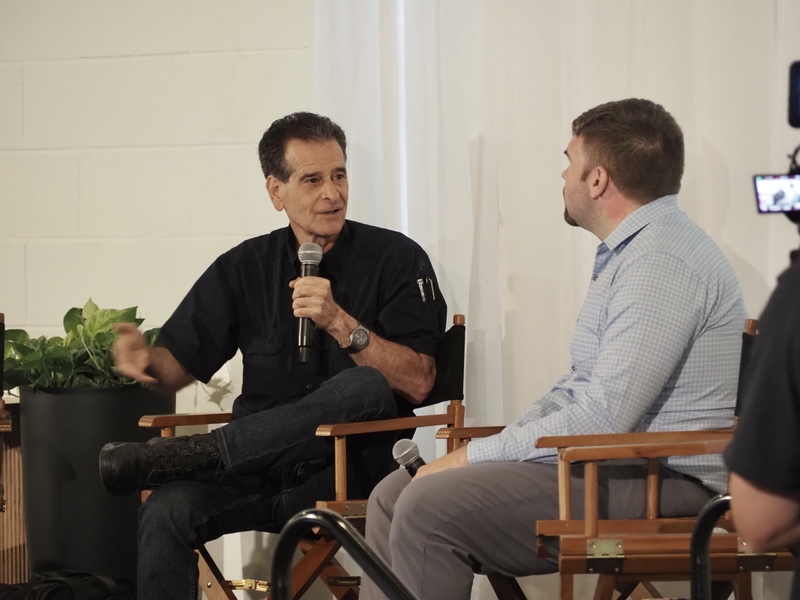
A fireside chat between Hitchcock, of StarCube, and Kamen headlined the day’s agenda — and forced organizers and Kamen himself to address his ties to Epstein.
Asked about the choice to include Kamen in the lineup despite his connection to the sex offender — Kamen, for example, spent time on the billionaire’s private island — Lambert said she believed he had contributed significantly to New Hampshire’s industrial past, and did not believe in “cancel culture.”
“I didn’t see anything too incriminating. I feel like he already took his lashings,” she said.
Kamen, who has denied knowledge of Epstein’s activities, took the stage to talk about his work in biotechnology and his STEM nonprofit, FIRST. But he also felt the need to try to clear the air, attributing his connection to the infamous millionaire to his attempts to court supporters for his nonprofits.
“I’ve kissed every frog I can find,” he said, in what he described as an attempt to get support for his philanthropy. “… One of the frogs I kissed who I thought could be really helpful … it stunned me, it nearly killed me.”
In his talk, Kamen touched on the importance of building more housing in order to retain young talent in New Hampshire and make life affordable. He also shared his vision for a train — inspired by one at Walt Disney World — running through downtown Manchester.
Other speakers also touched on New Hampshire’s need for housing. Vikas Enti, CEO of Massachusetts-based, AI-forward modular housing company ReFrame Systems, highlighted manufactured homes as a path toward climate resilience and lower housing costs.
Pardha Ponugoti, a tech entrepreneur from Portsmouth, spoke about integrating artificial intelligence into his life in surprising ways; he advocated for New Hampshire to get ahead of the curve by adopting the technology aggressively. And energy was the focus for Bill Spellane, CEO of StarCube, a company that Spellane says is in the early phase of developing compact nuclear “microreactors.”
Ideas for ‘Freedom Village’
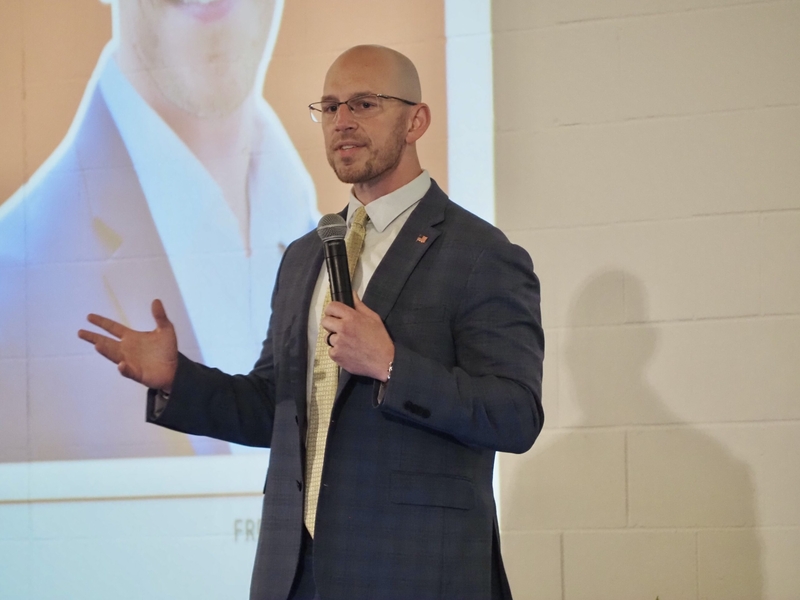
The four organizers staged a grand reveal of the Freedom Village plans at the end of the second day.
The village would take the form of a private housing development where members might “buy in” in order to join, Lambert said.
“It will pay property taxes to whatever city it belongs to. It’s just like a normal real estate development,” she said in the early August interview.
Yet, she added, plans for the community do have a “specific angle.”
“It’s definitely meant to be, like, a community for entrepreneurs,” she said at the time.
A 100-plus-acre parcel of city-owned land in Manchester is the group’s current focus, they said on Friday, adding that they had already participated in preliminary discussions with Manchester Mayor Jay Ruais.
When he spoke to kick off Friday’s session, Ruais welcomed the attendees to the Queen City and spoke highly of their mission.
“I believe the city, the state, we are all behind you in this effort to make this work and to make this a centerpiece, and make the centerpiece right here in Manchester,” he said.
But Ruais’ remarks preceded the developers’ announcement that they were planning to build the development in Manchester, and he did not address the specific city-owned parcel. Ruais’ office did not respond to a question sent by email after the summit about whether Manchester was amenable to selling it to the Freedom Village developers.
There are other unknowns, too. How the village will be funded is still being worked out, Hitchcock said in an email. When an audience member asked about its business structure on Friday, Lambert said the organization would be privately run, but that profit was not the goal.
Some who have reached out about the plan have asked Lambert about Freedom Village’s model for internal governance and conflict resolution, she said. But she’s more focused on long-term outcomes for the people who move to the community, she said.
“They spend a lot of their time … trying to discuss the governance,” Lambert said. “… And I’m just like, whenever I’m with the tech community, the entrepreneurial community, we’re just kind of all always talking about what we’re going to build.”
Living in community with others in tech carries significant benefits, like networking opportunities and the benefit of being creative around others in your field, Lambert said. But in the U.S., there are only a few cities that can offer that — and that feels limiting, she said.
“When you work in startups, in tech, you’re constantly dealing with the trade-off of, I can live in San Francisco or New York. Those are basically the only two cities that have meaningful tech communities,” she said.
Is New Hampshire a likely spot for a third such community to unfold? Lambert owns that it might seem like a stretch for some — but she and the rest of the Freedom Village team are wholehearted believers.
After the summit wrapped on Friday, attendees milled about the Manchester venue, many heading to an outdoor afterparty nearby. A nature walk was planned for the following morning; then those who traveled from out of state for the event planned to depart.
With the announcements about Freedom Village still fresh, some attendees said they were left with questions — while others were enthusiastic, including Manchester tech worker Chris James.
“I’ll be the first resident,” he said.
Concord, NH