What to know about state takeovers as Texas wrestles with the future of Austin public schools
Aug 25, 2026 | 6:00 am ET
Description
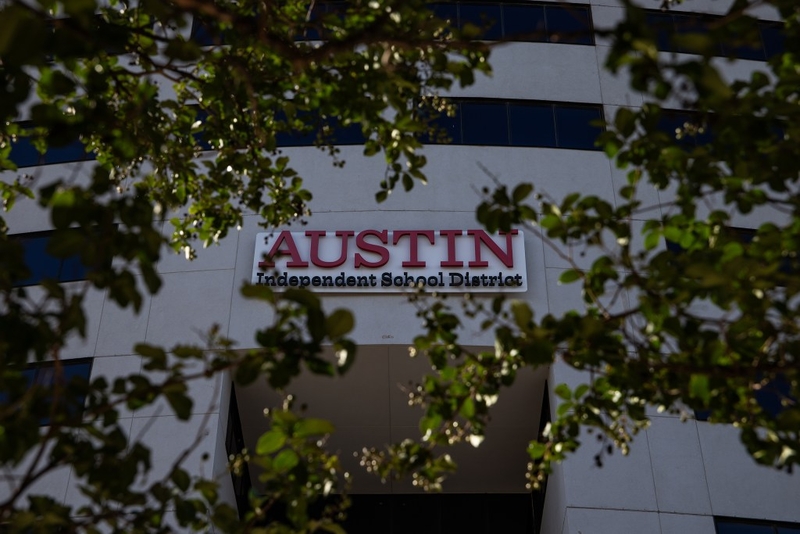
An Austin Independent School District sign is seen on the outside of the AISD building in Austin on June 11, 2026. (Kaylee Greenlee for Austin Current)
Chronic academic underperformance at two Austin public schools has the district in jeopardy of severe state sanctions.
Now, Texas Education Commissioner Mike Morath will decide what intervention looks like for the school district of nearly 70,000 students. Morath must either close the struggling schools or replace the locally elected school trustees and superintendent with leaders of his choosing.
The state is leading the country in its use of such takeovers. While this kind of intervention has historically been a last-resort measure, Texas leaders have used it in recent years as a tool they say will improve student learning. In many cases, it is carried out amid protest from parents.
Since 2023, seven districts — including Fort Worth and Houston — have had Morath replace their leaders.
What is a state takeover?
This intervention into public schools happens when the Texas Education Agency commissioner temporarily removes democratically elected local school trustees and replaces them with a board of managers he appoints. It is seen as the most severe formal state sanction for schools.
The managers assume school board duties, which includes approving budgets and tax rates as well as setting district policies on a range of issues from safety to instruction, according to state and federal law.
School boards hire superintendents to manage the daily operations of a district. The state education chief can — and often does — swap out a superintendent during a takeover. Even though Fort Worth superintendent Karen Molinar changed up lesson plans that parents said drove academic gains, Morath ousted her, signaling the state wanted a hard reset for the district.
Why do takeovers happen?
Agency officials can step in due to persistent academic struggles, financial mismanagement or systemic corruption.
A 2015 law made it easier for TEA officials to intervene when campuses fail state academic standards. Texas grades public schools on how they are educating students, largely based on how students do on the state standardized tests. Five consecutive Fs at a single campus triggers state action.
At that point, the education commissioner must either close the school or replace the district’s elected school board with an appointed board of managers.
The campuses that trigger a districtwide takeover have predominantly served Black, Latino or low-income students. State Rep. Harold Dutton grew up in Houston and was a student at Wheatley High School, the school that triggered the takeover in HISD.
The Democrat has said he wrote the 2015 law to force districts and the state to reckon with long-struggling schools.
The ratings that are the basis of recent takeovers largely come from the widely unpopular STAAR, which is being phased in response to concerns that it creates too much stress for students and takes up too much teaching time. It will be replaced with new assessments.
A district can be taken over multiple times. For example, TEA appointed managers in Beaumont ISD in 2014 because of financial mismanagement. It again seized control about a decade later over academic underperformance.
Before 2015, a commissioner already had the power to appoint a conservator to oversee a district or campus, while the district’s locally elected school board and superintendent remain in place. The commissioner can then appoint a board of managers in a district that has been under a conservator for two years.
Who is on the board of managers during a takeover?
A board of managers must be primarily made up of local residents, according to state law. Voters who live within the district’s boundaries can apply.
In past job descriptions, agency officials have stressed that the ideal candidates have experience in parent or neighborhood advocacy, social work, psychology, business, finance or law.
The essential job duties of managers include evaluating the superintendent and preparing the locally elected trustees to eventually assume their responsibilities again. The managers are required to hold public meetings under the Texas Open Meetings Act.
Meanwhile, the trustees can serve in an advisory capacity without decision-making power, like other community members. Local school board elections continue as normal, according to the TEA. Once the commissioner ends a state takeover, the most recently elected school board members will be phased back into governing the district.
How long do takeovers last?
Commissioner-appointed managers are typically in place for two to six years, TEA spokesperson Jake Kobersky has previously told the Tribune. The length of a takeover depends on how fast a district can meet the academic and exit goals set by the state commissioner.
After two years with managers, state law allows the TEA commissioner to restore local control if the failing campus gets passing grades on accountability ratings for two consecutive years. The commissioner can also extend the takeover.
Once it is determined that the campus or district has met standards, the commissioner can plan for a transition.
The Marlin school district, east of Waco, was under state control for seven years before TEA officials began to relinquish control to the elected school board in February 2024.
What can districts do to avoid a takeover?
In a rare case, the Wichita Falls school district met the bar of five Fs at a middle school for a takeover — but the commissioner allowed the district to keep its elected school board. While Wichita Falls was facing pressure to improve academic performance, the district adopted state-produced math materials and outsourced operations at the struggling campus to Third Future Schools, a charter network that focuses on turning around schools.
To get a break from harsh penalties and buy time before they are at risk of a takeover, school districts can hand over the management of underperforming campuses to charter schools or nonprofits. That’s because of a 2017 law that also gives the school extra dollars for the partnerships.
Austin ISD officials tried to enter such a partnership with a nonprofit Texas Council for International Studies. Agency officials rejected the bid, saying the group did not have a proven record of academic turnaround.
Do takeovers work?
Research suggests takeovers of public schools in the U.S. have been a mixed bag.
New Orleans and Lawrence, Massachusetts saw academic gains and higher graduation rates after such interventions. But another study of takeovers in dozens of districts between 2010 and 2018 found no evidence that the intervention led to improvements in student reading and math performance, up to almost a decade after it occurred.
In a Brookings Institute analysis, researchers found takeovers were especially harmful to student achievement when it took place in predominantly Black communities.
Houston ISD students have seen dramatic changes during the takeover, such as scripted, standardized lessons and higher pay for teachers. State-appointed leaders have pointed to improved student test results and progress on the state’s A-F accountability ratings in HISD as proof that the state intervention is working. However, the district has also seen an exodus of teachers and plummeting student enrollment.
María Méndez contributed to this report.
The Texas Tribune partners with Open Campus on higher education coverage.

Austin, TX