How Georgia farms’ fame (and favor) outpace their place in the economy
Aug 24, 2026 | 2:58 pm ET
Description
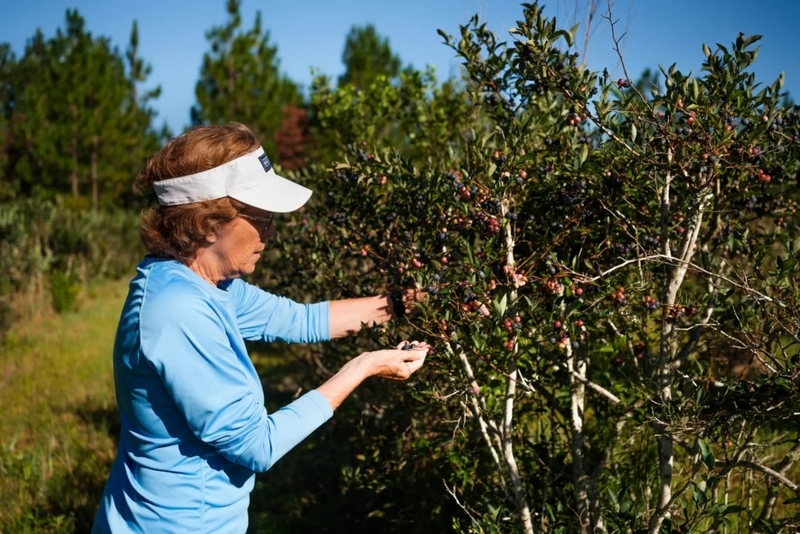
Linda Smith, owner of Heritage Hill Farm, inspects and picks blueberries during the summer harvest in Ludowici on June 24, 2026. Blueberries outpace peaches in Georgia. Credit: Justin Taylor/The Current GA/CatchLight/Report for America
Gov. Brian Kemp says it. Agriculture Commissioner Tyler Harper says it. Congressman Sanford Bishop has said it, as did his late colleague U.S. Rep. David Scott.
The phrase “Agriculture is Georgia’s No. 1 industry” infiltrates Georgia politics like pollen in the spring air.
Folks wearing business casual evoke sweat-stained hats and dirty boots, putting romanticized rural life at the heart of the state and high on its policy priority list. Republican gubernatorial nominee Rick Jackson, an Atlanta native, posted on social media that not only is agriculture the state’s No. 1 industry, it’s “part of who we are.”
Under the Gold Dome, the slogan pairs with policies that benefit Georgia’s tiny number of farmers and timber-growers, favorable property tax treatment, and allowing heavier trucks that damage public roads as long as the cargo is agricultural.
But the bucolic ideal of the family farm is nowhere near how the vast majority of Georgians make a living.
Cultivation and harvesting make up less than one percent of the state’s output and few Georgians own or work on a profitable farm.
To put agriculture anywhere near the top of Georgia’s economy requires stretching the definition to include restaurants and grocery stores — any workplace that uses food, fiber or timber — according to Kemp’s former top economic advisor, agricultural economics professor Jeffrey Dorfman.
The state’s most valuable work products come from people providing services like health care, government and real estate management and rental; or from manufacturing higher-value things like airplanes and cars.
Of course farming is incredibly important — we all need to eat. But politicians mislead the public when they imply that it’s a large part of the economy.
Old saying, new publication
In print, the claim that agriculture is Georgia’s No. 1 industry goes back to at least the 1960s when the Georgia Farm Bureau Federation president, a former state legislator, repeated it in his 1968 lobbying to promote the interests of farmers. In 1974, the line appeared in a poultry industry lament about trucker strikes, which was delivered by one of Georgia’s legendary lobbyists, Abit Massey, who stayed at work in the state capitol until 2009.
Some newspapers and magazines copy and paste the claim, without attribution.
But in months of searching, The Current GA could not find anyone claiming to be the source of the saying or anyone with backup for it.
The search included calls and emails with the most well-connected sources in Georgia agriculture and politics, including the Georgia Farm Bureau, the Georgia Agribusiness Council, the state Department of Agriculture and the University of Georgia’s school of agriculture.
Both the governor’s office and the office of the Georgia Secretary of Agriculture referred The Current to the University of Georgia’s Ag Impact Report, an unsigned, undated public relations website created by the school’s College of Agriculture and Environmental Sciences in 2025 to build public and legislative support for the agriculture industry.
The top of the site proclaims that Georgia’s No. 1 industry is agriculture, but it doesn’t include any source or any comparison to other industries. Instead, the website showcases farmers’ harvest values by crop and by county, data that the school has collected and published annually for more than a decade. CAES Professor Ben Campbell is among the team who work on those benchmark county statistics, but he had no documentation for the promotional line at the top of the website.
Neither Kemp’s nor Tyler’s office could cite a source for claims made about the agriculture industry before UGA published the website.
What statistics say
There are three ways economists might look at an industry’s size compared to others, according to Economist David Sjoquist, an emeritus professor at Georgia State University who specializes in public policy and Georgia’s economy.
“Most economists, if asked to measure the relative size of an industry, would use the federal Bureau of Economic Analysis’ gross domestic product data. Alternatively, they might use employment or wages and earnings,” Sjoquist wrote to The Current GA via email.
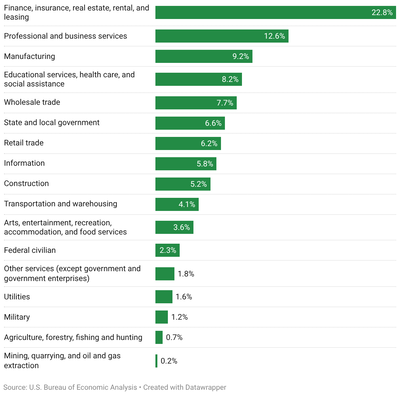
Georgia’s livestock, crop and timber farms’ output was about $6.7 billion, or 0.7% of Georgia’s $925 billion gross state product in 2025, according to the BEA, placing it well behind other categories such as financial services, government and manufacturing.
But that small number is a narrow definition of agriculture, according to Dorfman, Kemp’s former economics advisor who is now a professor of agricultural and resource economics at North Carolina State University.
“If by agriculture you mean ‘farming,’ then there’s no chance it’s the No. 1 industry anywhere,” Dorfman told The Current GA.
Georgia’s biggest industries by share of economy
Finance and services, not farming and growing timber, are the biggest industries in Georgia, measured by their share of the $925 billion in goods and services produced by Georgia industries in 2025.
He’s among the economists who include more businesses, like slaughterhouses, to calculate the size of “agribusiness” in their states.
But “agribusiness” would still have to stretch deep into suburbs and cities and include everyone who works in a restaurant or grocery store to be anywhere near the top of industry by GDP in Georgia.
Counting any workplace that touches any food, fiber or timber that comes from anywhere in the world, around 11% to 13% of the economy in Deep South and Midwestern states would go in the “agribusiness” category, Dorfman said.
But there’s one last hiccup to the BEA and its definitions. There’s no category just called “healthcare.” If there were, that would be a lot.
“We know the national average on healthcare spending is about 18% of the economy … Georgia has a lot of big hospitals,” Dorfman said. Given the state’s hospitals and medical schools, “I really doubt we are much under the national average.”
Few farmworkers, profitable farms
The decline of the tough and low-margin work of raising commodities has been evident for decades.
Parts of farm work are so tough that few will choose it at the wages offered if they have any other option. Farms and slaughterhouses sometimes turn to the people most desperate for work: guest workers or undocumented workers.
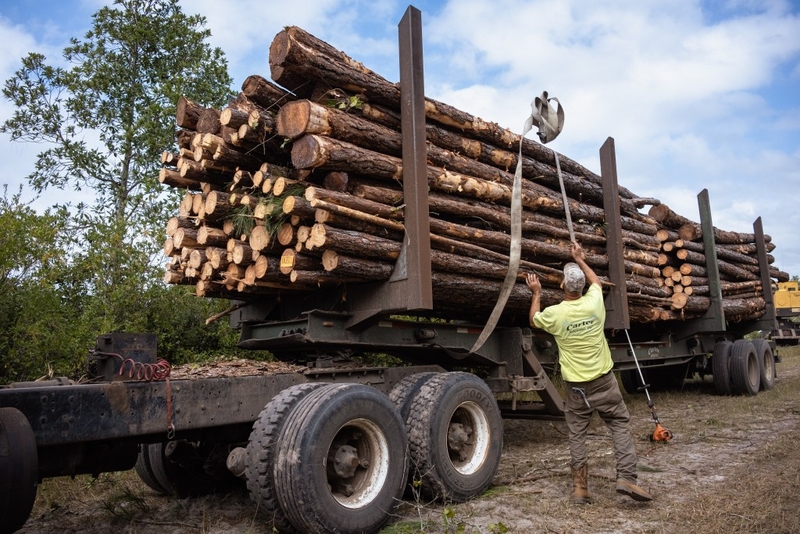
And many farms seek to bypass human labor with ever-developing machinery and devices, like drones to spot-spray herbicides and health-tracker collars for cows. Some farmers have diversified toward crops hardly known two generations ago, like pine trees and blueberries that require years of waiting for a payoff but no annual planting.
About 57,000 Georgians worked on a farm either as owner or employee in 2022, according to the U.S. Bureau of Economic Analysis. About five times as many people work for local school systems.
Agriculture side-hustles or farms that lose money are far more common than full-time family farming. The Census of Agriculture counts all of them — its tally of farms includes any place that normally sells $1,000 or more of farm products a year.
Only about 6,100 farms in all of Georgia netted more than $50,000 in 2022, according to the U.S. Census of Agriculture.
The other 33,000 farms are a mix of tiny farms, new farms, farms that experienced a bad year, or they’re run by “five o’clock farmers:” People who earn their living elsewhere but who also have a few acres of u-pick blueberries, a handful of chicken houses or some cows around the house.
Role in the state
But even as some political leaders keep repeating an unfounded talking point, state Republicans — and sometimes Democrats — agree on aid to the industry. Given natural disasters, paper mill closures, the cost of fuel, machinery, fertilizer and labor, it’s so hard to make money without help that few do.
In 2025, at the urging of some of the state legislature’s biggest farmers, Georgia became the second state to shield pesticide manufacturers from some lawsuits that blame the companies for illness caused by glyphosate.
When the Trump administration cut wages for short-term farm workers on H-2A visas in 2025 to as little as $10.52 an hour, some top Georgia Republican politicians celebrated.
Yet the state has made no major changes in regulation and oversight of worker conditions in response to a major federal farm labor trafficking case that opened in 2016.
The state grants favorable property tax treatment to timber farms and to land in conservation use, which includes farms. Georgia extends sales tax breaks on inputs and equipment to farmers who expect as little as $5,000 in annual revenue.
The politicians and lobbies who support protections for the industry have a variety of reasons like food security and the health of rural economies.
Part of the official rosy tint around agriculture might be also attributed to constituency, or even history.
Most of the people in state and legislative elected leadership come from places where they and their constituents are most likely to see farming and related businesses, or even take part in it as a landowner or actual farmer.
The ruling GOP is more dependent on voters around places like Newington, Dublin, Vidalia or Bonaire for its thinning majority than it was even 10 years ago. Since President Donald Trump introduced MAGA into the discourse, Atlanta’s closer suburbs have nearly stopped voting for Republicans. That means there are fewer suburban voices in leadership, much less urban ones.
“As the blue dot has grown larger around Atlanta … the Republican vote has become very much a rural vote in Georgia,” said Charles Bullock, a political science professor at the University of Georgia who specializes in Deep South politics.
But even city folks may hold an idealized idea of the country; rural-to-urban migration is part of many Georgians’ stories.
“There may still be grandparents who are living in parts of rural Georgia, this may go along with childhood memories of going to visit grandparents in a rural area and how different that was than growing up in suburbia and how much more fun it was,” Bullock said.
Maggie Lee, The Current’s data reporter, is a first-generation, part-time farmer in Fulton County.
METHODOLOGY
The BEA GDP numbers for Georgia for calendar year 2025 used in this story come from the agency’s April 9, 2026 publication of Annual Gross Domestic Product by State, table SAGDP2. To see this data, start with BEA’s Regional Data page and choose “Annual Gross Domestic Product (GDP) by State,” then choose “GDP by industry in current dollars.” On the next screen, set filters for “Georgia”, “all statistics in table,” then “2025.”
The BEA’s definitions of each industry are linked in the resulting table. Other technical terms are explained in the agency’s documentation.
These GDP figures omit unpaid labor, such as caregiving.
The U.S. Bureau of Economic Analysis data on employment by county and by industry from 1969 and 2022 captures farm workers and farm proprietors engaged in the direct production of agricultural commodities. Data comes from tables CAEMP25S (1969-2000) and CAEMP25N (2001-2022). The BEA discontinued this data series in 2024. For discussion of these trends, see “Changes in Farm Employment, 1969 to 2021” by Mark White and Andrew VanLeuven in farmdoc daily, Department of Agricultural and Consumer Economics, University of Illinois at Urbana-Champaign, July 14, 2023.
The 2022 U.S. Census of Agriculture statistics used in this story come from state-level data for Georgia, see Table 5. The USDA does that census every five years.
For a discussion of different ways to count farmers and farmworkers, see “How many people work in agriculture in the United States,” by the Congressional Research Service, April 8, 2025.
Peach and blueberry statistics come from the USDA’s 2024 summary of crops, published in May 2025. Download the report here.
This article first appeared on The Current and is republished here under a Creative Commons Attribution-NoDerivatives 4.0 International License.

Atlanta, GA