New coalition aims to sharpen Nebraska’s competitive edge, has single focus: child care policy
Aug 24, 2026 | 2:08 pm ET
Description
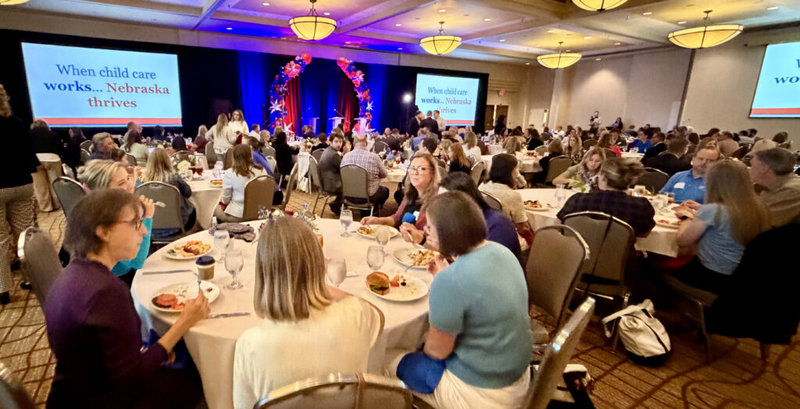
A new statewide campaign and coalition, Child Care Can, launched Monday in Lincoln with an announcement and gathering of about 200 people. The coalition, started with 65 member entities, will be focused solely on improving child care policy through recurring public investment. Organizers say next steps are developing specific strategies. (Photo courtesy of Child Care Can)
LINCOLN — Carrying and delivering twins didn’t take nearly the toll on Jessica Pallas as what came after: finding suitable childcare so she and husband Cale could hold onto their jobs and health insurance.
“Figuring out the childcare puzzle was more stressful than the pregnancy and the twins in the beginning,” said the first-time mom who lives in the small Nebraska town of Stromsburg with husband Cale and their daughters Merrick and Rowan.

The girls are now 3 years old, and their jigsaw puzzle of care looks different depending on the day and hour. Sometimes the twins are with a nanny at home. Some days they’re in York with Mom shifting them between a private preschool and a day care as she works remotely from a nearby coffee shop. One day a week they attend public preschool in Stromsburg.
“It’s wonky,” Jessica said.
But the wonky set the Pallases on a mission. They’ve done research. They’ve talked to many families. They said they recognize that childcare challenges date back decades, and they’re determined not to leave their daughters or grandkids with the same or worse difficulties.
So the couple has jumped into a new statewide campaign, Child Care Can, that launched Monday. Organizers describe the coalition as the largest ever formed – 65 entities so far — to focus solely on childcare policy in Nebraska.
The campaign defines its long-term goal: to secure recurring, robust public investment that increases access to affordable and quality child care so working parents can help grow economies in rural, urban and all areas of the state.
“Nebraska’s competitiveness depends on affordable, quality child care,” says the Child Care Can website.
Ranked 38th
The campaign is funded by Voices for Healthy Kids, an initiative of the American Heart Association, and the Alliance for Early Success. Early Futures Partnership, which includes Communities for Kids, is the organizational backbone.
Coalition members are led by a 13-person steering committee and range from child learning centers, colleges and YMCAs to economic development councils. Membership is diverse, including I Be Black Girl, Nebraska Indian Community College, the Nebraska Commission on Latino-Americans and the Center for Rural Affairs.
Specific strategies are to come later. Monday’s kickoff drew about 200 people and featured talks from business and childcare industry leaders, including the Aksarben Foundation, which has been focusing on how to turn around a lag in Omaha and Lincoln job growth compared with peer cities in other states.
Child Care Can organizers say child care should be viewed as infrastructure — foundational systems like roads, public safety and hospitals that allow communities and economies to function.
Elizabeth Everett serves as the campaign’s manager and says advocates in past years have done “tremendous” legwork to shine light and understanding on the child care challenge.
‘It’s a workforce issue,’ Nebraska lawmakers say of child care subsidy bill they advanced
This past legislative session, for instance, advocates pushed and state lawmakers adopted Legislative Bill 304 to permanently set household eligibility caps for childcare public assistance at 185% of the federal poverty level, rather than lowering back to 130%, as was the situation prior to 2021. That means eligibility for a family of four tops out at about $61,000 a year, compared with about $43,000 previously.
Nebraska’s childcare subsidy program is funded by federal and state funds, and early-childcare advocates say that as of the 2025 fiscal year, the state directs roughly $128 million a year in assistance. Families with a household gross income over 100% of the federal poverty level pay 7% of their gross income for childcare.
Everett said Nebraska currently ranks No. 38 among states for investment in childcare assistance.
Everett shared data points to reinforce the need for action. Among them:
- The statewide median cost for center-based childcare is between $9,000 and $15,000 per child annually.
- Since 2019, the number of center-based and family-based programs has declined by 4.7% and 22.6%, respectively. About three-fourths of young Nebraska children live in households where all available parents are working.
- Affordability and access difficulties annually lead to an estimated statewide loss of $64 million in state income tax revenue and roughly 6,800 jobs.
- Childcare workers make 52% of the average annual salary of all occupations in Nebraska, and annual turnover in the child care industry is about 20%.
What other states do
While Nebraska has made certain strides, Child Care Can leaders note that other states such as Montana, Iowa, New Mexico and Louisiana are going farther with “intentional” public investments in childcare strategies to grow their economies and to compete for workers, businesses and families.
Everett said states that are finding success in the childcare arena have in common coordinated and sustained advocacy efforts to help sway childcare policy.

“Nebraska will now have that,” she said of the Child Care Can campaign. Everett also is vice president of Early Futures Partnership, which oversees Communities for Kids and First Five Nebraska. She said creating the new campaign “makes an important shift from awareness to action.”
Montana, for example, recently created a state-driven trust fund to support early childhood education programs. New Mexico lawmakers established a similar fund in 2020, with about $300 million in seed money. That state designates a portion of surplus oil and gas revenues to help sustain the trust fund.
Iowa lawmakers recently passed a law making childcare assistance permanently available to childcare workers regardless of their income. Everett called the move a “huge workforce recruitment tool.” Nebraska failed to pass a similar bill.
State Sen. Eliot Bostar of Lincoln will work with the campaign as it explores ways for public investment.
“Nebraska has a role to play in building a stronger, more sustainable childcare system, but this is work we have to do together,” Bostar said. “By partnering with parents, childcare providers, businesses and communities, we can find practical solutions that help families afford quality care, help providers build sustainable businesses and help employers maintain the workforce they need.”
Everett said childcare providers are working long hours in businesses that can be difficult to sustain. She said quality childcare has become harder to find, afford and keep for too many families.
The Pallases said their search began early, when their pregnancy was about two months in. Jessica said she’d tell providers of her need and then it would come: a “big sigh” and “no space for two infants.”
When the girls were born, the Pallases hired college students as nannies. The cost essentially wiped out Jessica’s salary, but the family’s health insurance was provided through her job as an estimator for a Grand Island-based manufacturing company. She is able to work remotely. Cale works at his family’s agricultural feed sales company.
The couple, who met as students at the University of Nebraska at Lincoln — he’s 33 and she’s 31, knew they wanted to live in Stromsburg, where Cale grew up. But limited child care providers had them searching outside the town of about 1,100 population.
Eventually they landed spots in a nonprofit childcare center in York. Jessica estimated that 15 to 20 kids leave Stromsburg for York each day for childcare, about a 20-minute drive one way. She said her family loved their service provider there, but it shut down with only a two-week notice to families.
“We were really distraught to say the least,” Jessica said in an interview. The couple also spoke Monday at the campaign kickoff. They said sickness and health issues that required frequent attention were an added stress.
The couple found another York provider and more recently added preschool to the girls’ routines. Now two days a week, Jessica stays in York, performing work duties via computer at a local coffee shop, so she can tote the girls back and forth between daycare and preschool.
But the Pallases wanted their daughters to get to know Stromsburg kids as well, since that’s where they’ll go to kindergarten. On Wednesdays, Merrick and Rowan attend a preschool in their hometown.
They “make it work with a patchwork of solutions,” Jessica said. “Those are our babies. We love them to death. To put them in someone else’s care, especially when they are so little … it’s a lot.”
Childcare matters to business growth
Cale said improving childcare options matters to the growth of his family business. Currently he, his dad and another young man handle the operation, but plans include expanding by one or two workers as early as next year.

An area’s lack of childcare for young families can be a deterrent to recruitment and retention, he said.
“That can become such an insurmountable issue,” Cale said. “We as a business would never be able to attract the best employees to our community.”
The Pallases love their life in Stromsburg and are working to help strengthen the town’s long-term viability via their local community foundation. A listening session identified childcare as the top issue, they said. The pair plugged into the Communities for Kids network, which is key to the new Child Care Can campaign.
They pointed to reports from decades past that laid out daycare challenges. Jessica said she didn’t want her kids to inherit the “horror stories of worrying about childcare.”
“At some point we can’t just keep kicking the can down the road,” said Cale. “We wanted to be part of the solution.”
Lincoln, NE