CVS doesn’t deserve all to blame for the opioid crisis. But can we be honest about its complex role?
Aug 24, 2026 | 5:00 am ET
Description
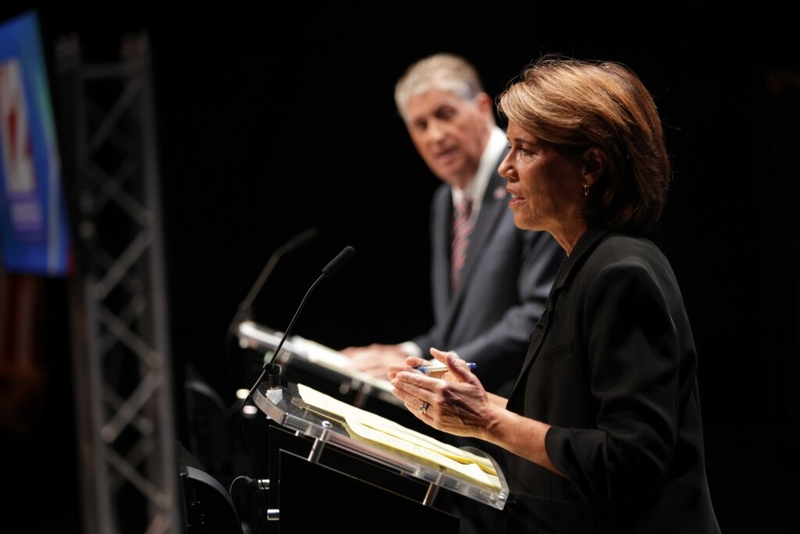
Democratic challenger Helena Buonanno Foulkes, a former president of CVS Health, makes a point while Gov. Dan McKee looks on during the WPRI debate at Sapinsley Hall at Rhode Island College on Tuesday, Aug. 18, 2026. (Photo by Corey Welch/WPRI 12)
Election years aren’t a great time for nuance.
I’ve been reminded of this as Gov. Dan McKee and Democratic challenger Helena Buonanno Foulkes head down the home stretch of their bitter gubernatorial primary rematch.
In particular, I’m concerned with how their arguments about the opioid epidemic — a “modern plague” that has claimed hundreds of thousands of lives, a complex ongoing public health crisis, the basis for some of the most complex litigation in American history — have veered into black and white territory.
If you listened to McKee — who has hammered Foulkes via websites, TV ads, social media posts, campaign statements, and debate remarks for her alleged ties to the crisis as a former CVS executive — you might think that CVS was solely responsible for the opioid epidemic.
This clearly isn’t true.
A long list of people, parties, or organizations share some responsibility for this crisis, including pharmaceutical companies, medical distributors, doctors, pharmacists, regulators, and insurance companies. Investigative reporting has pointed the finger at others: judges, consulting firms, the American Medical Association. We did not get into this mess because of any one company.
Meanwhile, when she’s not sharing her familiar talking points, Foulkes has strongly implied that sharp criticism of CVS is economically dangerous for the state. In the WPRO debate, she said Cumberland voters she met while door-to-door campaigning told her it was terrible what McKee was “doing to CVS.” Many of them work at the company, and don’t like it at all, she said.
She returned to this theme in their WJAR showdown. After mentioning that CVS and its 7,000 Rhode Island-based employees didn’t appreciate McKee’s attacks, she went further, citing a July statement from the executive director of Partnership for Rhode Island, a consortium of local businesses. “The 50 largest companies business leaders in this state wrote a letter to you, asking you to stop criticizing CVS,” she said. “You are going to drive them out of the state.”
Foulkes is not alone.
In June, Boston Globe columnist Dan McGowan argued McKee was “jeopardizing part of Rhode Island’s economic future” by his campaign’s “sustained attack” on CVS. Describing the Woonsocket-based giant as “one of the state’s most important corporate anchors,” McGowan suggested McKee ought to drop out of the race. In July, Providence Journal columnist Mark Patinkin called McKee’s attacks on CVS “cynical and self-serving” and described his criticism as a “dangerous game…of angering our biggest corporation.”
As someone who has reported on the opioid crisis for years, I am compelled to correct the record. Because while CVS may not be the only party responsible for the opioid epidemic, its role should not be ignored or dismissed.
Do the people rushing to defend CVS know that when the company agreed to pay $5 billion to settle thousands of opioid-related lawsuits, the Associated Press noted, “Only a handful of opioid settlements have had bigger dollar figures”?
Do they know that, in 2021, in Ohio, CVS and other chain-pharmacies lost a six-week jury trial over civil claims that the companies had fueled the opioid crisis?
Do they know about all the settlements CVS has reached over the years after U.S. Department of Justice investigations into various kinds of misconduct, from poor record-keeping to filling fraudulent prescriptions? $22 million in Florida? $8 million in Maryland? $5 million in California? $3.5 million in Massachusetts? And, after two separate cases — in 2015 and 2019 — a total of nearly $1 million here in Rhode Island?
Have they read the opioid-focused civil complaint against CVS and other chain pharmacies filed by Attorney General Peter Neronha in 2023? It reads, in part:
“[A]ccording to [DEA] ARCOS data, a CVS location in Wakefield purchased over 750,000 dosage units in 2014, in a community of 8,911 people. A CVS location in North Smithfield purchased enough dosage units of opioids in 2012 alone to supply 80 dosage units to every resident of the town.”
As someone who has reported on the opioid crisis for years, I am compelled to correct the record. Because while CVS may not be the only party responsible for the opioid epidemic, its role should not be ignored or dismissed.
When it comes to CVS and opioids, the situation calls for nuance.
CVS is by no means the only company implicated in the opioid crisis, as McKee might have you believe. It isn’t even the only chain pharmacy implicated.
But at the same time, it is true that the company contributed to the opioid crisis in notable ways.
Ignoring CVS’s role for the sake of how many people it employs or its economic impact is reminiscent of how we got into the opioid crisis in the first place. The subtitle of one medical journal article about the ill-fated marketing of OxyContin reads: “Commercial Triumph, Public Health Tragedy.”
But I hope that, whoever wins, we can return to discussing this crisis — which still claims hundreds of lives every year in our little state — as the complex, multi-faceted problem it is.
Flattening the issue may help a candidate gain a brief political edge. But it doesn’t serve the public.

Providence, RI