Oklahoma courts need to get with the 21st century and allow photos and video
Aug 24, 2026 | 6:29 am ET
Description
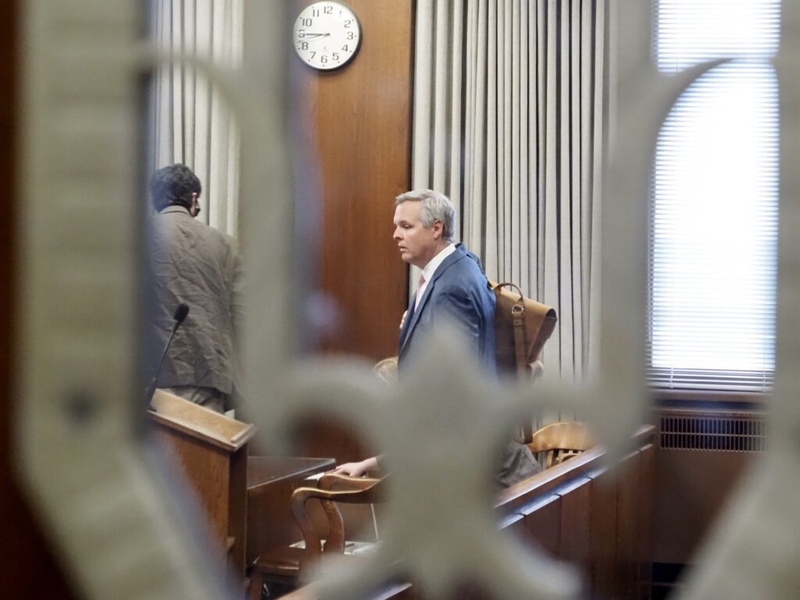
A photo taken from outside the courtroom of Epic Charter School co-founder Ben Harris arriving for a preliminary hearing Feb. 25, 2026, at the Oklahoma County Courthouse in Oklahoma City. (Photo by Nuria Martinez-Keel/Oklahoma Voice)
Last month, I found myself scratching my head – and not for the first time – that no cameras were in the courtroom to allow Oklahomans to witness the sentencing of restaurant owner Brent Swadley.
Public interest was high, as Swadley had recently been convicted by a jury of defrauding the Oklahoma Tourism and Recreation Department by generating fake invoices. A jury recommended he be sentenced to 10 years in prison and pay tens of thousands in fines. But it would ultimately be up to an Oklahoma County judge to decide his fate.
While the courtroom was packed with spectators, one thing was noticeably missing — cameras and recording devices.
That’s because our state’s judicial system stubbornly refuses to adopt healthy processes that allow for increased public access, understanding and accountability by routinely allowing recording and photography.
During most criminal and civil proceedings in Oklahoma’s courtrooms, there is generally no recording or photography permitted despite it being the year 2026 and technology ruling the roost everywhere else.
That’s why if you ever have the misfortune of being in the Oklahoma County Courthouse, you might witness photojournalists chasing people down hallways or see someone attempting to photograph a courtroom proceedings through a small window on the door of a courtroom.
There has been some movement toward transparency. The Oklahoma Supreme Court now offers an audio and video feed of oral arguments, but no still photography. And rarely you might find a judge who agrees to open his or her courtroom to photography or recording.
Largely, however, access remains blocked and the onus remains on media outlets to describe what’s happening in courtrooms or on everyday Oklahomans to take time out of their busy lives to attend proceedings in person.
It shouldn’t be that way, and we shouldn’t have a critical part of our democracy that too often remains shrouded in mystery.
I’m not the only one who has been wondering why Oklahoma’s judicial system is operating like it’s 1972.
Earlier this month, Scott Mitchell, while hosting his weekly political roundup for CBS affiliate News9, asked the two participants point blank if cameras should be in courtrooms. His question was prompted by a civil case playing out in Oklahoma County over how an insurance company is processing claims.
Mitchell said the “public can’t see what’s happening” during court proceedings.
“These are important issues that are happening in courtrooms,” he said. “Is it time for us to join the 21st century and have cameras in the courtrooms, so we can see what’s going on?”
The Democratic panelist, a lawmaker-turned-lobbyist, was disappointingly wishy-washy in his answer, but Sen. Paul Rosino, R-Oklahoma City, was blunt. It is absolutely time for cameras to be allowed in courtrooms to help with transparency, he said.
“We talk about transparency all the time,” he said. “The people of Oklahoma are educated. They understand what’s happening. They want to see it in real time.”
Oklahomans deserve to see court proceedings play out, and courts should not be immune from the same scrutiny that other public entities face.
Most law enforcement officers wear body cameras that allow the public to view the actions of the people they’re interacting with and their decisions. Oklahoma lawmakers also now stream all hearings and proceedings.
Courts should face a similar high bar of scrutiny because they’re also making decisions that change lives.
Unlike fictional television courtroom dramas that feature bombshells and loud arguments, civil and criminal courtroom proceedings in Oklahoma are often sedate and incremental. During civil and criminal cases that don’t require juries, oftentimes attorneys gather around a judge’s bench to argue in low-tones the merits of their cases.
It’s hard for spectators to hear. I know because as the plaintiff in an open records case against a state agency, I found myself sitting in the front row of a courtroom last month, struggling at times to hear the arguments for and against the release of the severance agreement we were fighting for. It’s so hard to hear that sometimes you’ll see older journalists sitting in the jury box next to the judge.
Before I moved to Oklahoma, I worked in Utah, whose judicial system has long had strong public transparency protections.
Like other states, it has a pool system in place for photography and recording. In journalism lingo, it means all media outlets are required to share broadcast feeds or still images of the proceedings.
Ahead of hearings, there’s a clear process in place for news outlets to apply for permission to shoot still photography or video of a proceeding.
The judge selects an applicant and fills out a form indicating what can and cannot be pictured. Usually the defendant, judge, prosecutor and defense attorneys are fair game. The victims, witnesses and juries are generally off limits, except in very limited circumstances.
A media liaison employed by the court system acts as the go-between and operates a private social media channel to communicate to media outlets which hearings will be covered and who will be the pool photographer. The judge determines where photographers should set up.
Anyone not selected can still attend, they just can’t record or photograph.
The process works seamlessly. The vast majority of cases receive no media coverage, but when someone needs access, it’s easily available.
That’s why you might have seen pictures of Tyler Robinson, who is accused of assassinating conservative activist Charlie Kirk, in court or seen clips of Robinson’s pretrial hearings on the news.
Utah is not the only state that has a formal process to help ensure public access. Many others do, too. Florida, for instance, allows cameras unless a judge finds a reason to bar them. The state also operates a channel to broadcast and stream newsworthy proceedings.
It’s puzzling why Oklahoma’s judicial leaders have not implemented a similar process.
It’s past time that they do something because Oklahomans are noticing in an era of social media and instant access that our judicial system operates differently than others. And I would say in an inferior way.
If our judicial leaders can’t figure out a solution on their own, it will only be a matter of time before our lawmakers do it for them.
Oklahoma City, OK