Why nuclear, why New Hampshire, why now?
Aug 24, 2026 | 5:00 am ET
Description
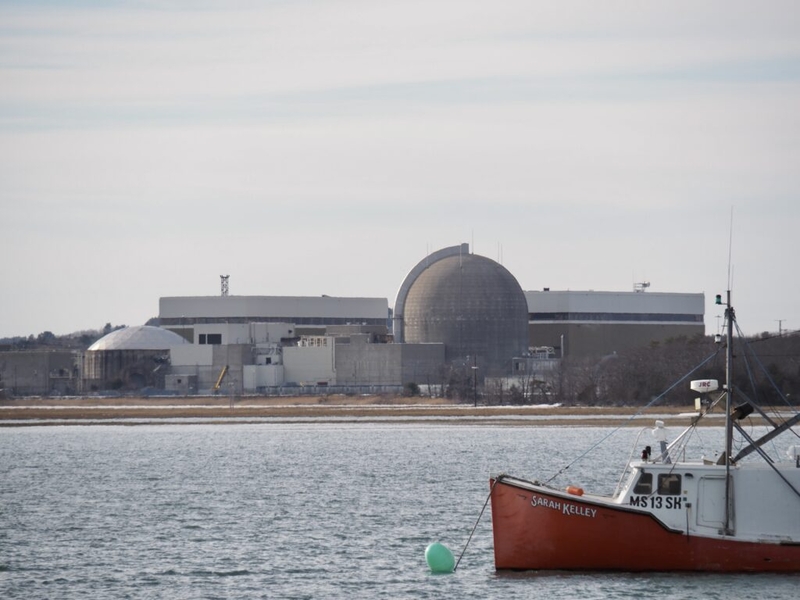
Seabrook Station nuclear power plant, viewed from across the Blackwater River. (Photo by Molly Rains/New Hampshire Bulletin)
At a moment of big changes in U.S. energy use and policy, with electricity bills pinching consumers and discussions on climate and emissions both high stakes and deeply politicized, New Hampshire’s executive branch has locked in on a vision for one specific path forward.
“What we do best right now looks like nuclear, and I think we can benefit from expanding that,” said Thomas Barrasso, director of energy innovation for the New Hampshire Department of Energy at a public meeting this June.
At the direction of Gov. Kelly Ayotte, the department has spent the summer pulling together a nuclear playbook for New Hampshire. The goal, as Ayotte laid it out in March, is to find a way to get more nuclear generators running in the state.
In the run-up to a preliminary September deadline for that “road map,” the discussion has brought in perspectives from some of New Hampshire and New England’s biggest energy institutions and regional experts. Yet, at a series of Department of Energy-hosted stakeholder sessions this June and in interviews with the Bulletin after, some hedged on whether nuclear can deliver all the benefits the region’s governors hope it will — while others openly contradicted that idea.
Meanwhile, the positivity of those driving the conversation forward, including the department, some state representatives, and industry players, hasn’t wavered.
The discussion sheds light on a unique moment, electrically, in New Hampshire, and on the array of problems — current and anticipated, local and global — still unsolved.
Governors stress rising price, demand
The road map project is one result of a March executive order in which Ayotte wrote investing in more nuclear power could lower costs for ratepayers and reduce emissions. Emerging nuclear technologies, she said, have the promise to be safer and more reliable than existing plants.
New Hampshire is already familiar with nuclear power. The Seacoast hosts Seabrook Station, one of New England’s two remaining nuclear power plants, owned by energy giant NextEra Energy Resources. And Portsmouth Naval Shipyard has long hosted some of the United States’ military nuclear submarines and the experts who work on them.
A few days after her March executive order, Ayotte joined governors from the rest of New England in a joint statement championing nuclear power. New England, they said, needs more electricity, and nuclear could provide it.
Electricity use in New England has been on the decline since the mid-2000s, thanks in part to increases in energy efficiency, according to ISO-NE, which operates the region’s electric grid. (Lately, New England has experienced “record” low levels of demand, said Eric Johnson, executive director of external affairs for the ISO, during a meeting in June.)
But now, he said, “we’re in an inflection point.”
The ISO now expects energy use to trend upward. There are several reasons for that change, one of which is the projected addition of large loads from data centers and cryptocurrency mining — things that aren’t yet prevalent on the New England grid, according to the ISO, but could potentially become so.
Other factors include the shift of high-energy sectors, like vehicle transportation and home heating, from direct fossil fuel use onto electricity.
But electrification doesn’t automatically remove fossil fuel from the equation. In New England, over 50% of electricity is generated with natural gas, according to the ISO. That links back to the cost concern raised by New England’s governors: Dependence on natural gas, according to the New Hampshire Department of Energy, is a major reason New Hampshire’s electric bills — and those in other New England states — often rank among the highest in the nation.
Those elements aren’t the only factors that explain New Hampshire’s high and rising electric rates. Intricacies and recent changes in the way energy is bought and sold in the region, and how rates are set, also contribute, according to energy professionals.
Promises and limitations
Nuclear energy is constant and reliable, Rep. Keith Ammon, a New Boston Republican who has pushed for more nuclear energy in New Hampshire, said during opening remarks at the June meetings. He added that the technology was changing, and that new reactors were safer, more flexible, and more cost effective.
“Nuclear doesn’t care about the weather. It just runs,” he said, comparing the technology to wind and solar power, which, with output tied to weather conditions, are considered “intermittent” power sources. (Clean energy proponents point to battery storage as a way to spread this power out over time.)
In terms of political palatability under the Trump administration, nuclear also seems to have the upper hand over wind and solar projects. While President Donald Trump has blocked offshore wind developments nationwide and elsewhere in New England, his administration favors nuclear energy and is pushing for widespread development with executive orders and funding opportunities for states and industry.
But how would it affect costs for New Hampshire consumers? At the June meetings, utility experts weighed in.
Additional electricity-generating capacity from new nuclear generation would indeed help New England as a whole meet rising demand, said Justin Pelkowski, director of wholesale power contracting for Eversource Energy, New Hampshire’s largest electric utility.
But zero in on New Hampshire, and the equation looks different, he said.
That’s because New Hampshire is already a net exporter of energy, generating more within its borders than residents and businesses use. Additional generation would simply increase the net amount of electricity sent out to the regional grid from within New Hampshire. And New Hampshire ratepayers, who would likely finance it, would not see a direct, local benefit, although there would be a regional one.
Because the New Hampshire grid does not want for power, additional generation would not fill a local gap — meaning it is less likely a company would see an incentive to choose New Hampshire to construct generation, Pelkowski said.
New Hampshire has little control over where the electricity generated in-state is sold. That’s because generators may contract with buyers out of state for their electricity. A proportion of the electricity generated at Seabrook Station, for example, is sold out of state.
“Just because an asset is located in the state of New Hampshire doesn’t mean we buy the energy or benefit from the energy,” said Rep. Kat McGhee, a Hollis Democrat, in an interview.
In McGhee’s view, this fact means that the idea of boosting in-state generation to immediately lower costs for New Hampshire ratepayers is a fallacy. But on the House Committee on Science, Technology, and Energy, on which McGhee is ranking member, other members “did not have that understanding,” she said.
Depending on where it is sited, a new facility could also trigger a need for significant transmission infrastructure upgrades to handle the added power, Pelkowski said. This would also affect rates.
According to the Eversource representatives, a new nuclear plant would not address New England’s reliance on natural gas, and thus high costs. Extensive buildout would be necessary to make a meaningful difference on high-demand winter moments, when gas is most constrained, that have the largest impact on bills, Pelkowski said.
“It’s not going to solve the issue,” Pelkowski said.
A financing dance
Courting more nuclear generation would also require finding a way to finance it.
Prospective generation owners are interested in security that they will recoup profits on an investment, said Michelle Gardner, executive director of northeast regulatory affairs with NextEra Energy Resources.
“The most important thing I want to emphasize is the need for long-term revenue certainty,” she said during the June meeting. “Developing nuclear is very capital intensive, and even on a SMR (small modular reactor) scale, it has a long development cycle, and there are still a number of risks.”
Developers are unlikely to move ahead with projects unless they feel certain they will recoup their investment, she said.
“No one, and I’m happy to be challenged, is going to develop nuclear without a contract,” she said.
But those contracts tend to be costly for ratepayers, said New Hampshire Consumer Advocate Don Kreis.
New Hampshire has laws designed to prevent capital projects from having an outsized impact on rates, some of which originated after the construction of Seabrook Station went massively over budget, bankrupting the utility Public Service of New Hampshire and leaving ratepayers on the hook.
More recently, the Vogtle nuclear plant in Georgia — the first new nuclear plant built in the U.S. in decades — finished $17 billion over budget, drove Westinghouse Electric Co. into bankruptcy, and left ratepayers with a heavy burden.
Kreis said he wasn’t convinced a project could be pulled off without a negative impact on ratepayers.
For new nuclear in New Hampshire, “nobody has demonstrated a good or even plausible economic case,” he said in an interview.
In the long-term — for instance, now that the cost of Seabrook Station has been paid off, and the plant continues to run — nuclear power can seem instantaneously inexpensive compared to other power sources. But the lifetime cost and initial impact are another thing, said Rep. Michael Harrington, a Strafford Republican.
“If you think you can sell to ratepayers the fact that we’re going to have a big increase in electric costs because 10 or 15 years from now it’ll seem cheap, well, I’ll sell you a bridge in Brooklyn,” he said during the Department of Energy meeting.
During a public comment period at the stakeholder meeting, some shared hope that the state would find a creative way forward to continue pursuing more nuclear.
“It’s clear to me in many, many discussions that there is a bipartisan acceptance that nuclear is the way to go,” said Rep. John Schneller, a Bedford Republican. “It’s certainly part of a larger solution.”
Others, including Doug Bogen of the Seacoast Anti-Pollution League, shared reservations.
Bogen said he was concerned about the financial, environmental, and safety impacts of new generation. One of those impacts, Bogen said, is the cost of directing funds to nuclear that may otherwise yield a more immediate benefit.
“If we’re going to spend billions of dollars promoting and building these nuclear plants, what are we not doing instead? Where are we missing out on renewable other sources, even efficiency improvements, that could save us a lot more money?” he asked.
To Bogen, the conversations at the three-day Department of Energy conference didn’t delve deep enough into the reasoning behind the choice to pursue additional nuclear generation over alternatives. He said the focus felt ideological.
“Are there real issues here,” he asked, “or is this just politics?”
Concord, NH