Alabama Community College System to join network expanding broadband
Aug 18, 2026 | 7:30 am ET
Description
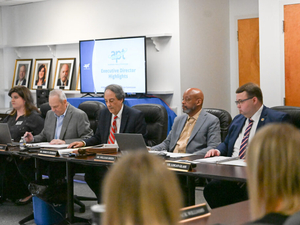
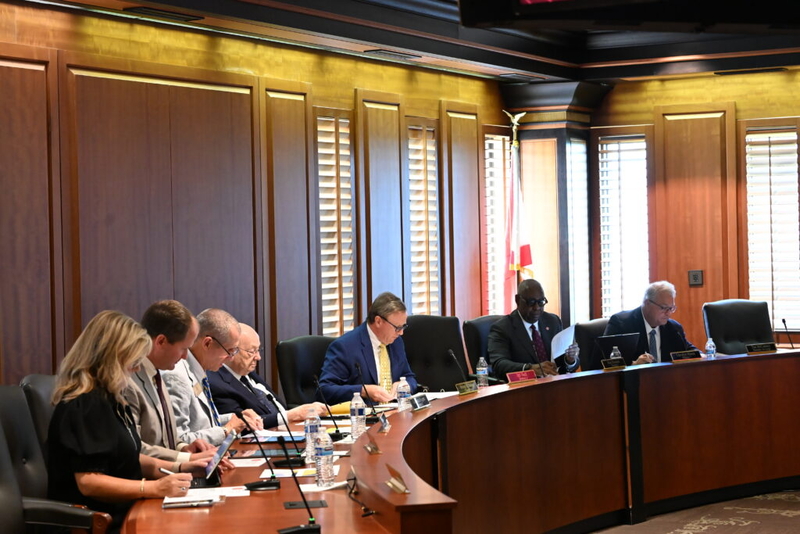
Members of the Alabama Community College System Board of Trustees as seen Aug. 12, 2026. (Andrea Tinker/Alabama Reflector)
The Alabama Community College System Board of Trustees said Wednesday that the system has joined a network that works with rural electric cooperatives to expand broadband service around the state.
Gadsden State, Lurleen B. Wallace, Northwest Shoals, Shelton State, Snead State, Southern Union and Wallace Community College-Selma are the first schools within the system to join the Alabama Fiber Network (AFN).
“This network gives our colleges the infrastructure to share resources, strengthen academic and workforce programs, and better serve students across the state while preparing us for the technologies of tomorrow,” said ACCS Chancellor Jimmy Baker in a statement Wednesday.
Clinton Bourgeois, assistant director of marketing and communications for ACCS, said in an email Monday community colleges were previously “capped at one (gigabyte) of data” and once schools join the AFN, they will have 10 GB available to use.
Sen. Donnie Chesteen, R-Geneva, the chair of the Senate Education Policy committee, said in an interview Friday afternoon The Alabama Anchor Institution/Middle-Mile Program, funded through the Alabama Department of Economic and Community Affairs (ADECA), serves as the backbone for the fiber network.
“That funding was supposed to connect our schools, our courthouses, our hospitals, our community colleges. That was the infrastructure or the backbone of the fiber network,” he said.
AFN’s website states the fiber network works in cooperation with ADECA and Be Linked Alabama, which is also done in collaboration with ADECA.
ADECA Director Kenneth Boswell said in a statement Monday afternoon the state’s investment in broadband is “paying dividends in communities across the state.”
“This partnership strengthens Alabama’s broadband infrastructure and will allow more Alabamians to gain access to vital online resources and learning tools,” Boswell said.
Ed Lawrence, senior vice chancellor of Information Technology for ACCS, said in an interview after the announcement that in addition to the faster Internet speed, the participating colleges will have the ability to connect with other colleges.
“One of the biggest things is having a private network that will be able to connect all the colleges together within each other, so they can communicate within their network,” Lawrence said.
ACCS said in a statement Wednesday the system aims for all 24 community colleges and technical schools to be integrated into AFN by the end of 2027.
Brock Kelley, president of Lurleen B. Wallace Community College, said in an interview after the announcement the higher Internet speed has been helping students with their educational and social lives.
“The strong connectivity means the most to us with our students because they’re, from both an educational standpoint, they’re able to get things done in a timely manner, and from a social aspect of it, they’re able to communicate effectively with their families back at home, especially when they’re staying in our dorms,” he said.
Chesteen said during the meeting he’s been working to expand broadband because he lives in a rural area.
“Geneva County is a rural county. We have more dirt roads than paved roads,” he said. “So my thought process began: if you’re using a divide in the classroom, and if you’re riding on a bus in Geneva County trying to get home on a dirt road, you get home trying to do your work. You don’t have service. So for me, that was the origin of where I began working on broadband as a member of the House.”
The colleges joining AFN will also serve as “community hub” providing Wi-Fi, public access and digital literacy training for vulnerable, rural or low income communities who lack Internet access.
Chesteen said providing those areas with Internet connectivity is the “last mile” for ensuring every region of the state has broadband access.
“That’s broadband equity access deployment funds, and this is going to be the last mile. So for all of those homes in rural Alabama that haven’t had connectivity into this time, that funding is going to provide the last mile funding for homes in rural Alabama,” he said.
Montgomery