The Voting Rights Act is down for the count. It’s time to think about what comes next.
Aug 10, 2026 | 5:59 am ET
Description
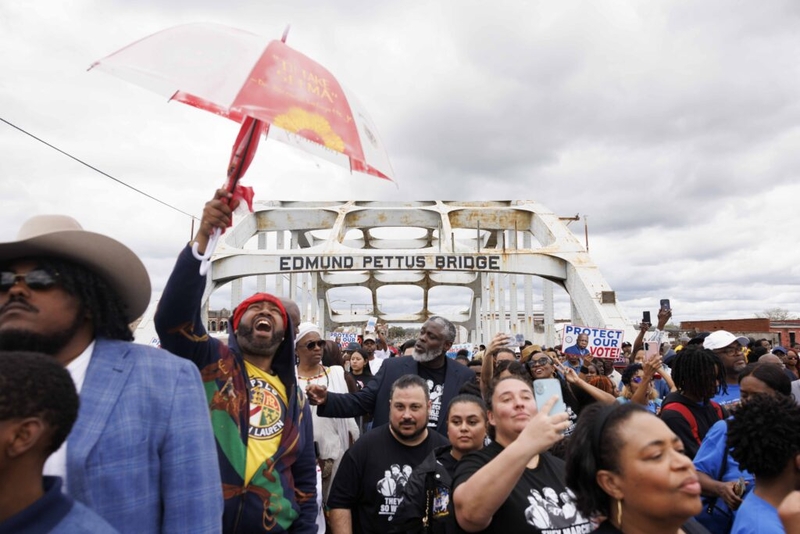
Marchers walk across the Edmund Pettus Bridge during commemorations of the 61st anniversary of Bloody Sunday in Selma, Alabama on March 8, 2026. The event was a catalyst for passage of the Voting Rights Act, signed by President Lyndon Johnson a few months after the attack. (Estela Munoz for Alabama Reflector)
We marked the 61st anniversary of the Voting Rights Act last week. But there’s little left to celebrate.
The U.S. Supreme Court this spring completed its decades-long project of nullifying the statute. The Alabama Legislature then threw out primary votes in four congressional districts and imposed a map the nation’s high court once judged to be racially discriminatory.
So we have a new round of primaries this week. All to reduce if not eliminate Black Alabamians’ ability to govern themselves.
Yet the work of democracy continues. It must. Something will come after the suffering, corruption and hypocrisy of this era.
And what follows could be worse. Not content with turning the clock back to 1962, a disturbing number of people would push it to 1932 and erase the New Deal.
If we want our era to be a warning for the future and not become our perpetual reality, we must do more than restore what was lost. The John Lewis Voting Rights Act, championed for years by U.S. Rep. Terri Sewell, D-Birmingham, would push us forward. But it cannot be the final step.
The last decade has made it clear: The country must thwart the would-be oppressors among us. And we must rethink a system that nationalized Jim Crow.
Judicial reform will be a major part of that. We cannot have a representative government with a federal judiciary that treats the political desires of one-half of the country as illegitimate.
But we also need to revisit how we vote.
I come back to Allen v. Milligan. That was the 2022 ruling that led to the redrawing of Alabama’s congressional districts and, for the first time in state history, two Black Alabamians serving in Congress at the same time. The Supreme Court rendered it a dead letter. It could not challenge the key finding of the three-judge panel that first heard the case.
Those judges (with two members nominated by President Donald Trump) noted that voting is racially polarized in the state. When white Alabamians (64% of the population) vote as a bloc, or when white politicians draw districts that make it impossible for Black voters (27% of the population) to build multiracial alliances, a quarter of the population gets locked out of government.
The Supreme Court, through cynicism or naivete, thinks that this is fine because it follows the strict letter of the law. The Milligan panel, a far less juvenile body, realized voting is meaningless detached from results. Its creation of the new 2nd Congressional District meant that Black Alabamians, for the first time in state history, had congressional representation that mirrored their place in the state population.
The new map cuts the Black Voting Age Population in the district from 48% to under 40%. That’s not insurmountable for U.S. Rep. Shomari Figures, D-Mobile, the current incumbent. But should he survive, Republicans in the Legislature will redraw the district again with the blessing of the U.S. Supreme Court.
The problem is the winner-take-all system. A government that allows an elected official to neglect or even attack 40% of the voters in a district hardly scans as a democracy. It’s a major reason people sour on government: They don’t feel represented.
So: Make sure everyone is represented.
Proportional representation creates multimember districts. Instead of one person taking a single seat, a party gets representatives based on vote share. If you had a district with five representatives and two parties that split the vote 60/40, one party would get three seats, and the other party would get two.
This would be a heavy lift. Democrats and Republicans have a lot invested in the system. You’d have to expand the size of Congress or the Legislature. The system itself would not in itself address racial polarization; in fact, if it were in place for the 2022 Alabama legislative elections, Democrats might have fewer seats than they do. (If it were the 2018 electorate, they’d have more.)
But proportional representation isn’t as foreign as we think. In several proportional representation systems, the voter chooses a party instead of an individual. With straight-ticket voting, that’s how more than two-thirds of Alabama voters already cast ballots.
More importantly, a voter could go to the polls with far more confidence that their vote mattered. And it would be far more difficult for the majority to tinker with election laws and the electorate to dominate. At a minimum, it would end an intolerable situation where candidates with mere pluralities can kneecap our basic rights.
That will be key to preventing a rerun of our current authoritarian experiment. A feckless Congress is bowing to the president in part because representatives come from districts where 15-45% of constituents have no voice. The Alabama Legislature sends your tax dollars to private schools and criminalizes voting assistance, confident there will be no repercussions.
The Voting Rights Act allowed Black southerners to be heard. Now we must ensure that their voices make it into the halls of power. Protecting the ballot isn’t enough. We must ensure that voting leads to representation. Otherwise, we’ll keep living under the rule of a minority that limits self-governance to an ever-shrinking caste.
Montgomery