The problem with going solar in Indiana
Aug 06, 2026 | 5:00 am ET
Description
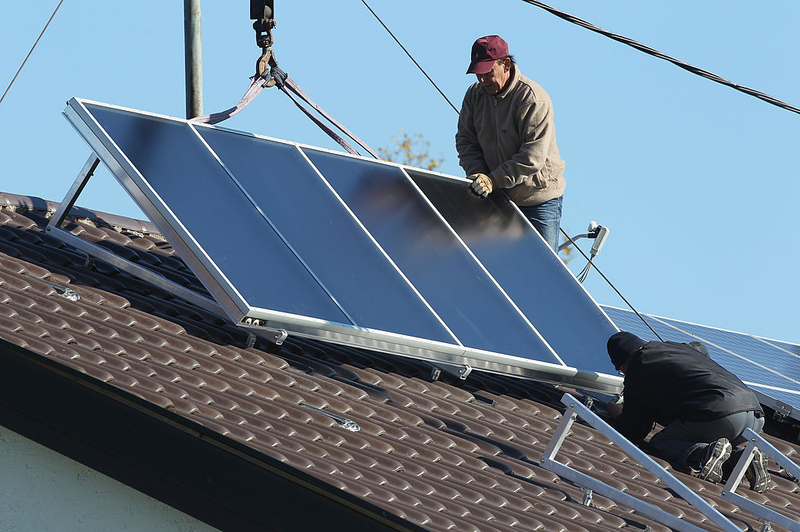
Workers install solar power modules for producing electricity on the roof of a house. (Alexandra Beier/Getty Images)
Over the past year, I have been noodling over the possibility of installing solar panels on my roof. This simple curiosity eventually turned into action — I got several quotes for what solar installation might cost. It was at that point that I discovered a 2017 Indiana state law that makes installing solar financially difficult for individual homeowners but quite profitable for electric companies.
I like the idea of being more self-sufficient. I like the fact that, once installed, solar panels provide pretty much free energy for my home that is healthier for our planet. And solar technology has become much better and more affordable over time. As climate author Bill McKibben put it on a podcast: “Sometime earlier this decade, we passed some invisible line where it became cheaper to produce energy from the sun and the wind than from setting stuff on fire.”
While it has become less expensive, installing a solar harvesting system is not cheap in the short term; especially after federal lawmakers abruptly eliminated the 30% residential tax credit at the end of last year. I would have to pay a lot up front for the ability to harvest free photons that would otherwise just warm up the shingles on my roof. Under fair economic conditions, that upfront cost pays for itself over time through drastically lower monthly power bills, eventually earning back every dollar spent and saving money for years to come.
Let’s look at what this should look like for an average Hoosier household.
The average Indiana home uses ~900 kilowatt-hours of energy per month. At an average cost of $0.15 per kWh, that equates to an average electricity bill of $135 per month (plus a $17 monthly customer fee, totaling $152 monthly) .
Indiana high court sides with utilities on solar power, ending benefits for small owners
To cover 100% of those energy needs, a family would need an 8-kilowatt solar system, which costs around $25,000 to install.
With fair energy policy, this system would essentially eliminate a family’s electricity charges, leaving them with only the mandatory monthly fee to the electric company required to be connected to the grid. That would drop their $152 monthly energy bill to $17.
At this savings rate, the payoff horizon is 15.4 years. Assuming a 30-year solar panel lifespan, a solar household would save around $23,650 in energy bills over the last 14.6 years of the system. All while releasing zero carbon dioxide into the atmosphere.
While that is how it should happen, a 2017 state law ensures that is not how it works in Indiana. Here’s why.
On a sunny afternoon in July, a home solar array typically makes far more power than the house needs, sending the extra electricity back to the neighborhood power lines. At night, when the sun is shining in Australia instead of Indiana, the family has to pull electricity back off the grid to keep the lights on.
Think of the power grid like a bank account: with a solar system you make energy “deposits” during the day, and make energy “withdrawals” at night. The system that tracks these deposits and withdrawals is called “net metering”.
In most states, if you deposit 20 kWh of power during the afternoon (as is usual on a typical sunny day), you get a full 1-to-1 credit to withdraw those same 20 kWh later that night. While states like Florida, Ohio, and Iowa protect 1-to-1 net metering as a matter of property rights and energy freedom, Indiana’s Senate Enrolled Act 309 created an artificial government price control that penalizes Hoosier families for investing in their own homes.
Passed in 2017, the law allows electric companies to harvest those same 20 kWh of afternoon power from you and immediately sell them to your neighbors for $3.00 (the full $0.15/kWh retail price), while crediting you just $0.70 (the discounted $0.035/kWh wholesale rate). When you pull that same power back out of the grid that night, they charge you $3.00 once again. That leaves the homeowner getting back less than 25% of the energy value they deposited just hours earlier.
This greatly changes the financial math for solar energy in Indiana. Rather than reducing the previous $152 monthly energy bill for a solar owner to $17, this net metering boondoggle means that the average solar owner in Indiana still pays $85 monthly. That pushes the payoff horizon to over 31 years, which exceeds the lifespan of the panels entirely. Instead of saving tens of thousands of dollars, Hoosier families actually end up taking a $900 net loss on their investment.
The $23,650 of potential savings that SEA 309 takes from solar households does not disappear into thin air. Those savings become profits for Indiana electric utilities and their (mostly) out-of-state shareholders. Funded out of the pockets of Hoosiers. It’s time for the General Assembly to repeal SEA 309, restore fair 1-to-1 net metering, and give Hoosier families the right to benefit from their own private property investments.

Indianapolis, IN