Nate Morris jumps through last hoops before confirmation as ambassador to Colombia
Aug 06, 2026 | 5:30 am ET
Description
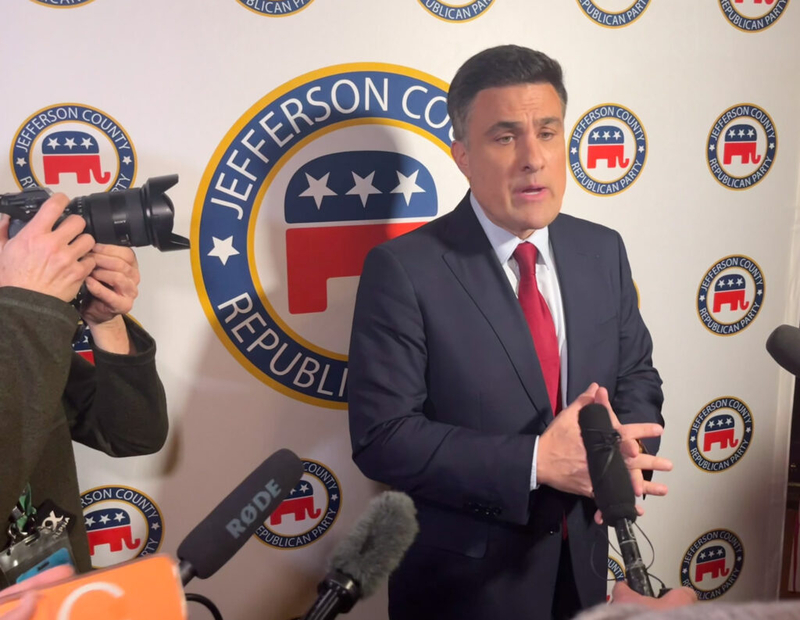
Businessman Nate Morris takes questions from the press after a Jefferson County Republican Party debate for U.S. Senate candidates. (Kentucky Lantern photo by McKenna Horsley)
On Wednesday, Nate Morris jumped through one of the last hoops to become the next U.S. Ambassador to Colombia. Morris answered questions from the Senate Foreign Relations committee, in preparation for a committee vote that will send his nomination to the full Senate. Morris is a native Kentuckian, a successful businessman, and a popular figure on the ideological right. How common is it for a person of his profile to become a United States ambassador? More common than most think, and much more common in the past two years.
Career vs. political
Assuming he is confirmed by the full Senate, Nate Morris will become what is colloquially known as a “political ambassador,” as distinct from a career diplomatic professional from the US Foreign Service. Political ambassadors serve two main purposes. The first is to reward major donors and political allies with what amounts to patronage. The second is to convey to a foreign audience that the ambassador has a relationship with the President, and is thus to be taken seriously. In practice this means that political ambassadors fall into two camps; major political figures dispatched to manage extremely important diplomatic relationships, and underqualified friends of the President sent on extended vacations to safe, pleasant places. In both cases, career diplomats backstop the ambassador’s lack of experience and expertise, ensuring smooth functioning regardless of who formally heads the mission.
Changes under Trump
Every modern President has nominated a mix of political and career ambassadors. President Trump entered office in 2017 with a hostile relationship towards the professional foreign service. Accordingly, in his first term the percentage of political ambassadors jumped from about 30% of the total to 43%, representing a significant change but not necessarily a full break from previous practice. By contrast, since resuming the Presidency in January 2025 some 90% of Trump’s ambassadorial appointees have come from the political side, representing a huge shift in diplomatic practice.
Moreover, Colombia had historically been regarded as the sort of country that requires a professional, career ambassador. The complexities of the security relationship with Bogota, Colombia’s proximity to Venezuela, and the country’s role in the international narcotics trade have convinced most recent Presidents to appoint career Foreign Service officers to the position. The appointment of Morris thus represents a break not only with longtime staffing practice, but also with how the US government has viewed its relationship with Colombia.
Previous ambassadors from Kentucky
Morris is hardly the first political ambassador to hail from Kentucky. Just this century, Matthew Barzun served as Ambassador to the United Kingdom and to Sweden; William Farish served as Ambassador the UK; W.L. Lyons Brown Jr. served as Ambassador to Austria; Catherine Todd Bailey served as Ambassador to Latvia; and Kelly Craft served as Ambassador to Canada and to the United Nations. In addition, career diplomats Christine Ann Elder served as Ambassador to Liberia, and Greta Holtz to Oman.
Indeed, Morris is not the first Kentuckian to serve in an ambassadorial role in Colombia. Three Kentuckians in the first half of the 19th century – Richard Clough Anderson Jr., Thomas P. Moore, and Robert B. McAfee – served in diplomatic roles to what would become Colombia, although of course 19th-century diplomatic practice was much different than modern diplomacy.
The nomination process
Nate Morris was nominated for the position of Ambassador to Colombia on June 1, 2026, and was interviewed by the Senate Foreign Relations committee on Wednesday, August 5. A vote to send his nomination to the full Senate should come soon. His nomination as ambassador came as payback from President Trump for dropping out of the 2026 GOP primary for US Senate, clearing the field for Representative Andy Barr. While the open nature of the quid pro quo raised eyebrows, it did not violate federal law and likely will not affect the course of his nomination.
There is little reason to believe that Morris will struggle in either the Foreign Relations committee or the full Senate. Whether he will excel as an ambassador in such a difficult posting is a different question. Veterans of the Foreign Service are replete with stories of bad or inept behavior from political appointees, ambassadors who normally serve in far less critical positions than Morris. Moreover, with the Foreign Service strained by resignations and by the unusually large number of political ambassadors appointed during the Trump administration, Morris may lack some of the support that amateur diplomats normally receive. Still, Nate Morris is an important political figure in his own right, rather than a used car dealer who donated enough money to catch the President’s interest. Morris’ tenure as Ambassador to Colombia will be a key test of his future viability as a candidate for political office.
Frankfort