Housing forum for South Omaha turns to immigration-related concerns
Aug 05, 2026 | 7:53 pm ET
Description
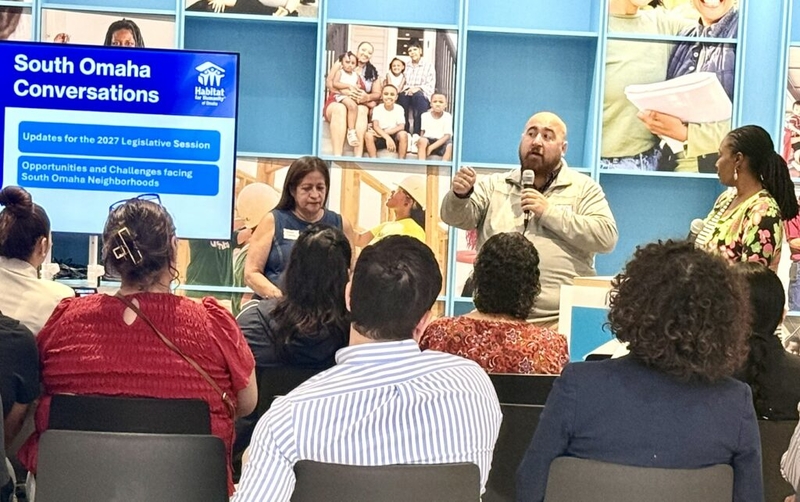
Nebraska state Sens. Dunixi Guereca, speaking, and Margo Juarez, both of whom represent South Omaha neighborhoods, were featured guests at a Habitat for Humanity of Omaha gathering Tuesday evening intended to hear what is on the minds of South Omaha residents. (Photo by Cindy Gonzalez/Nebraska Examiner)
OMAHA — A South Omaha-focused forum hosted by a nonprofit housing agency drew about 80 people and provoked concerns ranging from a need for more “blue-collar” jobs, affordable houses versus apartments and local voices on public boards and in policy-making offices.

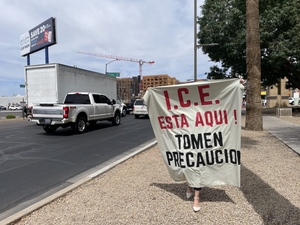
But the most impassioned discussion centered on treatment of immigrants — including community fallout from ramped-up detentions as well as what some described as rent gouging of newcomers.
Organized by Habitat for Humanity of Omaha, the event was part of its “Key Conversations” series that connects residents and their public representatives in a quest to build stronger communities. Recent other meetings highlighted as a speaker Mayor John Ewing Jr. and, on another occasion, North Omaha lawmakers Ashlei Spivey and Terrell McKinney.
Tuesday night’s event featured state Sens. Margo Juarez and Dunixi Guereca, whose constituents include South Omahans. Business owner Jamie Gutierrez helped moderate. Habitat homeowners and staff also spoke about the road to attaining homeownership.
‘Impacts the economy’
Ricardo Castro, a South Omaha Realtor and business owner, was an audience member who raised concerns about homeowners and even landlords who he said increasingly are being detained and deported.
Castro, in an interview, elaborated on migrants he knows who recently were stopped at South Omaha gas stations and apprehended by immigration agents, leaving little to no time for them to resolve issues about homes, properties or businesses they’ve invested in.
“It’s happening more often,” he said, adding that enforcement tactics have stoked fear and disrupted commercial activity.
Both Guereca and Juarez, noting that they represent areas recognized as historical landing places for immigrants, said it was not surprising that conversation pivoted to the impact of heightened enforcement during President Donald Trump’s second term.
“It’s something that people are living,” Guereca said after the meeting, adding that fear and impact ripples to employers, church congregations and neighborhoods. “It’s absolutely going to be front of mind.”
Said Juarez : “It impacts the economy, no doubt about it.”
The two lawmakers, both in the second year of their first four-year term, told the group that immigration-related bills each had introduced were squelched in committee before reaching debate on the legislative floor.

They spoke of their frustration in trying to advance such state legislation and said it was important for advocacy groups and others to continue to educate migrants on their rights and for residents to raise their voices.
“The reality is that in Lincoln and in D.C., they are not friends of the immigrant community,” said Guereca. “We have to be our own friends. We have to be our own support system.”
One stalled bill introduced by Guereca focused on local and state law enforcement agencies entering into 287(g) agreements with the federal government to enforce immigration laws. The proposal required prior notification to a local governing body and called for a public hearing.
Col. Bryan Waugh, who leads the Nebraska State Patrol under Gov. Jim Pillen, said during a public hearing earlier this year that those new requirements could “unintentionally hinder public safety operations, delay time-sensitive decision-making and create administrative burdens.”
Also this year, Juarez introduced a bill to stop mask-wearing by immigration agents in Nebraska. A similar proposal came from state Sen. Megan Hunt of Omaha, who said legislation also would stop ICE impersonators from concealing their faces to try to commit crimes. Both proposals died in committee.
Juarez spoke about a bill she made her priority last year, which in part sought to allow immigrants who have legal permission to work in the U.S. but lack permanent residency access to unemployment insurance benefits their employers pay into. That bill was crushed under the weight of a Trump administration threat that the state could lose hundreds of millions of dollars in federal aid.
Blue-collar workers
Shirley Robertson, who works with a local nonprofit that helps migrant families, said rental costs for some older houses are getting “out of control” and in some cases feel like “abuse.”
Longtime South Omaha native and merchant Marge Stoysich said she’d like to see more on-the-job training opportunities for workers who don’t go to college.
“What happened to good-paying jobs for blue-collar workers?” she asked. “We need more in South Omaha.”

Juarez said job creation or replacement becomes more of an issue with the shutdown of the WK Kellogg Co. production plant at 96th and F streets in Omaha. The closure was announced in August 2024 and layoffs have occurred in phases, with the final 450 workers losing jobs in July and August. The plant had operated since 1942.
Guereca, acknowledging that not all young people are college-bound, said part of the answer is “holding accountable” the Nebraska Department of Economic Development to help drive to the state a variety of jobs.
He noted there still are thousands of job vacancies in the Lincoln and Omaha area. He said he was frustrated on the campaign trail to hear big business and trade groups lament about a need for workers, yet people in his district say there’s no work.
“Let’s find a way to connect the community with those job availabilities,” Guereca said.
Nebraska needs population growth to fuel the economy and workforce, Guereca said in an interview. With domestic growth not meeting that demand, he said elected officials should look at reforming the immigration legal system.
Shape housing policy, neighborhoods
In response to a question from an audience member, he and Juarez noted the importance of representation on boards, commissions and local elected offices. Guereca recounted when certain Douglas County officials last year sought to rent part of the Omaha-based county jail to the U.S. Immigration and Customs Enforcement for use as migrant detention beds.
Roger Garcia, County Board chair and outspoken critic of ICE, led a movement to steer clear of that proposal, Guereca recalled, saying that reinforced the idea of representation and participation.
Gutierrez, CEO of Midwest Maintenance in South Omaha and member of the Habitat board, welcomed the variety of topics addressed during the forum at the agency’s headquarters in north downtown. She said such discussions help shape housing programs, neighborhoods and can lead to a more thriving community and state.

Lincoln, NE