US Senate candidates make final pitch to primary voters at Farmfest debate
Aug 05, 2026 | 8:45 pm ET
Description
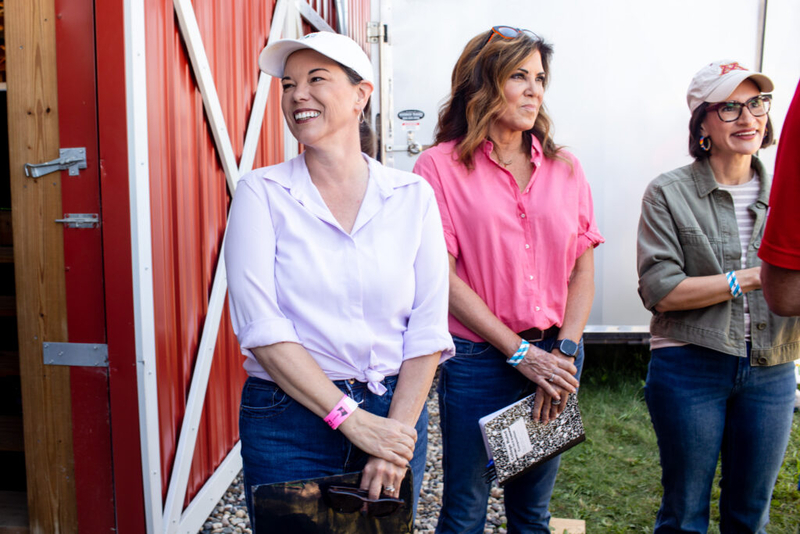
From left, Rep. Angie Craig, Michelle Tafoya, and Lt. Gov. Peggy Flanagan, prepare for the candidate forum for U.S. Senate at Farmfest in Morgan, Minn., on Aug. 5, 2026. (Photo by Nicole Neri/Minnesota Reformer)
MORGAN, REDWOOD COUNTY — If there’s one thing farmers can always agree on, it’s that times are tough.
The four leading Democratic and Republican candidates for U.S. Senate acknowledged the tribulations facing farmers at the annual Farmfest, during a final debate on Wednesday before the Aug. 11 primary.
Their assessments of the causes and cures of agriculture’s ills diverged significantly, however.
U.S. Rep. Angie Craig, Democrat of the 2nd District, and Lt. Gov. Peggy Flanagan, the DFL-endorsed candidate, blamed the Trump administration’s across-the-board tariffs and the war in Iran for causing costs to soar and demand to crater. They advocated for passing a full farm bill rather than the skinny version moving through Congress.
Republican candidate Michele Tafoya, a former NFL sideline reporter, said overregulation was strangling farmers and that Trump’s trade conflicts would yield better deals down the road. Royce White, a former NBA player, said he wants to end farm subsidies and called the farm bill an example of “uniparty dominance.”
Although Republicans haven’t won a statewide office in two decades, many in the party see Tafoya’s Senate run as their best shot in years at ending their losing streak and foiling Democrats’ hopes of reclaiming control of Congress.
Yet they face the significant headwinds of running in the same party as a deeply unpopular president. While Trump has enjoyed strong support from farmers and rural voters overall, that support appears to be waning with persistent inflation and economic uncertainty.
Farmfest, the state’s premier agricultural expo, doubles as an important political stomping ground, where politicians try to court a crucial voting bloc perusing the latest seeds and agricultural machinery.
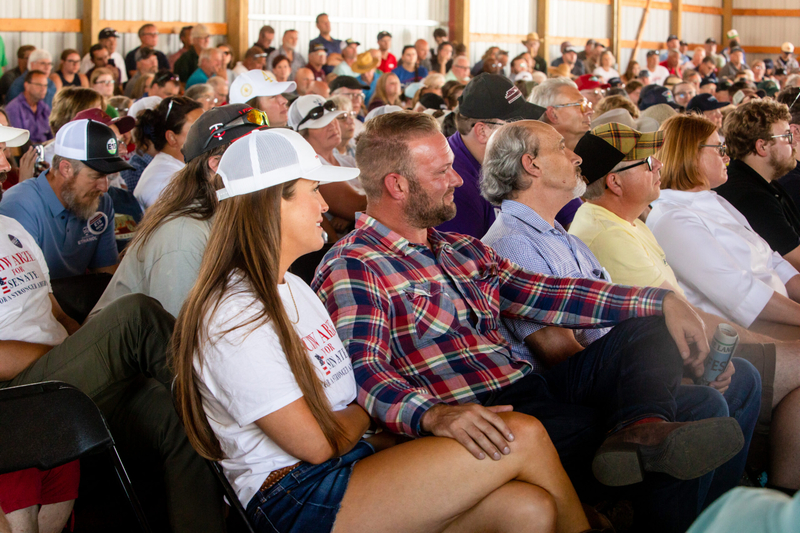
Adam Schwarze, the Republican-endorsed candidate, was conspicuously absent from the debate because he didn’t meet the polling threshold of 15% in an independent poll. In a July KSTP poll, just 5% of Republican voters said they supported Schwarze while 41% backed Tafoya and 10% supported White, who was down 5 percentage points from the previous month’s poll that qualified him for the debate.
Schwarze blasted the Farmfest organizers for excluding him, describing it in an interview with the Reformer as a ploy by the “D.C. apparatus” to tip the scales in favor of Tafoya. Schwarze issued a press release claiming the debate was canceled, but nevertheless watched it from a front-row seat with his supporters in campaign T-shirts.
Craig, Flanagan and Tafoya all said they supported allowing the year-round sale of E15 — gasoline with 15% ethanol — which would drive up demand for corn. White said only vaguely that “we have to deconstruct the administrative state.”
Craig boasted that she introduced the bill to permit E15 to be sold in the summer, which is prohibited because of smog concerns, and accused Trump of blocking its passage despite voicing support for it.
“The reason why we haven’t been able to get year-round E15 across the finish line is because the Trump administration is in the pocket of Big Oil,” Craig said. “They keep being Lucy with the football.”
Craig was able to show off the knowledge she’s developed as a member of the House Agriculture Committee, where she now serves as the ranking Democrat. She casually dropped in jargon like the need for a “12-title, five-year farm bill,” and decried the Trump administration’s cuts to “APHIS,” the acronym for the Animal and Plant Health Inspection Service, whose importance is magnified with the rise of the New World screwworm.
She said Trump’s trade wars have forced farmers to accept government assistance to stay afloat amid economic turmoil and uncertainty.
“What we need is good farm policy, not ad hoc assistance,” Craig said.
Tafoya acknowledged the pain global trade wars were causing farmers but framed it as a necessary sacrifice to secure more favorable long-term trade agreements.
“There should be short-term bridge assistance to farmers to get through those disruptions,” Tafoya said.
Tafoya blamed overregulation as the biggest impediment to farmers, and also hammered Democrats for the defrauding of social service programs — a topic Republicans aim to make the focus of the 2026 elections.
Trump’s push for mass deportation has hurt farmers, who rely on immigrant labor, though it remains popular among Republicans.
Craig and Flanagan both said they support providing a pathway to legal residency or citizenship to law-abiding workers in the country without authorization.
“I think we can have an immigration system where we have secure borders, but we also have an immigration system that is grounded in safety and dignity and humanity,” Flanagan said.
Flanagan also pointed to her biography — she’s the child of a single mother who used food stamps — to criticize the Trump administration for its cuts to the SNAP program, which is administered by the U.S. Department of Agriculture.
Tafoya said she supports expanding visas for guest workers under the bipartisan Securing Agriculture’s Workforce Act though said she does not support “amnesty.” White said all people in the country without authorization must be deported.
White, who was the 2024 GOP Senate nominee, avoided getting near the weeds of farm policy and instead spoke to larger right-wing themes like “uniparty dominance,” mass deportation of “foreign invaders,” and transgender athletes in women’s sports.
He did make one agricultural policy position clear: ending subsidies to farmers, which he compared to a heroin addiction.
“It’s never easy to get off the heroin, to get off the drugs. It’s no easier for farmers to get off of the subsidies from the federal government than it is for the welfare ward down in the Twin Cities,” White said.
In response to a question about using farmland for renewable energy and data centers, White said the Chinese Communist Party must be stripped of farmland in America and accused Democrats of suffering from “suicidal empathy.”
“The nexus between radical left Marxism, like my opponents at the end of the table, and radical Islam is the propensity to self-destruction and suicide,” White said.

Saint Paul, MN