Commission to assess tragedy of Black youth at former reform school holds first meeting
Aug 05, 2026 | 6:15 am ET
Description
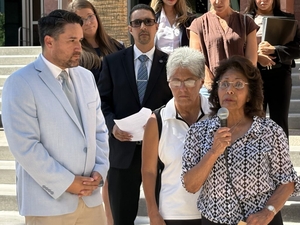
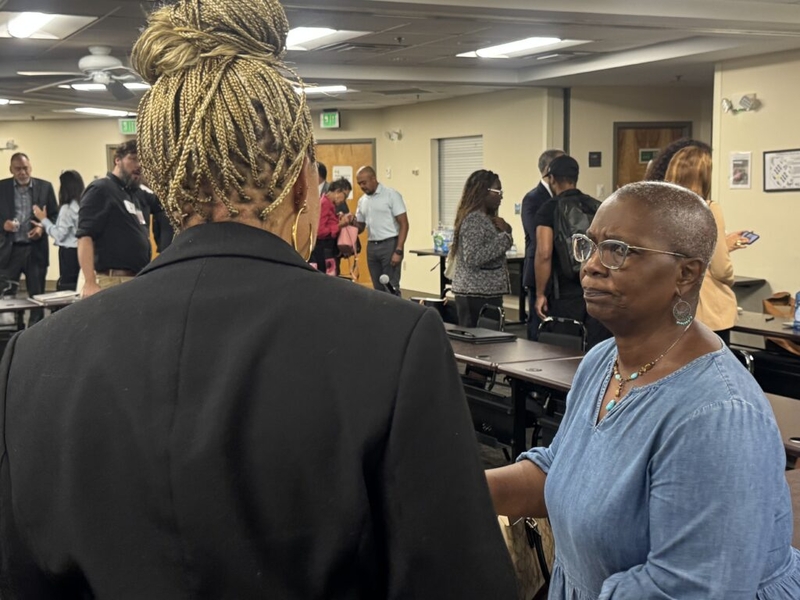
Linda Gorham, right, chats with Deputy Attorney General Zenita Wickham Hurley on Tuesday. Gorham's cousin, Richard Saunders, died in the 1930s at age 15 in the former House of Reformation in Prince George's County. (Photo by William J. Ford/Maryland Matters)
After visiting the site of a formerly segregated reform school in Prince George’s County where at least 230 Black youths are buried, Phyllis Hammond wrote a poem.
Hammond, 69, read “If these woods could talk” Tuesday, at the first meeting of the commission that has been charged with researching “the history, operations, and resident deaths” at the former House of Reformation and Instruction for Colored Children in Cheltenham. Hammond, one of nearly two dozen members of that commission, wrote the poem in honor of her uncle, Amos Hammond, who died at the age of 18 in 1921, and other children who died at the reform school.
“If these woods could talk, would they share how brutal and cruel they were treated by these corrupt authoritarians day in and day out without any justices in place to protect them from harm?” she said at the People’s Resource Center in Crownsville. “If these woods could talk, do you think they could share each of these young boys’ tragic lives and deaths while entrusted in the hands of the juvenile system?”
The commission’s goal is to “provide a complete and public accounting of the children who died and were buried on the grounds” of the reform school, located on land between the current Cheltenham Youth Detention Center and the manicured Cheltenham Veterans Cemetery along Route 301.
The commission was established through legislation sponsored this year by Sen. William C. Smith (D-Montgomery) and Del. Jeffrie Long Jr. (D-Calvert and Prince George’s). Both lawmakers are members of the commission, but were not able to attend Tuesday organizational meeting because they were in Annapolis for the last day of the special session considering a constitutional amendment on congressional redistricting.
Before members introduced themselves, Attorney General Anthony Brown (D), the commission chair, thanked those who volunteered to serve. Brown said that part of the commission’s work, thanks to more than $1 million approved in this year’s state budget and another $200,000, will be to secure a genealogical research contract.
“That contract is prioritizing one thing: Finding the names of the boys who died here and finding their families. That’s where we’re starting,” he said.
Brown also offered a warning about some of the initial findings by the state Department of Juvenile Services (DJS), that Black boys were used as manual labor, beaten, and worse.
“I want to prepare you. You’ll be outraged. You’ll be saddened. You may be horrified,” Brown said. “But I hope, I believe you’ll also be energized because these children are depending on us to do this work. Their families are watching.”
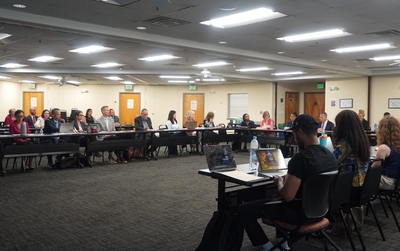
Crystal Foretia , who worked as a fellow with DJS and led the research into the 230 boys at the school that started in 1873, said Tuesday that available death certificates showed the majority of deaths at the facility were from tuberculosis, pneumonia, typhoid fever and meningitis.
But Foretia, a Montgomery County native and current Yale Law School student, said while during her PowerPoint presentation that researchers must dig deeper on official causes of death, assessing the living conditions of the youth, for example, and comparing the death rate to that at an all-white reform school.
That’s why Linda Gorham wants to know more about the death of her 15-year-old cousin, Richard Saunders, who died at the House of Reformation in 1939. Gorham, who will serve as one of 10 advisory members to the commission, said after the more than two-hour meeting that her cousin’s death certificate said he died of tuberculosis.
“But we heard today, it could be something else,” said Gorham, a licensed psychologist with two sons, ages 40 and 49. “Again and again and again, this trauma that’s happened to Black boys over and over and over again in our society. [Serving as a member] is about giving voice to Richard and the other children harmed.”
A preliminary report from the commission is due by Dec. 31, 2027, documenting the progress of the investigation, with recommendations to the governor and General Assembly.
The commission plans to visit the House of Reformation site sometime next month.
Anyone who may be family member or a descendant of a child who died at the House of Reformation can contact the commission at [email protected].
Annapolis, MD