NC auditor’s liaison advised county elections board members on how to fire directors
Aug 03, 2026 | 2:53 pm ET
Description
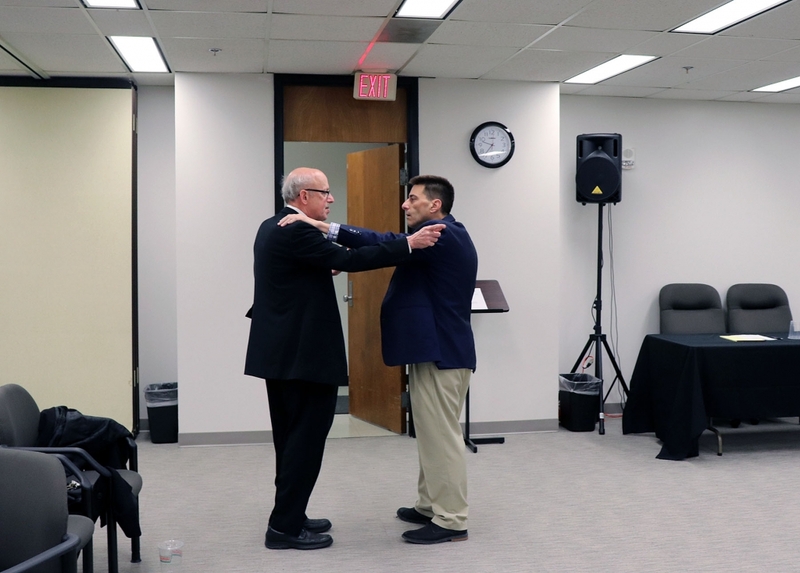
Gerry Cohen, who expressed interest in serving on the State Board of Elections and Ethics Enforcement, and NCGOP Executive Director Dallas Woodhouse talk Wednesday after the Board’s meeting in 2018 (File photo/NC Newsline)
Last fall, Republicans on at least two county boards of elections in North Carolina received instructions on how to fire their executive directors. Instead of getting advice from the state elections director or legal staff at the state office that generally serves as a resource for county boards, they received the information from Dallas Woodhouse, then an employee in the state auditor’s office.
Last September, Woodhouse sent GOP members of elections boards in New Hanover and Anson counties a step-by-step guide on documents they needed to collect, who they needed to talk to, and how to conduct a closed session. He included a template for the petition county boards would need to help justify their reasons for recommending terminations, to be sent to state elections Director Sam Hayes and his chief of staff.
“LIST REASONS. BE PRECISE. EXTREMELY FACTUAL. DO NOT ADD OPINION, ONLY LIST WHAT YOU CAN PROVE.”
Woodhouse’s advice on firings, with the email subject heading “County BOE Dir termination guide,” was revealed through a public records request by the progressive nonprofit organization American Oversight, which specializes in obtaining public records. The email sheds more light on the extent of Woodhouse’s interactions with Republicans who hold majorities on county elections boards.
Woodhouse said in interviews with NC Newsline that he never told counties to fire anyone, and that Republican board members asked him for advice as they were trying to resolve problems in their offices.
Other public records requests have surfaced Woodhouse text messages to county chairs on early voting locations and hours.
Email to Anson and New Hanover board members
Public records about executive director firings show that Woodhouse emailed the instructions to Anson County Board of Elections Chair Kelly Newton, New Hanover Board of Elections Chair Jamie Getty and member Beverly Setz.
Getty told NC Newsline she does not remember receiving the September 2025 email.
Newton and Setz did not return messages seeking comment.
But Setz responded to Woodhouse by email, saying she received the information and asked for a follow-up meeting that would include former county elections board member Bruce Kemp, a fellow Republican.
“Thank you, Dallas,” Setz said in a Sept. 23, 2025 email. “I will look over the material received, and I look forward to meeting with you tomorrow. In my short tenure, I have printed the emails sent to the Director, but I have received no satisfactory response. It would be beneficial for Bruce Kemp, who had been on the Board for 4 years before my appointment, to be included in the meeting. I am certainly willing to continue the charge.”
Woodhouse replied: “Bring anyone you want…its your dime.”
Kemp did not return a phone call from NC Newsline.
A GOP county elections board member said he was warned against voting for a campus polling site
Woodhouse said in an interview he did not think he met with Setz and Kemp. “I’m sure that meeting never took place,” he said in an interview.
State Auditor Dave Boliek hired Woodhouse, a Republican operative and former executive director of the NC Republican Party, to work with county elections boards as part of the newly created job of elections liaison. Woodhouse was reassigned in early July and resigned from the auditor’s office about a week later.
Woodhouse or the North Carolina Board of Elections?
Woodhouse said he offered the advice on how to fire executive directors because he believed that members of county boards could not turn to state elections staff for advice.
State law requires the state elections director or state board members to approve county boards’ requests to terminate local elections directors.
“They are the ultimate decider,” Woodhouse said. “It could be deemed as putting a thumb on the scale.”
In the past, however, county elections members have asked the state elections director for information on how to terminate county directors, said Jeff Carmon, a Democrat and member of the state Board of Elections.
The state director knew how to give county board members directions without pre-judging, Carmon said.
“Because the state board staff has attorneys and HR personnel, they are better equipped to guide without violating any laws or going beyond their authority,” Carmon said.
A spokesman for the state board of elections didn’t immediately respond to a request for comment.
American Oversight also received records about sessions over zoom that the auditor’s office held in October 2025 for new GOP chairs of local boards of elections. The agendas said the meeting would cover absentee ballot deficiencies, board processes for meetings on absentee ballots, vote tabulation and canvass.
The auditor’s office also held meetings for new board chairs in December. It posted information about those meetings on its website. Notices and information about the October meetings are not on the auditor’s office election transparency page, however.
Those meetings were distinct from trainings by the state Board of Elections, which hosts two conferences a year open to all members of elections boards, Carmon said, and also addresses issues that arise between conferences.
Woodhouse said the auditor’s office never tried to supplant what the state board does, and called any perception that the office was acting as a shadow board of elections “absurd.”
But these activities raise serious questions about the role of the auditor’s office in elections, said American Oversight Executive Director Chioma Chukwu.
“They show Dallas Woodhouse and other auditor office staff advising on the removal of nonpartisan election administrators, convening trainings for county election leaders, and positioning themselves as a key source of guidance on election administration — a role traditionally held by the State Board of Elections,” Chukwu said in a statement.
“Moreover, they were directing county boards to adopt partisan-biased early voting plans,” Chukwu continued. “That’s not how North Carolina’s election system is supposed to work. When political actors begin acting outside established lines of authority, it undermines confidence in the independence of election administration. North Carolinians deserve confidence that election decisions are being made through transparent, established channels by the officials entrusted with that responsibility, not through informal partisan networks operating behind the scenes.”
A resignation and a termination
Woodhouse was offering the guidance in September 2025, when Rae Hunter-Havens was the executive director in New Hanover.
Two weeks later, Hunter-Havens announced her retirement. A press release cited health concerns, according to news reports. She continued working for the county under contract until April 1 of this year.
The New Hanover elections board faced criticism over its late counting of absentee ballots in the 2024 election, according to the Port City Daily.
Hunter-Havens could not be reached for comment last week.
The Anson County Board petitioned the state board to remove Sherry Melton from the county executive director job earlier this year. The petition was successful, the Charlotte Observer reported.
Last month, Carmon requested the state board subpoena Woodhouse to discover the scope of his interactions with county elections officials. Board member Stacy Eggers IV, a Republican who was acting as chairman, shot down the suggestion.
Continuing revelations about Woodhouse’s activities reinforce the need for the board to find out all that Woodhouse did while working in the auditor’s office, Carmon said.
“It is incumbent upon us to get to the truth as to what was really happening,” Carmon said. “It seems every week, something new is uncovered.”
Raleigh, NC