Dark money, misleading claims flood Kansas ahead of judicial selection referendum
Aug 03, 2026 | 3:55 pm ET

Description
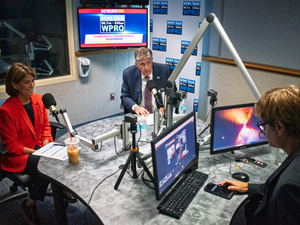
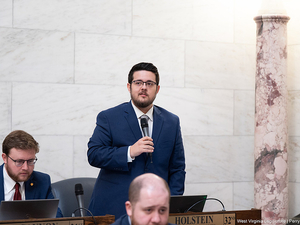
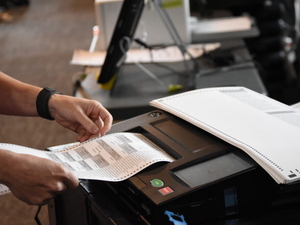
Donors have flooded organizations with millions of dollars ahead of the Aug. 4 vote on a ballot question that could change the way Kansas Supreme Court justices are selected. (Photo by Anna Kaminski/Kansas Reflector)
TOPEKA — Partisan donors have spent at least $12.8 million in Kansas on dozens of television ads and stacks of mailers, advocating for or against a ballot referendum that could determine the political temperature of the state Supreme Court for generations.
From county political parties to dark money mega-donors, Kansas’ “vote yes” and “vote no” campaigns are benefiting from millions in outside spending from high-profile financiers, seeking to influence Tuesday’s vote on a proposed constitutional amendment that asks Kansans if they want state Supreme Court justices to be selected by popular vote.
“Vote yes” ads have warned of “leftist elites” maintaining an unfair status quo on the bench. “Vote no” ads warn of “corrupt billionaires” seeking to control the court’s interests. Out-of-state backers have funded campaigns on both sides, according to state campaign finance records, up to July 20, the last campaign finance reporting date until October.
In Tuesday’s primary election, voters will choose whether to oppose or support a constitutional amendment that would, if passed, eradicate the current system of selecting Kansas Supreme Court justices and allow sitting justices and candidates for the open seats on the court to make political contributions and take part in political campaigns.
A “no” vote would maintain the current merit-based system. A nominating commission, which is made of up five lawyers who are put on the commission by other lawyers and four non-attorneys selected by the governor, chooses candidates to interview from a pool of prospective justices. The commission nominates three candidates, and the governor picks a justice from the three. Sitting justices undergo recurring retention votes in the next general election, and every six years after that.
Kansas has used the current system since voters established it in 1958. Thirteen states elect their Supreme Court justices in nonpartisan elections, and eight use partisan elections. Fourteen states, including Kansas, use merit selection, 10 use gubernatorial appointments, two use legislative appointments and four use a hybrid of elective and appointive methods, according to the Brennan Center for Justice, a law policy organization at New York University Law.
Ad claims
In a “vote yes” video ad paid for by Kansans for Democracy, a voiceover claims the nominating commission operates “behind closed doors, trading favors, rewarding friends.”
“The public can’t see it or control it,” the voice says.
In fact, the commission’s candidate interviews are public and broadcast on YouTube.
Anamarie Rebori Simmons, the communications director for Kansas United for Impartial Courts, which opposes the amendment, said Kansas’ merit-based system is “battle-tested,” and “constitutional experts from across the state select qualified, impartial justices.”
“Billionaire political donors are resorting to lies to try to trick Kansas voters in their desperate attempt to turn our qualified Supreme Court justices into politicians for sale. If this amendment passes, those same donors will be able to spend tens of millions of dollars on ads like this one to influence our courts,” she said.
Kansans for Democracy was the largest financial supporter of the proposed amendment. It is an organization funded with $1.7 million in donations from First Principles Action, a Nashville-based PAC founded in 2024 by the former executive director of the Republican Attorneys General Association. Both have ties to legal activist Leonard Leo, whose network of dark money nonprofits has filtered into state races.
Kansas United for Impartial Courts, which is affiliated with the American Civil Liverties Union and Appleseed, is the single largest spender in advocating for or against the ballot question. It has used rhetoric attempting to appeal to voters who want an unbiased court, and it has relied upon testimony in its ads from former Kansas Supreme Court Justices Carol Beier and Lawton Nuss, who have said a court established by partisan popular vote would be untrustworthy.
Elizabeth Patton, regional director for the Koch-founded conservative advocacy organization Americans for Prosperity, criticized the justices’ involvement. She said Kansas United for Impartial Courts has based its campaign in “deceiving voters that the current selection process is both impartial and non-political.”
“Former Justice Lawton Nuss was admonished for having meetings with lawmakers in active litigation, and former Justice Carol Beier had campaign fundraisers at her house. Members of the selection committee have said on the record that they make political calculations, not merit-based decisions in their nominations. The ‘vote no’ campaign is a campaign to continue this corruption,” Patton said.

Nuss was admonished by a disciplinary board in 2006 for violating the judicial code of conduct after he discussed a school finance case over lunch with two Republican state senators.
“This is all a matter of public record from 20 years ago,” Nuss told Kansas Reflector. “Kansans were aware of this information — and my dedicated judicial service — when they voted to keep me as chief justice of their Supreme Court in 2010 and again in 2016. Our constitutional process worked. But now billionaire political donors are trying to change that process for their own gain.”
A state ethics panel dismissed a complaint against Beier in 2016 after it found her husband hosted an event while she wasn’t home for 2014 Democratic gubernatorial candidate Paul Davis.
“This claim is false,” she told Kansas Reflector. “The judicial conduct commission examined and dismissed it many years ago. This is just another last-minute smear — trying to give billionaires power over our high court.”
Kansas United for Impartial Courts has dwarfed groups’ trackable spending on both sides of the referendum. The organization has funneled more than $8.5 million into advertising and advocacy against the proposed amendment, encompassing the vast majority of the “vote no” campaign’s roughly $8.7 million in spending. Ads have included sentiments for keeping the court “fair and impartial” and leaving money out of politics.
Various arms of the American Civil Liberties Union gave the organization around $4 million and Planned Parenthood Action Fund donated $1 million. Oklahoma philanthropist and Kansas City native Lynn Schusterman gave $1 million. Liberal activist George Soros’ Open Society Policy Center gave the organization $400,000.
Americans for Prosperity spent almost $1 million, and Your Right to Vote Association received $700,000 from the nondescript, Virginia-based Impact Mission Fund and $10,000 from Justin Hill, president of The Lawrence Paper Co.
From small donations — such as $306 from the Franklin County Central Republican Committee — to big spenders including Schusterman, the money spent on referendum campaigns in the past year is significantly less than what states that elect judges experience when partisan groups want to move the ideological bent of the courts.
More than $51 million was spent in 2023 in Wisconsin to flip the court’s majority for the first time in 15 years, according to the Brennan Center’s Douglas Keith. In 2025, billionaire Elon Musk waded into the state’s judicial election, and more than $100 million was spent that year, Keith wrote.
‘Squishy’ writing
Democratic Gov. Laura Kelly said after casting her ballot on July 27 that the amendment’s language and advertising about it have been confusing “on purpose.”
She said the constitutional amendment primarily is tied to two issues: Access to abortion and school finance, which the Legislature has unsuccessfully tried to challenge through the courts.
“The Legislature has never accepted the first ruling on either one of those, and so this is their way to change that and to give themselves the authority to decide these things,” Kelly said. “I just hope that people recognize that, and even through all the confusion that they know to vote no.”
The money that might enter Kansas judicial races concerns Barb DeSanto, who worries the biggest pocketbooks will change the courts. It can be difficult to identify the individuals who donate to organizations, adding to the challenge of understanding how voting is influenced.
DeSanto, who taught public relations and journalism for 35 years and retired recently from Kansas State University, reeled off a list of questions about the dollars that might come into the state.
She wants to know how donations will be accounted for, whether judges will have to disclose the donations as conflicts of interest if they’re hearing a case and how judges will get time away from the bench to raise funds.
As someone who taught public relations, DeSanto also watched advertising about the amendment with interest. The messaging has sharpened throughout the campaign, especially those ads that challenge people to vote no, she said.
The language in the amendment is confusing and some of the advertisements have been as well, DeSanto said. For instance, some ads say Kansans deserve the right to vote on judges, without explaining that Kansans do vote on whether to retain judges, which gives them input, she said.
The potential for millions of dollars to be spent by organizations outside the state to elect judges with certain partisan political leanings upsets DeSanto, who said she thinks the Citizens United court decision was one of the worst things to happen to the country. That 2010 decision allowed unlimited spending by nonprofits, labor unions and businesses to voice opinions about federal political candidates.
But ultimately, DeSanto said she’s worried people are voting on something that’s “not even real yet.” She criticized “squishy” writing in the amendment that leaves the process for electing judges unknown.
“This is a proposed amendment so you’re voting on something that hasn’t been written yet, and that’s misleading in itself,” DeSanto said. “Vote for this, and we’ll write the law. No, I’d rather you write the law first, and then I can read it and vote on it.”
Topeka, KS