Data centers emerge as top Alabama election issue as community concerns grow
Aug 03, 2026 | 6:01 am ET
Description
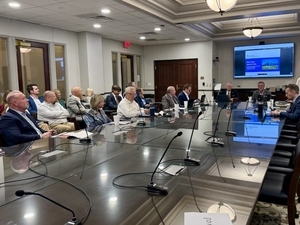
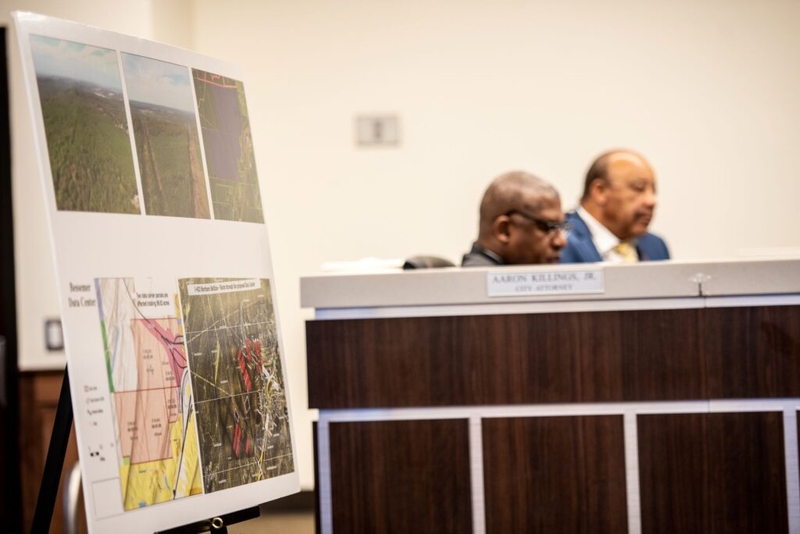
A plan for a data center is displayed before Bessemer City Council members during a hearing on Nov. 18, 2025 in Bessemer, Alabama. Data centers have emerged as a top issue for voters across ideological spectrums as environmental and public health concerns rise. (Andi Rice for Alabama Reflector)
Data centers have emerged as a top issue in Alabama’s midterm elections as concerns over public health impacts and a lack of transparency over the multibillion dollar facilities grow among communities and public health experts.
The facilities, which store digital data in servers, are not new to Alabama. There are dozens across the state, according to Data Center Map, a website that tracks the facilities across the nation. But experts and environmental advocates say the size and quantity of new artificial intelligence data centers raise significant worries.
“I think a huge thing that a lot of folks are concerned about is what I call quality of life issues. Whether it be noise, traffic, light pollution, or just changing the general characteristics of a community,” said Justinn Overton, executive director of Coosa Riverkeeper, in a phone interview Tuesday. “They want to hear cicadas over the hum of generators. They want to see the night sky, not the lights of a data center or some other extractive industry running business 24/7.”
The existing data centers are small, but the new or proposed centers, like Project Marvel in Bessemer, are as large as 18 Walmart Supercenters.
Transparency issues have also been significant. Bessemer’s mayor and attorney signed non-disclosure agreements with Project Marvel’s developer, Virginia-based QTS Data Centers, earlier this month.
Overton said the public must be part of the process of a project as large as that.
“When it comes to these data centers, the transparency around what they’re using is really important, and that’s why the public comment period is so critical for permits coming from our state regulatory agency, ADEM [Alabama Department of Environmental Management], because the community has an opportunity to speak up and speak out at that time when the permit comes on comment,” she said.
The transparency conversation does not stop at public participation, she said. According to QTS’s website, its data centers use close-looped water systems to reduce water usage for cooling servers. Kris Zierold, a professor of public health at the University of Mississippi, said in an interview Tuesday that most of the commonly-used pipes in close-looped systems are not good for humans.
“They also use corrosion inhibitors in the pipes, which we use a lot of times for copper and lead pipes to try to prevent lead from getting into the water,” she said. “In this case, I don’t 100% know what types of corrosion inhibitors they’re using, but some of the more common ones can actually not be good for us.”
QTS declined an interview on Thursday, but wrote in a statement that it uses municipal water in its closed-looped system and is committed to working with the community to “plan infrastructure responsibly while addressing local priorities and long-term needs.”
Candidates for the state’s highest office have differing opinions on how to address constituents’ concerns, but so do candidates in a Republican special primary.
Essential vs. Guardrails

Republican gubernatorial nominee Tommy Tuberville has embraced the technology, sometimes aggressively. He said earlier this month that “we’re going to do data centers.” The same day, he said the environmental and public health concerns are “bull crap.”
In a post on social media last week, he said domestic data centers are necessary to ensure Americans’ data is not stored abroad.
“But here’s the truth: We need somewhere to securely store our data. Otherwise, it will all go to China. We cannot let that happen,” the post said.
In a virtual press conference last week, he promised that Alabamians would not pay for any new data centers in the state.
“My pledge to every single Alabamian is that I will protect Alabamians from paying a single cent more for their energy as a result of a data center moving to their community. Not a single cent,” he said. “We’re going to do this the right way because I want to make sure that Alabama taxpayers get a great deal.”
Democratic gubernatorial nominee Doug Jones proposed a one-year moratorium on data center development at a policy address last week. The proposal, he said, was shaped by input at recent town halls conducted by the campaign.
“One year until we have guardrails and policies in place that protect our people and our communities,” he said. “Those concerns are not bull crap. They’re real and they’re being heard in communities across the South.”
Doug Jones calls for affordability measures, government reforms in policy speech
While data centers can bring in many local jobs during construction and a smaller number of long-term employment opportunities post-construction, Jones said the environmental impacts of data centers need to be understood before the large facilities are built in Alabama.
“I know that there are construction jobs and union support for building data centers. I know that data centers have the potential for providing badly needed revenue for local communities. But I also know that these projects have the potential of altering the environment and quality of life in the surrounding communities forever,” he said. “So we sure as hell can’t tell local communities to shut up.”
Two Republican candidates in the Aug. 11 special primary in Alabama’s 2nd Congressional District have similar disagreements.
Rep. Rhett Marques, R-Enterprise, echoes Tuberville’s position. At a recent candidate forum in Dothan, he said “they’re coming.”
“It is, I believe, up to the locals whether they want it or not. There are plenty of places in Alabama for a data center,” he said. “It should be up to the local counties and municipalities.”
David Matthews, another candidate in the Republican primary, compared data centers to taxes, saying he would not increase either one. His concern lies mostly in the impact of artificial intelligence on the job market.
“Send the data centers to Georgia or Mississippi, but we need to make sure that everybody is taken care of when whole swaths of jobs are lost in many different sectors,” he said.
Stephen Ansolabehere, a government professor at Harvard University who is an expert on public opinion and elections, said in a phone interview Thursday that treating data centers as inevitable is not a good approach.
“You want people to want a development, and you want them to embrace the job potential or the economic growth potential of building a tech hub around a data center,” Ansolabehere said.
Although data centers have emerged as a top issue in the governor’s race and congressional races, Ansolabehere said the biggest impact in November will be downballot. County commissions and city councils, he said, put the most pressure on facilities.
“There is a lot of energy on the Democratic side in unexpected places, like Iowa is a close election, and even places like Alabama where it has been pretty Republican now for a while,” he said. “The Democrats will probably do far better than one would expect in local politics.”
Environmental impacts
The lack of public participation in large developments has stirred communities across the ideological spectrum, but experts say the environmental impacts will go even further.
Zierold said there are not any population-based studies on the public health effects of the hyperscale centers. But she said existing scientific facts can help determine potential impacts.
“We know that it’s going to put out nitrous oxides, which cause all types of respiratory issues,” Zierold said. “We know those things from science, but the question is how much, how far. In terms of water, obviously, they use a ton of water. Any area that’s in drought, obviously, is going to cause problems there.”
Data centers operate continuously. Their back-up generators, Zierold said, are often run by diesel fuel, which is bad for both the environment and humans.
“There’s always a worse pollutant working to get these centers continuously running, but l the really sad thing is that they’re putting these centers in all over the place, and they’re not doing any science,” Zierold said. “They’re not saying, ‘OK, well, if you live within two miles of this, you’re going to be exposed to X.’”
Jilisa Milton, executive director of Greater-Birmingham Alliance to Stop Pollution (GASP), said in a phone interview Thursday that the particulate matter can get caught in the lungs or bloodstream. That can cause aggravated asthma and cardiovascular issues, according to the U.S. Environmental Protection Agency.
Milton said another concern is the possibility of the power needs of a hyperscale data center straining a community’s infrastructure.
“It takes many [generators] to power one of those things,” she said. “There’s a lot of questions about whether the power sources that we currently have can really maintain many of these facilities, and there’s not a lot of understanding about whether there’ll be power outages or whether there’ll be power surges.”
QTS’ website does not address the quantity of power it needs to run a center, only that it absorbs the cost of it.
The infrastructure concern also applies to water usage, even though data centers use a closed-loop system.
“One of the top-level issues with data centers is whether our infrastructure, including our water infrastructure and our power infrastructure, can handle that, and especially handle that without impacting current customers or the people that live here,” said Ryan Anderson, a staff attorney at the Southern Environmental Law Center, in a phone interview Wednesday.
Anderson said that while a moratorium is a solution, it’s a temporary one.
“People want their elected officials to act, and they want them to act now,” she said.
Struggles to regulate
Anderson said a moratorium like one proposed by Jones could allow the state to study data centers in other states and their impacts on the environment. But the state’s hands are tied when it comes to any new regulations that could come out of a study like that.
The Legislature this spring passed a law prohibiting the state from having stricter environmental regulations than the federal government.
If a federal regulation does not exist, the Alabama Department of Environmental Management (ADEM) cannot make a rule unless it is backed by “best available science.” The EPA said in June that it would not set any national standards for data centers.
“We can’t know the health impacts until somebody actually sits down and does a population-based study,” Zierold said.
If a yearlong moratorium was enacted, and a study found that data centers’ diesel-fueled back-up generators were impacting the air quality in Alabama and in turn negatively impacting Alabamians’ health, ADEM would not be able to change the state’s regulation unless it could prove a “direct causal link” between exposure to a substance and “manifest bodily harm.”
Environmentalists said during the legislative session that proving something like that would be impossible, calling it “witchcraft.”
Bill that could weaken Alabama’s environmental regulations speeds through Legislature
Anderson hypothesized that a study during a moratorium would give the state more information on data centers’ impacts on electricity and the power grid, which she hopes would lead to the centers steering away from diesel fuel.
“They should power their own way using clean, affordable energy, and not deepening reliance on fossil fuels,” she said. “There are also solutions in terms of transparency, where we can require public hearings about data centers, or votes from elected officials – who are beholden to the people – to decide whether or not to let data centers come to their community.”
She said that at its core, the battle over data centers is about quality of life for Alabamians.
“I almost kind of view the data center issue as a litmus test for us to figure out if elected officials are going to be beholden to industry like they often are, or if they’re actually going to be responsive to the needs of their constituents,” she said.
Overton said that she has seen data center concerns cross ideological boundaries in the state. Public officials and developers need to be transparent, she said, and there needs to be more time for the public to weigh in.
“Just because something is legal doesn’t always mean it’s moral,” she said. “I think it’s up to us to require accountability and responsibility from the people that are coordinating industries and the people that are our elected officials and our state regulators.”
The Key Points box was written by Anna Barrett.
Montgomery