Utah lawmakers face major Medicaid forecast problem that ‘smashed a hole’ in the state budget
Nov 23, 2026 | 7:01 am ET

Description
If lawmakers don’t find revenue to pay for higher Medicaid costs in the 2027 legislative session, they’ll need to consider cuts to services. (Illustration by Alex Cochran for Utah News Dispatch)
Utah lawmakers have a big budget problem they’ll have to deal with next year.
A nasty combination of higher healthcare costs, faulty forecasting models, accounting errors and other complex issues have compounded into a major, $175 million Medicaid budget deficit and about $242 million in additional future ongoing costs that Utah lawmakers will need to confront during their upcoming session set to start in January.
The Legislature can dip into rainy day funds specifically set aside for Medicaid, but that will only make up a portion of last year’s $175 million shortfall and close out the current year’s costs. And it’s not enough to fully account for higher ongoing costs expected for not only the upcoming 2027 fiscal year, but also future years.
So lawmakers are expecting a “brutal” year for social services budget requests. And if they don’t find revenue to pay for the higher costs, they’ll need to consider cuts to services.
The budget problem also comes as state officials in Utah — and across the country — are grappling with implementing tighter federal Medicaid eligibility requirements included in HR1, the major federal spending legislation passed by Congress last year known as the “one big, beautiful” bill.
States struggle to impose new Medicaid work rules, even with 6-month reprieve
Already, because of HR1, state officials estimate somewhere between 32,700 to 44,700 Utahns may lose Medicaid coverage.
But now, on top of that, state leaders must also deal with hundreds of millions of dollars in budget issues that could lead to more cuts.
Medicaid advocates including Nate Crippes with the Disability Law Center hope lawmakers find ways to address the issue without slashing services.
“Let’s not jump to cuts,” he said in an interview with Utah News Dispatch. “Given we’re already facing work requirements and people losing coverage because of HR1, I think further cuts at the state level are going to be really harmful and impactful.”
‘Smashed a hole’ in the state budget
After lawmakers on the Health and Human Services Interim Committee were first briefed on the issue in August, last week the powerful budgetary Executive Appropriations Committee heard more about what went wrong and how legislative fiscal analysts, the Department of Health and Human Services and the Governor’s Office of Planning and Budget are working to fix it.
During Wednesday’s hearing, House Majority Whip Candice Pierucci, R-Herriman, said that while she understood part of the problem was rising healthcare costs, what was most “concerning” is that it was also due to “egregious” accounting errors.
“As you know, this has smashed a hole in the budget for our next year, and (we’re) just trying to understand how this actually happened,” she said.
Pierucci also said as lawmakers have discussed the issue, “a lot of people have felt like that was a pretty big mistake” and they’re wondering how to prevent it from “ever happening again.”
“I mean, it feels like in the private sector, if something had happened like that, there’d be a change in personnel potentially,” she said.
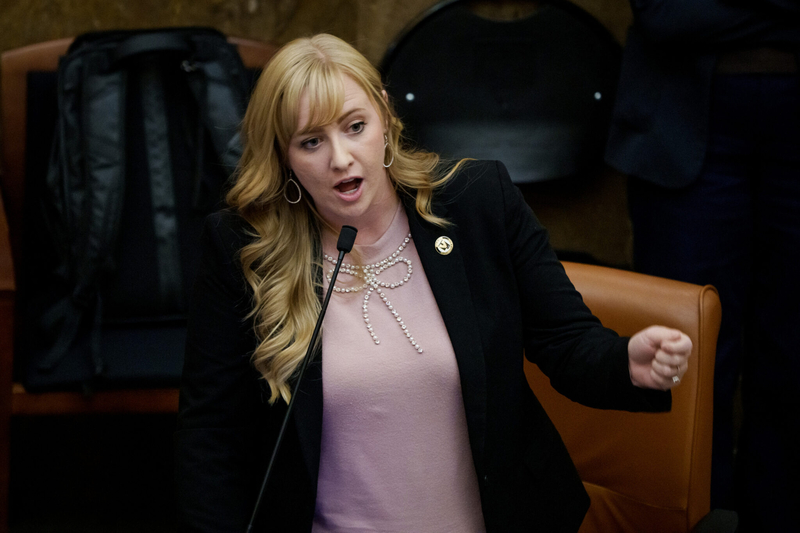
Senate Minority Leader Luz Escamilla, D-Salt Lake City, expressed concerns about potential cuts to Medicaid services due to the problem.
“I look at the people that are (involved) in social services appropriations, and that is going to be a brutal committee to be serving next year,” Escamilla said.
Pierucci asked Utah Department of Health and Human Services Commissioner Tracy Gruber about the department’s plan to fix the issue.
“We’re doing a deep dive in all of our Medicaid finance procedures and operations,” Gruber said, “and also ensuring that the team that we have in place have the right skills and competencies to manage arguably one of the more complex government programs that the state’s currently operating.”
What went wrong?
Utah Medicaid Director Julie Ewing briefed lawmakers on four main reasons why Utah’s Medicaid budget projections were so far off.
The first problem, she said, was the post-COVID-19 Medicaid “unwinding” coupled with rising healthcare costs.
During the COVID-19 pandemic, people enrolled in Medicaid could not be removed from the program, resulting in high enrollment numbers. When that public emergency ended, the state was then required to unwind that continuous eligibility requirement, which led to about 200,000 people being removed.
But even though enrollment went down during that unwinding, the people who stayed on had more acute — and therefore more expensive — medical needs, she said. Projections didn’t anticipate the needs of that population or their costs.
“So consequently we have a new Medicaid population that’s actually of a higher acuity, even though it’s smaller,” Ewing said. “And if you couple this with the nationwide healthcare inflation, cost per member per month went up, faster than the projected per-member, per-month costs that were in the forecast.”
Second, Utah’s health department implemented a new system called PRISM which acts as the “backbone of the Medicaid program.” It enrolls providers, pays claims, processes prior authorizations — “it does everything for Medicaid,” she said.
“The changeover to the new system temporarily disrupted many of those functions, which led to muddled data, and so DHHS was unable to see the emerging cost patterns,” Ewing said. “And additionally, without the data, proxies had to be used and assumptions had to be used. And these assumptions and proxies led to significant differentials between what actually came in.”
Third, Ewing said the state’s Medicaid program had “outgrown our legacy forecasting tools, which led to inaccuracies.”
The health department isn’t the only agency that forecasts the state’s Medicaid budget. It’s developed in coordination with the Legislative Fiscal Analyst’s Office and the Governor’s Office of Planning and Budget. All of those agencies were relying on a “very complex spreadsheet,” Ewing said, “which was not built to handle this level of program volatility that we experienced.”
The model also didn’t have the capability to adjust for “radical federal policy shifts, complex eligibility churn,” and it did not anticipate the higher acuity needs of the existing Medicaid members after the public health emergency unwinding, she said.
All these issues compounded, creating faulty forecasts for the real costs of Utah’s Medicaid program.
The fourth driver, Ewing said, was “several accounting errors that obscured both the final deficit amount and failed to account for ongoing” costs and accruals from previous years.
Legislative Fiscal Analyst Jonathan Ball said the bulk of the issue boiled down to “data quality and modeling quality.” He said to fix the problem, fiscal staff have “totally rewritten how we do the estimates.”

The budget hole
In total, Ball said fiscal analysts estimate Utah lawmakers will need to set aside about $346 million in one-time money to address last year’s $175 million deficit, as well as set aside enough money to finish off the current fiscal year and include a “buffer” in case costs overrun the new projections. Additionally, they estimate lawmakers will need to find $242 million in ongoing money to address future costs.
Where will that money come from? Ball noted the Legislature has rainy day funds set aside specifically for Medicaid totaling about $107 million, plus some other funds lawmakers deposited into an account after the state expanded Medicaid. Ball also noted lawmakers already set aside about $30 million in buffer funds for Medicaid that they can use to put toward last year’s deficit.
“So we can cover all of last year’s deficit with these rainy day funds and buffers, (and) we can cover a little bit more than half of the current year costs with those,” he said. “And then what you all will be left with is finding that other half of one-time (needs) and either reducing the future costs or finding revenue to cover that $242 million in future costs.”
Gruber said it’s “obviously a very challenging deficit in Utah’s Medicaid program.” But she added the deficit is “unfortunately, not unique to Utah.”
“About two-thirds of the nation’s states have a similar deficit in the Medicaid program,” she said, though she acknowledged Utah is also facing its own unique issues due to budget forecasting issues.
Utah’s Medicaid program has more than 300,000 enrollees, and the program is a “significant driver of the healthcare economy,” she said.
“We understand the importance of getting the Medicaid forecasting and accounting under control,” Gruber said.
What is being done to fix the problem?
Health department leaders have put together a plan to ensure Utah’s Medicaid budget problem doesn’t happen again.
That includes “modernizing” the Medicaid program’s forecasting, which Gruber said has already been implemented for the next fiscal year after working with the Governor’s Office of Planning and Budget and legislative fiscal analysts to come up with new methods.
Second, the plan calls for an “independent operational review” of major cost drivers in the Medicaid program to generate several policy recommendations for lawmakers to consider.
Third, they’re working on rebuilding the Medicaid program’s finance operations, including “ensuring that we have the right staff capacity and the right competency and the right technology to manage a very sizeable budget,” Gruber said.
As part of those efforts, DHHS leaders are requesting an additional $2.1 million and 21 full-time employees “to expand cost-containment competencies and anti-fraud IT tools,” according to their plan.
“We understand the challenge that this deficit is placing on the department and on the state,” she said. “We’re doing all that we can to prevent it from happening in the future.”
Rep. Ray Ward, R-Bountiful, is also working on a bill aimed at finding efficiencies within Utah’s Medicaid program, including ensuring the program isn’t overpaying on certain services.
“If there’s a service that we can still give people what they need in some way but not be overpaying for it, that would be much better than just cutting out a needed service,” he told Utah News Dispatch in an interview earlier this month. “That’s what we’re looking for.”
Ward said he doesn’t expect his bill will be able to take care of the full budget dent, but he’s hoping it will “add up to some significant portion of that.”
“I’m (working) to find as many things as I can that I think will still let people get the services they need,” he said.
Potential cuts
Ewing told Utah News Dispatch in an interview last week that DHHS is working with a consultant to do an “end-to-end review” of Utah’s Medicaid program, and they’ve offered up options for lawmakers as potential cuts.”
Lawmakers have also asked DHHS staff to make some specific recommendations, “and we’re currently working on that,” she said, but details of those recommendations aren’t ready to share yet.
However, Ewing noted that it’s important to remember that Utah’s Medicaid program also heavily relies on federal matching dollars, so if the state cuts funds, that could forgo an even bigger amount in federal funding.
“So, if you cut a dollar in state (funds), you’re not only cutting that dollar, you’re also leaving anywhere from $1.61 to $9 on the table in federal matching dollars that flows into the state,” she said.
If lawmakers want to do drastic cuts, like $200 million from the state Medicaid budget, it would actually cut much more.
“It’s really important that we convey that so that there’s not sticker shock at the end when providers are getting paid less and different things, in significant ways,” she said.
She also noted that any cuts could not happen quickly because federal law requires time before any cuts are implemented.
“Of course, we don’t want to see people lose access to care,” Ewing said. “But having said that, too, I think we also owe an obligation to lawmakers and taxpayers to come up with an idea of how we bend this cost curve.”
Editor’s note: The key points for this article were written by a Utah News Dispatch journalist.
Salt Lake City, UT