After NC lawmakers pull plug on civil legal aid, nonprofits are left searching for solutions
Aug 03, 2026 | 6:01 am ET
Description
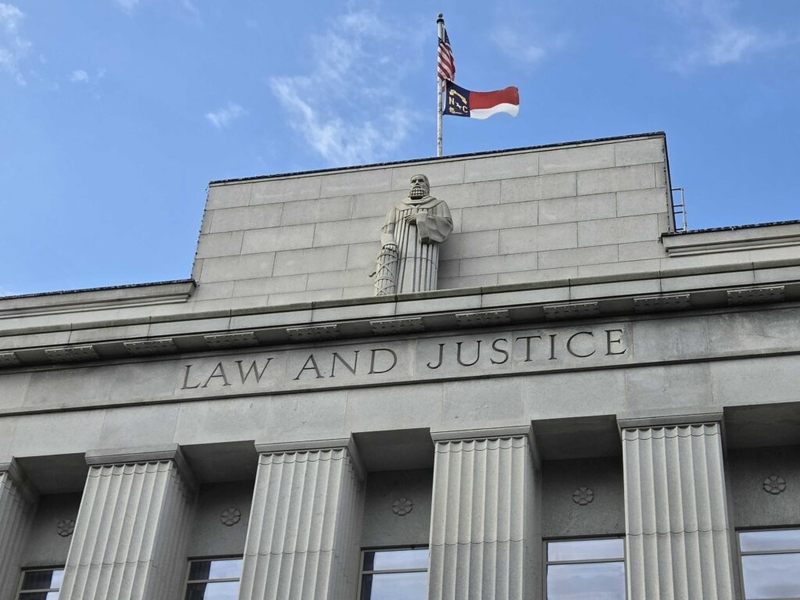
The North Carolina Supreme Court building, pictured on June 2, 2026. (Photo: Clayton Henkel/NC Newsline)
As Democratic lawmakers rose to attack the recent state budget plan put forth by the Republican leadership of the North Carolina General Assembly, they repeatedly brought up a somewhat obscure legal acronym vital to legal aid across the state: IOLTA.
“We put more money into our indigent defense system, and that’s great. It needs it. But it’s come at the expense of IOLTA funding going to legal aid organizations providing important civil legal services to poor people,” said Sen. Julie Mayfield, D-Buncombe, in a July 1 floor speech. “We’re helping poor people over here, and we’re hurting them over here.”
The Interest on Lawyers’ Trust Accounts program has for decades funded civil legal aid services across North Carolina until last year, when Republican lawmakers froze all IOLTA grants over concerns that the money was being used for political purposes.
After passage of the state budget, that freeze has become a complete elimination of future civil legal aid funding through IOLTA — an end to a grant program that legal aid nonprofits have relied on for more than 40 years.
Rural NC legal aid offices close after General Assembly freezes public assistance fund over politics
‘This is not the government’s money’
The new budget makes North Carolina the only state in the country that offers neither state funding for legal aid in civil cases nor financial support from IOLTA.
The money that went toward IOLTA’s grant program is generated as interest by pooled legal funds that attorneys are required to hold in trust. The funds, which are overseen by the North Carolina State Bar, are not taxpayer dollars nor are they revenue generated by the state government’s operations.
“This is not public money. This is money that is generated by interest on individual clients’ trust accounts,” said Peter Gilbert, who serves as litigation director for the North Carolina Justice Center. “This is not the government’s money, but they are asserting the right to control the board of it.”
The Justice Center was among the largest recipients of IOLTA funding, receiving a $1 million grant supporting a broad array of legal aid areas, including for housing, employment, public benefits, immigration, and consumer protections.

An April program audit by State Auditor Dave Boliek was unable to identify any instances of misused funds, finding that the program complied with all grant eligibility requirements. Despite this, he called for a massive program overhaul, condemning what he described as a lack of adequate oversight.
“As our audit shows, IOLTA grants are going to organizations with clearly partisan, political agendas,” Boliek said in a statement following the audit report’s release. “With IOLTA’s revenues and grant payments surging, it’s incumbent that the flow of dollars is met with additional scrutiny to ensure proper use.”
Acting on these recommendations, the North Carolina General Assembly eliminated the civil legal aid grants disbursed by IOLTA, leaving in place only grants intended to improve legal administration.
Legal Aid of North Carolina CEO Ashley Campbell said that while her organization and others pushed lawmakers to protect civil legal aid, it was ultimately House Speaker Destin Hall, R-Caldwell, an attorney himself, who could not be convinced.
“There’s strong bipartisan support for all of Legal Aid’s work, and we know that from the many conversations we’ve had with members on both sides of the aisle over the last two years,” Campbell said. “Ultimately, it was the Speaker who proposed these changes in the bill.”
Hall did not respond to NC Newsline’s request for comment.
Senate President Pro Tem Phil Berger, R-Rockingham, told members of the media on July 1 that members had “serious concerns about how that money was being utilized.”
“The legal aid entities have other sources that they can go to. I think there are some federal dollars that go into that. There are donations that can be made,” he said. “We have another issue that requires additional dollars that provides assistance to folks who can’t afford lawyers, and that is the privately assigned counsel.”
‘You are not eligible’
Beyond the removal of civil legal aid grants, the budget contains several other provisions that by themselves would bar the vast majority of past recipients from future awards, explicitly excluding groups that engage in a wide swath of civil legal matters.
“There are really four independent ways that this bill will cripple civil legal aid in North Carolina,” Gilbert said. “The thing to know about these restrictions is all of the organizations in North Carolina that have received in the past these civil legal aid grants engage in these types of activities.”
The bill creates a new NC IOLTA Board of Trustees made up of four members appointed by the state legislature, two members appointed by the chief justice of the state Supreme Court, and three by the council of the State Bar. It appears to eliminate the current board of trustees, which has overseen the funds for decades but which the bill makes no reference to.

Crucially, the bill redirects up to $15 million in IOLTA funds to state-run indigent defense services and up to $2 million to administration of justice grants, which focus on innovations to improve the efficiency of the justice system. It authorizes no funding for civil legal aid.
That leaves out over 90% of past grant recipients. In 2025, the last year IOLTA was permitted to issue awards, more than $11 million went toward civil legal aid, from disability rights and immigrant legal services to preventing domestic violence and expanding access to health care. Just $850,000 was issued in the form of administration of justice grants.
Finally, the budget imposes substantial restrictions on organizations that remain eligible for grants. They cannot perform work related to federal immigration law or transgender health issues. And they are also forbidden from performing any legislative advocacy that does not directly relate to their own existence or funding.
Legal Aid of North Carolina sought to educate legislators on the fact that a large share of their work related to immigration law is aimed at combating human trafficking in cooperation with law enforcement, Campbell said.
“We are going to continue doing that work, but if you engage in any immigration legal work at all, regardless of the type of work, you are not eligible for even the small grants that will now be made,” she said.
Gilbert said the increase in funding to indigent defense services — for which attorneys are only provided in criminal legal matters — in no way makes up for depriving civil legal aid of funding.
“What they’ve done is met their duty under the federal Constitution to fund a criminal defendant’s Sixth Amendment right to counsel,” Gilbert said. “What they’ve done is taken away private money to fund a public purpose that they were constitutionally required to fund already.”
‘We are providing basic needs’
Particularly hard hit will be Legal Aid of North Carolina, IOLTA’s largest grant recipient in 2025 at roughly $6 million. IOLTA had been the nonprofit’s second-largest funding source.
Campbell, the Legal Aid NC CEO, said in the interview that the organization was forced to announce the closure of nine of its offices because of the 2025 funding freeze, many of them in rural areas, and lay off around 50 employees.
“The biggest concern we have is that this is not a one-time impact,” Campbell said. “The funding was established by our state’s highest court for the purpose of civil legal aid, and it supported civil legal aid for over 40 years.”
Charlotte Center for Legal Advocacy CEO Larissa Mañón, whose nonprofit received $765,000 to fund legal aid for health care, housing, and immigrant justice, among other areas, said the new law reflects a misunderstanding of what civil legal aid is.

“The actual audit, if you read it, actually shows that all the organizations use the money exactly as intended and all organizations have reporting, have their own audits that they were required to complete as part of their own regulatory processes,” Mañón said. “We are providing basic needs for people who otherwise would be unable to afford them.”
At least some have stepped in to help remedy funding shortfalls. In Goldsboro, for example, Legal Aid of North Carolina was able to keep its office open after announcing a closure because a bipartisan group of county commissioners and the clerk of court rented them a new space for just $1.
Pisgah Legal Services, a western North Carolina nonprofit that received more than $1 million and played a pivotal role in helping low-income residents navigate legal matters related to Hurricane Helene, has also been hit hard.
“We are really hoping to not have to scale things back, but it is a real possibility if we can’t replace funding and replace it pretty quickly,” said Molly Maynard, the nonprofit’s chief program officer. “We had a number of one-time Helene funding sources that kind of filled the gap for us in the immediate aftermath, but that’s obviously not going to happen again in the future.”
Maynard said while some members of the legislature were “great champions” for their work, “it clearly did not help us in the long run.”
“I just worry that there are going to be thousands of people every year who don’t have access to help getting a protective order when they’re facing abuse, getting legal assistance when they’re facing an eviction or foreclosure, accessing really essential public benefits,” she said. “That’s the real impact of this.”
Raleigh, NC