A decade after Obama’s historic Hiroshima trip, the world edges toward oblivion. Can we step away?
Aug 02, 2026 | 4:33 am ET
Description
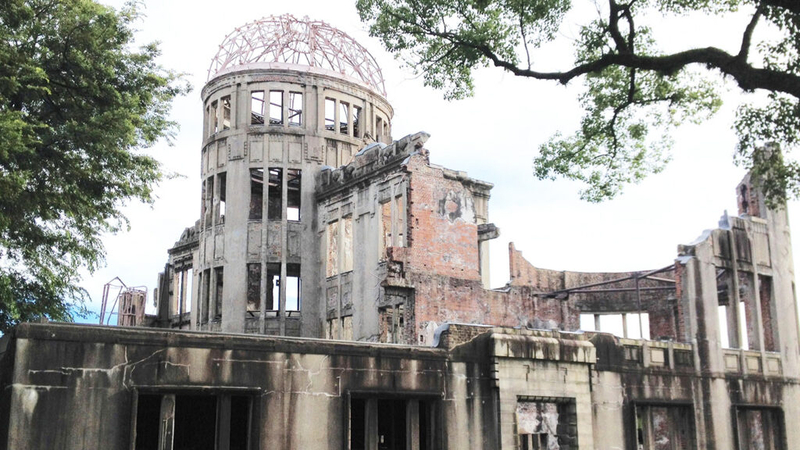
The A Bomb Dome overlooks Hiroshima in 2015. The dome, which was part of the city's industrial exhibition hall, was directly beneath the atomic bomb dropped pm Aug. 6, 1945. (Photo by Max McCoy/Kansas Reflector)
Thursday is the 81st anniversary of the atomic bombing of Hiroshima, and as a society we’re still struggling with how to respond to the ability to annihilate ourselves.
Ten years ago, Barack Obama became the first sitting U.S. president to visit Hiroshima, and his message was one of reflection. He spoke of the 100,000 Japanese men, women, and children who died in the Aug. 6, 1945, blast, along with thousands of Koreans and the dozen American prisoners of war.
“Their souls speak to us,” Obama said alongside Prime Minister Shinzo Abe at the Hiroshima Peace Memorial. “They ask us to look inward, to take stock of who we are and what we might become.”
When Obama delivered those remarks on May 2016, he had less than a year remaining in his last term in office. Already the world was beginning to change. Donald Trump had won the Indiana GOP presidential primary and, despite expectations, had become the party’s presumptive nominee. Sanctions against Iran were lifted after the U.N. certified the country had sufficiently dismantled its nuclear weapons program, as called for by a landmark agreement. In June 2016, the United Kingdom would narrowly vote to leave the European Union, foreshadowing the right-wing populism that would soon sweep western democracies.
The year before Obama visited Hiroshima, I was there, to speak at the annual peace conference. At the conference I talked about meeting atomic photographer Yoshito Matsushige in Hiroshima decades before, when I was a young newspaper reporter from Kansas. Matsushige was among the dozens of hibakusha, or Japanese A-bomb survivors, I had interviewed about their horrific experiences, which many described as “beyond imagination.”
During the conference, I met Yasuyoshi Komizo, chair of the Hiroshima Peace Culture Foundation and secretary-general of Mayors for Peace. Pondering this year’s anniversary, I asked Komizo, who has since retired but remains a peace activist, his thoughts on Obama’s speech and how much closer the world has come to disaster since 2016.
Komizo told me in an email interview there was general optimism after Obama, in his 2009 Prague speech, announced “America’s commitment to seek the peace and security of a world without nuclear weapons.”
The hope that Obama would visit Hiroshima was realized seven years later, in the midst of a turbulent presidential election year, and despite his advisers urging caution.
“He was under immense public pressure within the U.S. not to offer an apology to Japan,” Komizo said.
Obama did not apologize, but in Hiroshima he talked about the shared responsibility “to curb such sufferings again.” He expressed hope for choosing a future in which Hiroshima and Nagasaki are known “as the start of our moral awakening.”
After Obama concluded his remarks, he approached Sunao Tsuboi, a hibakusha, teacher, and co-chair of Nihon Hidankyō, the atomic bomb survivors organization that would be awarded the Nobel Peace Prize in 2024 for its efforts to create a world free of nuclear weapons.
“Tsuboi welcomed Obama with open arms,” Komizo said of the literal embrace that followed, “knowing Obama (was) doing his best but also bound by limitations. We cannot say that there are no bitter feelings in the hearts of the hibakusha, but I think Tsuboi found sincerity in Obama as a leader.”
Obama also greeted Shigeaki Mori, another hibakusha, and expressed his gratitude for Mori’s efforts to track down the stories of the American prisoners of war who were killed by the bombing and to find their families.
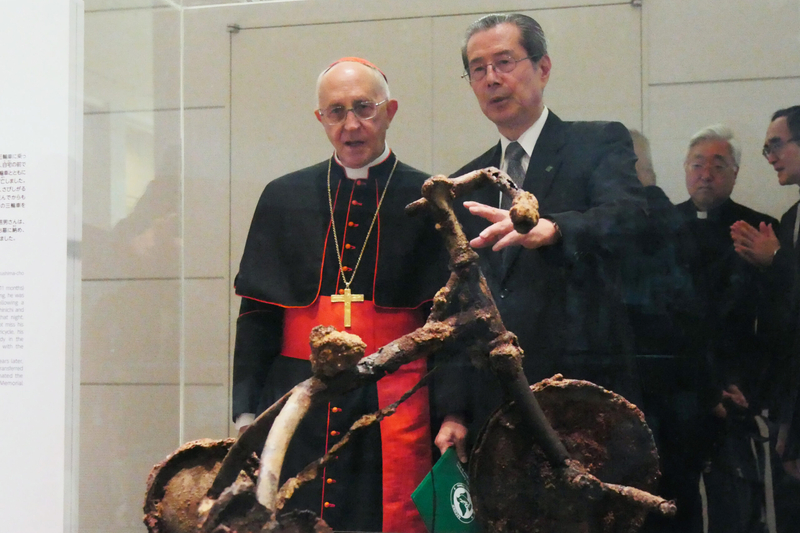
At the atomic bomb museum, Komizo said, Obama looked at the various displays and artifacts and paused at a painting by Ikuo Hirayama, a Japanese artist known for his dream-like silk road desert landscapes. Komizo said he told the president that Hirayama, who died in 2009, had been a Hiroshima atomic bomb survivor. Hirayama created only one painting about the bombing, “The Holocaust of Hiroshima,” in the hope atomic weapons would never be used again. Obama thanked him for the information, Komizo recalled, and then became reflective.
I recall looking at the same silk road painting in the peace museum and being oddly moved, although the subject matter has nothing to do with the bombing. The power in Hirayama’s work, beyond its artistry, may be in its juxtaposition with the horrors on display at the museum — a charred tricycle, the blood-stained uniforms of school children, a human shadow etched in stone by the heat of the blast. For every story told by one of the atomic bomb survivors, a thousand were lost.
One of the stories told over and again was by Akihiro Takahashi, who was 14 when the bomb fell on Hiroshima. When I interviewed him in 1986, he was chair of the Peace Culture Foundation, the same post Komizo would assume years later.
On the morning of Aug. 6, 1945, Takahashi and his classmates were lining up on the middle school yard for roll call when they spotted an American B-29 bomber, causing the children to shout “B-san!” They were used to seeing B-29s on their way to bomb other Japanese cities, but so far Hiroshima had been lucky.
The luck ran out that morning.
“I was pointing at the B-29, and two or three teachers came out from the school building,” Takahashi told me through a translator. “The class leader told us to get back in line. I heard a tremendous noise and all of a sudden it was dark.”
When the dust lifted, the school was gone and his classmates were lying motionless around him. He and another boy were alive, but their clothes were in tatters, their skin was burned, and they were bleeding from glass fragments.
“It was a kind of hell,” Takahashi said. “The two of us, we had to crawl over the rubble just like cats or dogs do. To 14-year-old boys, it was a very scary scene.”
They made their way past piles of corpses and other survivors, who walked like ghosts with their flesh hanging from their arms. At the river, Takahashi soothed his wounds in the water for hours until the black rain began, then he started for home. Relatives found him along the way, and he spent a year and a half in a hospital. When I met him, he was 55. His right arm was still small and useless and covered with thick scars, and his right ear was shriveled.
In 1980, during a trip to Washington, D.C., Takahashi met Paul Tibbets, the pilot of the Enola Gay, the B-29 that dropped the atomic bomb that nearly killed him. Takahashi recalled that Tibbets was reluctant to talk to him, because he had never met a survivor before.
“I offered my hand and I said, ‘I have no intention of complaining to you.’ He saw the (scars) on my right hand and asked if the atomic bomb had caused them,” Takahashi said.
He said he told Tibbets that he prayed for the day when nuclear weapons would be abolished. There would be no winners or losers next time, he said, because the entire earth would be consumed.
Tibbets, according to Takahashi, kept repeating that he had no regrets and was just following orders. He said he would do it again.
“But it seems to me that I thought I saw a tear in his eyes,” Takahashi said. “So I thought he was human after all.”
Takahashi said he invited Tibbets to Hiroshima, but that he declined.
When asked about the meeting years later, Tibbets said the story about the tears was “bulls***.” He also said he would have dropped the atomic bomb on Hanoi during the Vietnam War, if ordered. He told another interviewer that he would have done the same to Islamic extremists.
Tibbets died in 2007. He was 92.
Takashi died in 2011. He was 80.
In 2016, Komizo was invited by the National Park Service to participate in the Manhattan Project National Historical Park scholar’s forum. In his remarks, he said: “A key question is what kind of future we aim for. I hope sincerely that in line with the founding spirit of the United States of America, as well as its global leadership in democracy and human rights, the (NPS) exhibition will be organized to inspire visitors to ponder and work out innovative and more humane ways to achieve peace and prosperity.”
It is difficult to imagine such a forum today, when uncomfortable historical facts are the target of a regime attempting to whitewash history. Last year, the Trump administration asked national park visitors to flag exhibits that said “negative” things.
Last week, the administration posted signs outside the Smithsonian’s National Museum of American History about supposed “inaccurate information” inside. The museum, according to the administration, was engaged in anti-white rhetoric, transgender activism, and was “insufficiently patriotic,” according to NPR.
Ten years ago, the Doomsday Clock was at three minutes to midnight.
Since 1947, the clock has been a graphical representation of global catastrophe, as estimated by the Bulletin of the Atomic Scientists. The farthest the hands have been away from midnight was in 1991, at the end of the cold war, at 17 minutes. In 2016, the clock was at three minutes to midnight.
But in 2020, the Bulletin stopped measuring the risk in minutes. They turned to seconds. In addition to the threat of nuclear war, there was the additional risk posed by climate change, and world leaders had allowed the international political infrastructure for managing threats to erode. By 2024, disruptive technologies such as AI were included in the assessment.
Now, the clock is at 85 seconds to midnight, closer than ever to doomsday.
“A year ago, we warned that the world was perilously close to global disaster and that any delay in reversing course increased the probability of catastrophe,” the Bulletin announced in January 2026. “Rather than heed this warning, Russia, China, the United States, and other major countries have instead become increasingly aggressive, adversarial, and nationalist.”
The turn to global violence did not spare Abe, the prime minister who spoke alongside Obama a decade ago. A divisive figure in Japan, he was assassinated in 2022 by a politically motivated assailant with a homemade shotgun.
It was part of the unraveling of the political order that had stitched the world together after 1945. Japan, which had been a ruthless colonial force, was remade as a western democracy after the war. It took decades for Japan to acknowledge that many of the Koreans killed in Hiroshima were forced laborers or women who had been enslaved as sex workers by the Imperial Japanese Army. Foremost among the challenges of democracy is dealing with the sins of the past while avoiding catastrophe in the present.
As I write, the Iran ceasefire has collapsed and the United States has launched fresh strikes. The Russian invasion of Ukraine has entered its fourth year and is the largest military conflict in Europe since World War II. American diplomacy, once the model for the world, has suffered an erosion of trust and leverage in this Trumpian era of foreign policy by tweet and grift.
Still, Komizo told me, there are ways for the average American to work for peace. I should note that he is careful to avoid disparaging any particular leader or political party, and that his advocacy for peace is based on a nonpartisan humanitarian philosophy.
“Ways to contribute to a nuclear weapons-free world can be manyfold,” he said. “They include arts, music, movies, literature, seminars, exhibitions, education, scientific research, dialogue with politicians. Please be innovative and suit your own skills and tastes.”
Cultivating human bonds is a collaborative effort, he said.
“Such efforts can transcend national boundaries and differences in skin color, religion, gender and generations,” Komizo said. “When people in different backgrounds work together, beyond their seeming differences, they may discover far greater commonality as members of the same human family.”
It will take courage, he said, to build a new foundation on which true peace and security can be built. Although the world has become more challenging in the 10 years since Obama’s visit, Komizo said, he remains optimistic.
“More and more young people are taking to heart the earnest wish for peace of the hibakusha,” he said. “A pulse for peace transcending generations can be heard.”
I hope my friend Komizo is right.
But all I can hear at the moment is my own heart, beating down the seconds.
Max McCoy is an award-winning author and journalist. Through its opinion section, the Kansas Reflector works to amplify the voices of people who are affected by public policies or excluded from public debate. Find information, including how to submit your own commentary, here.

Topeka, KS