Why the stakes are high for Missouri in Trump’s Canada tariffs
Aug 01, 2026 | 6:50 am ET
Description
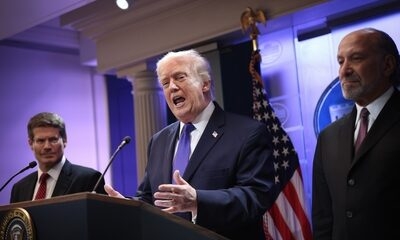
President Donald Trump speaks during a press briefing at the White House Feb. 20, 2026 in Washington, D.C., after the U.S. Supreme Court ruled against Trump’s use of emergency powers to implement international trade tariffs. At left is Solicitor General D. John Sauer and at right is Secretary of Commerce Howard Lutnick. (Kevin Dietsch/Getty Images).
President Donald Trump’s announcement of a 50% tariff on certain Canadian imports has renewed attention to U.S.-Canada trade. While much of the national conversation about trade focuses on China, for Missouri, Canada may matter even more.
Canada is Missouri’s largest export market. In 2025, the state shipped $5.8 billion in goods to Canada, about 31% of all Missouri exports. Overall, Missouri exported $18.7 billion in goods worldwide, supporting an estimated 74,000 jobs. Small and medium-sized businesses account for 84% of Missouri’s exporting companies, showing that trade disruptions affect not only large corporations but also locally owned businesses.
Although many Canadian products, including oil, natural gas, and key minerals, are exempt, the new tariffs would affect industries such as automobiles, alcohol, dairy, and manufactured goods.
Missouri’s economy is particularly exposed because it does not simply trade with Canada; it produces with Canada. Manufacturing demonstrates why this relationship matters. In 2025, Missouri exported $16.1 billion in manufactured goods, led by transportation equipment ($4.8 billion), chemicals ($3.7 billion), and machinery ($1.6 billion). Many manufacturers rely on Canadian suppliers for parts and materials while also selling finished products to Canadian customers. When tariffs increase costs or slow trade, businesses face difficult choices: absorb the added expense, pass it on through higher prices, postpone hiring and investment, or cope with reduced demand if Canada retaliates by imposing tariffs on American products.
Agriculture faces a similar challenge. Missouri ranked as the nation’s 10th-largest agricultural exporting state, shipping $5.1 billion in agricultural products abroad in 2024, including soybeans, corn, soybean meal, feed products, and pork. Farmers depend not only on affordable fuel, fertilizer, and equipment but also on access to export markets. If Canada responds with tariffs on U.S. agricultural products, Missouri producers could face lower sales and greater uncertainty at a time when many farmers are already facing higher production costs.
Tariffs are often seen as taxes on foreign producers, but they are actually paid by U.S. importers. Businesses may absorb some of the added cost, but many pass it on through higher prices. Because many everyday products, from building materials and automobiles to groceries, depend on trade with Canada, Missouri families could ultimately pay more for the things they buy every day.
However, not every industry views the tariffs the same way. Some businesses could benefit if the tariffs ultimately persuade Canada to reduce barriers to U.S. products. Nationally, for example, many dairy producers have welcomed the tougher approach, arguing that Canada’s protected dairy market has long limited their ability to compete. Whether those potential gains would outweigh higher costs and the risk of Canadian retaliation remains uncertain. The overall economic impact, however, is likely to extend well beyond any single industry.
The tariffs may ultimately serve as a negotiating tool as much as a source of revenue. Both the United States and Canada have signaled a willingness to negotiate because they have too much at stake to allow a prolonged trade conflict. If negotiations produce a new agreement, today’s tariffs may prove to be temporary leverage rather than a permanent feature of North American trade.
For Missouri, the stakes are particularly high.
Trade with Canada supports thousands of jobs, billions of dollars in exports, and some of Missouri’s most important industries. Whether these tariffs become a temporary negotiating tactic or the beginning of a longer trade conflict will depend on the willingness of both governments to reach an agreement. Until then, Missouri businesses, farmers, and families will be watching closely.
Jefferson City, MO