Surpluses prove state lawmakers’ eyes are bigger than their stomachs
Aug 01, 2026 | 11:35 am ET
Description
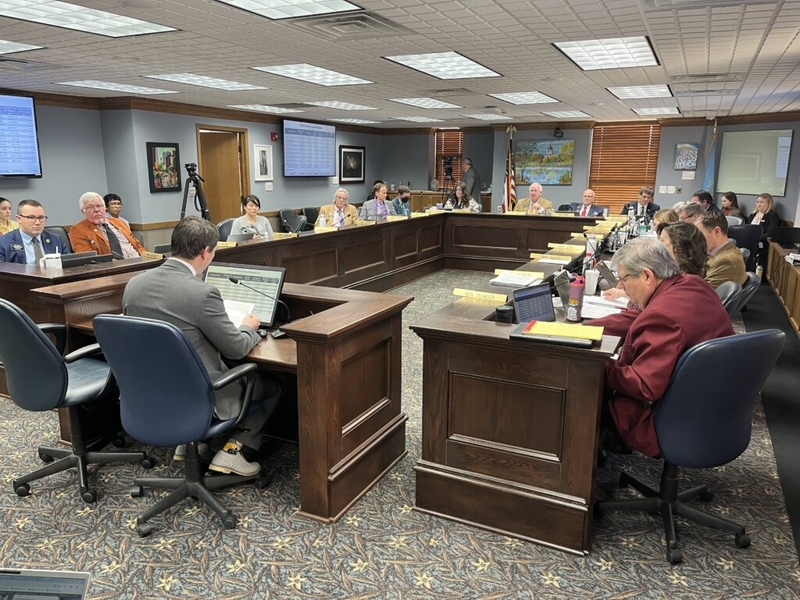
Jeff Mehlhaff, of the Legislative Research Council, presents fiscal year 2026 and 2027 revenue projections to the legislative Joint Appropriations Committee on Feb. 11, 2026, at the South Dakota Capitol in Pierre. (Photo by Makenzie Huber/South Dakota Searchlight)
There are two times a year when you can count on South Dakota politicians getting a little pumped up about their performance and taking a victory lap.
One is at the end of the legislative session when lawmakers pat themselves on the back about their ability to produce a balanced budget. They’re right to take pride in their work. There are currently 10 states that run budget deficits. Balancing a budget is something that continues to elude the U.S. Congress.
On the other hand, a balanced budget is mandated by the state constitution. By balancing the budget, legislators are simply following the law. It’s like they’re congratulating themselves for driving the speed limit.
The other time you can count on a politician taking a bow is at the end of the state fiscal year in June. That’s when the amount of the budget surplus is announced. It doesn’t matter who is in the governor’s office. The announcement of the surplus will be lauded as that administration’s dedication to government efficiency. That’s what happened this year when Gov. Larry Rhoden greeted the news by saying it was the result of “good stewardship of taxpayer dollars.”
Governor celebrates surplus as Democratic lawmaker says state missed opportunities to help people
This year, a $69 million budget surplus came from $30 million in higher than anticipated revenue, including $17 million in extra sales and use taxes. Another $39 million came from underspending by state agencies.
The excess revenue may be a sign of a more robust than expected economy. It’s disconcerting, however, that the state budget process, with dueling theories from the Legislature and the executive branch, goes to a great deal of trouble to predict how much revenue will be coming in. In this case, the state’s budget experts looked into their crystal balls and managed to miss their target by $30 million.
The $39 million that went unspent by state agencies included $32 million from the Department of Social Service. This raises the question of whether the people in society who need help the most are getting short shrift from the state agency specifically designed to help them.
That’s not the case, according to Jim Terwilliger, commissioner of the state’s Bureau of Finance and Management. In a South Dakota Searchlight story, Terwilliger said the department’s underspending was the result of fewer than expected Medicaid patients and less use of substance abuse and mental health services at the Human Services Center in Yankton because it’s understaffed.
“We’re trying to predict how many people come to the hospital with various acute conditions and so on and so forth,” Terwilliger told the Legislature’s Appropriations Committee. “So it’s not something that’s easy to predict going forward.”
Granted, predicting the state’s economic future is hard work. The $69 million budget surplus is less than 3% of the $2.5 billion state general fund budget. The $32 million returned to state government by the Department of Social Services represents less than 5% of the state general funds in the department’s budget. Still, make $69 million worth of budgeting errors in the private sector, and that thumping sound would be caused by heads rolling.
This year’s $69 million budget surplus is on the low end compared to the surpluses in the past five years. There was a surplus of $63 million in 2025, $80 million in 2024, $96.8 million in 2023, $115 million in 2022 and $85.9 million in 2021. Some of that may be due to the increase in federal money during the pandemic. Still, there has to be a better way to ensure that the money in the budget has a chance to be spent for the betterment of South Dakotans or, if it’s not needed, doesn’t get put in the budget in the first place.
A state government known for its conservatism, both in the Legislature and the executive branch, should have a better budgetary record. Each year since 2001, the last time there was no surplus, appropriators’ eyes have been bigger than their stomachs. They either budget more than they can spend or miss the clues about how revenue will play out in the coming year. Then in June, they declare the budget surplus is due to government efficiency. Government efficiency should start with a budgeting process that works, not end with an embarrassingly large surplus.
The matter-of-fact nature of the explanation of this year’s budget surplus to the Appropriations Committee belies the fact that mistakes were made. It wasn’t just a matter of the state departments’ underspending. It certainly looks like it was a matter of the citizens of South Dakota being overtaxed. Now $39 million that was earmarked for services for South Dakotans will instead linger in state government’s budget reserves, which have swelled to a record $325 million.
On some level it’s reassuring to note that taxpayer dollars in the budget reserve may be used as one-time funds in state projects. However, it would do so much more to boost confidence in state government if lawmakers and the bureaucrats who work with them would just get the budget right the first time. That’s something that’s worthy of a victory lap.

Pierre, SD