Kansas Democrats, confused by ethics rules, restricted interactions with federal candidates
Jul 30, 2026 | 2:05 pm ET
Description
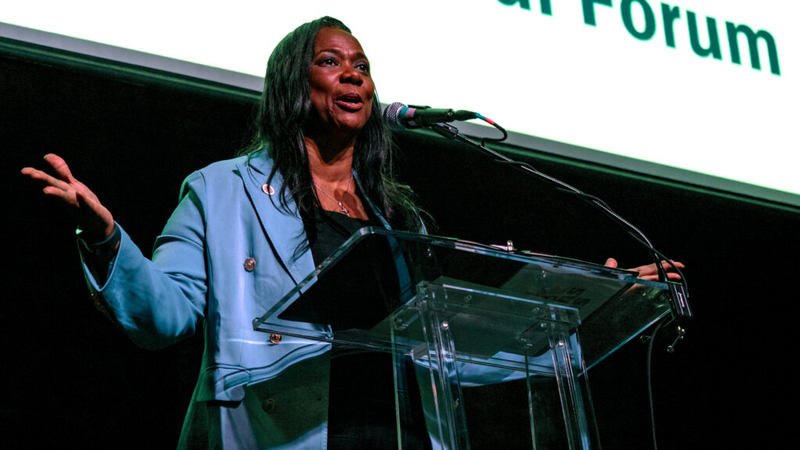
Jeanna Repass, chair of the Kansas Democratic Party, appears at an April 26, 2026, event at the Aztec Shawnee Theater. Repass said the party was trying to follow ethics rules when it restricted county parties from interacting with federal candidates. (Photo by Sherman Smith/Kansas Reflector)
TOPEKA — The Kansas Democratic Party stoked confusion and frustration by issuing restrictive guidelines to county party leaders about ethics rules surrounding candidates for federal office, saying county parties couldn’t include the candidates in events or printed materials.
The guidance sent in early June was based on a misunderstanding between Democrats and the state agency that governs ethics violations, the Kansas Public Disclosure Commission, and stems from the Johnson County Democratic Party’s attempt to promote select candidates for U.S. Senate and disregard U.S. Rep. Sharice Davids’ primary challenger, Sarah Preu.
The disclosure commission informed Democrats that state law forbids them from spending money to promote “a single candidate” for federal office, but that it was OK to “provide information for all candidates in a race.” The Kansas Democratic Party then sent a statewide directive that said county parties weren’t allowed to hold forums for federal candidates, print materials that reference them, or spend money on anything that would aid them.
As a result, the party unnecessarily blocked candidates from participating in parades and other events that could have boosted their public awareness in the weeks ahead of the primary. The Johnson County Democratic Party deleted federal candidates from its website and reprinted its voter guide.
Democrats say they were just following the rules, based on correspondence with ethics regulators who approved their flawed guidance before it was sent.
Candice Wilson, general counsel for the disclosure commission, told Kansas Reflector the agency became a “sacrificial lamb” for those who were upset by the party’s misunderstanding of the rules.
“We are committed to being nonpartisan and fair, and any insinuation that we have put our thumb on the scale of any particular party or candidate is not true,” Wilson said. “We just want to engage in educational efforts with groups to ensure that everyone is obeying the law and that our elections are transparent and fair.”
Jeanna Repass, chair of the Kansas Democratic Party, said Johnson County Democrats made a mistake by trying to promote just five of the 11 Democrats running for U.S. Senate.
“There was a kerfuffle involving Johnson County, and it got what I would call very aggressively heated,” she said.
But, she added, “we have done nothing but try to broker this correctly.”
“So this idea that they were the sacrificial lamb is outrageous,” Repass aid. “I’ve been taking the bullet.”
The kerfuffle
Deann Mitchell, chair of Johnson County Democratic Party, said the county party’s 50-member board decided to promote select candidates based on fundraising, cooperation with the party and, in one case, a candidate’s conduct.
The party printed 70,000 voter guides and planned a candidate forum for the U.S. Senate race before the disclosure commission intervened. Mitchell said she had to claw back the voter guides, which were already in canvassers’ hands, and reprint them at a cost of $13,000. The party chose not to include federal races in the reprinted voter guide or on the website, and to cancel the forum.
Mitchell said the decision was based on Wilson telling her she wasn’t allowed to spend money on “a” federal candidate.
“So from that, I took it that we could not have ‘any’ federal candidates on our voter guide, website, anything,” Mitchell said.
The real constraint was that the county party’s board was unwilling to be all-inclusive with the candidates.
Wilson said the commission heard from “multiple federal candidates” who said they wanted to be included in the Johnson County voter guide.
“Instead,” she said, “the Johnson County Democratic Party had framed it to us that the candidates had asked not to be included. So we certainly know about candidates’ frustration.”
Mitchell disputed that assessment. She said one candidate, Michael Soetaert, asked the party not to promote him. She said another candidate, Damon Anderson, was nonresponsive. The board excluded Anne Parelkar, Jason Hart and Kevin Latz because of fundraising, she said.
The board also refused to support the candidacy of state Sen. Patrick Schmidt, a Topeka Democrat who had attacked the frontrunner in the race, Church of the Resurrection pastor Adam Hamilton, with accusations about how he handled a report of child sex abuse at a church camp two decades earlier.
Mitchell said the board’s decision was based on Schmidt’s “conduct,” which she explained as him recruiting candidates to run against incumbent legislators.
Schmidt said he encouraged one individual to run in Democratic Rep. Susan Ruiz’ district in Johnson County. But, he said, the decision to exclude him was really about protecting Hamilton.
“Whoever the deciders are within that organization were angry about trying to call attention to Adam Hamilton covering up sex abuse at his church,” Schmidt said, referencing an accusation that Hamilton denies.
How the law works
There is a two-part test under state law.
Is a county party spending money, and does it benefit a particular candidate?
If the answer to both parts is “yes,” the party is violating the law and could be subject to fines from the disclosure commission.
Wilson provided Kansas Reflector with written memos issued by the commission dating to 1998 to show the law has been interpreted consistently for decades.
Democrats, who have seldom had contested primaries for federal races in recent years, believed the law was being applied differently this year. That’s because there was confusion over the second part of the two-part test.
Alex Fall, political director for the Kansas Democratic Party, provided Kansas Reflector with emails he exchanged with Wilson in early June. He asked Wilson to review a draft of the guidance the party planned to send to county chairs.
“This guidance looks good,” Wilson replied on June 9.
It wasn’t.
Wilson provided Kansas Reflector with a clarification memo she sent to the party the next day. The memo outlines the two-part test and says it is OK to invite “all federal candidates for a particular election to attend/speak at an event.”
The memo is consistent with guidance Wilson provided to Mitchell on June 8 in a back-and-forth exchange, which Mitchell provided to Kansas Reflector.
“If you wish to provide information for federal candidates, you may do so only so long as you do not expressly support a single candidate and instead, provide information for all candidates in the race,” Wilson wrote.
Mitchell asked as a “point of clarity” whether the party “CAN promote the federal candidacy if we list ALL candidates.”
Wilson responded: “You cannot spend money to promote a federal candidate, even if you list all the candidates.”
The distinction — the word “promote” — was lost on Mitchell.
Later, as confusion and frustration escalated, Wilson provided further clarity. She said in a June 24 email that her previous communication meant “you may not circumvent the law to support/favor a federal candidate by listing all candidates.”
For example, Wilson wrote, the party can’t promote Davids just because it lists Preu as a candidate.
“I just want to reiterate that in no way is our agency prohibiting you from including federal candidates on voter guides or at events,” Wilson wrote.
That was more than a month ago. The Johnson County Democratic Party still doesn’t list federal candidates on its website. Instead, it provides a note saying the disclosure commission prevents them from listing federal candidates, which isn’t true. The county party could list all of the candidates if it wanted to.
Ironically, the Johnson County Republican Party briefly listed Schmidt, the Topeka Democrat, as a candidate alongside Republican incumbent U.S. Sen. Roger Marshall and his primary challenger, Arch “Pond” Naramore.
Mitchell said the experience has been “a growing pain” for a county party that has expanded over the past eight years.
“I am attempting to follow the rules,” she said. “I reprinted 70,000 pieces of lit. Had my website scrubbed. Our office was scrubbed. We have done everything that we thought we were required to do, and then we get told, ‘Well, you’re being mean,’ or whatever, because we’re trying to follow the rules that we were given directly from Candice.”
Topeka, KS