Democratic vice chair urges strategic voting in August election amid GOP turnout concerns
Jul 30, 2026 | 5:59 am ET
Description
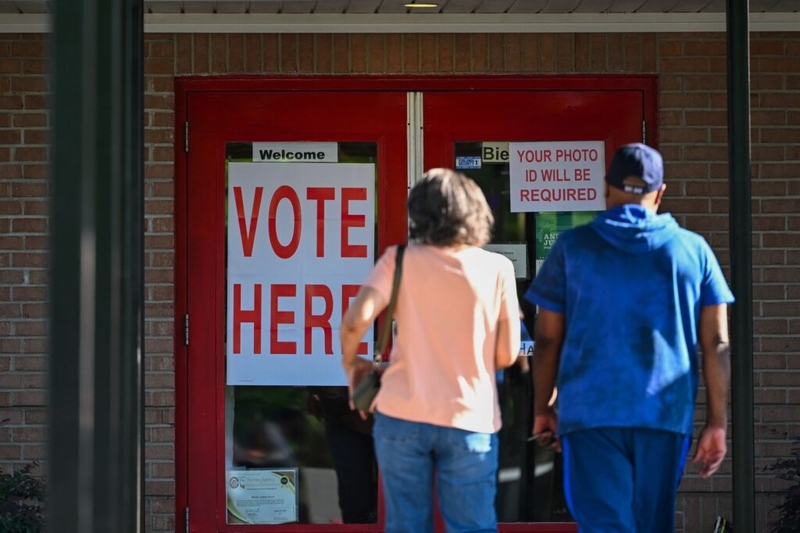
Two people enter a polling place at Messiah Lutheran Church in Montgomery, Alabama on May 19, 2026. Ahead of the August special primary elections, the vice chair of the Alabama Democratic Party is calling on Democrats to pull Republican ballots to get "weaker" competition for the general election. (Anna Barrett/Alabama Reflector)
The vice chair of the Alabama Democratic Party is calling on Democrats to pull Republican ballots in the Aug. 11 special primary elections to get “weaker” competition in the general election.
Tabitha Isner’s call comes as candidates in the special election have expressed concerns over low voter turnout in the state’s 1st, 2nd, 6th and 7th congressional districts. Republican candidates in Alabama’s 1st Congressional District are expecting 5-10% turnout in August. About 23% of voters cast a ballot in the May 19 primary, according to election results.
“I think Democrats should vote in the Republican primary, so that we can get the weakest, or at least a weaker Republican, to have the nominee. Someone who would be easier for Democrats to beat in November,” Isner said in an interview Wednesday.
Outside the 6th Congressional District, Democratic nominees are largely set.
Republican ballot numbers drop, Democratic ballot numbers increase as voter turnout declines
The Alabama Attorney General’s Office last week said that voters are not limited to the ballot they chose in May’s election because the election is a “standalone special primary election,” rather than a “subsequent primary runoff election.”
The special primary was called after a U.S. Supreme Court order that allowed the state to use a 2023 Legislature-passed congressional map, instead of a court-ordered one, for the 1st, 2nd, 6th and 7th Congressional Districts. Because of the special primary, ballots cast in the affected districts on May 19 were voided.
The new districts altered the Black Voting Age Population (BVAP) the most in the 2nd Congressional District, which is currently represented by U.S. Rep. Shomari Figures, D-Mobile. He was elected in 2024 under the court-ordered map, in which AL-02 had a 48.7% BVAP. Now, AL-02 has a 39.9% BVAP, according to court documents. Voting is racially polarized in Alabama.
Rep. Scott Stadthagen, R-Hartselle, chairman of the Alabama Republican Party (ALGOP), said in a statement Wednesday that eligible Republicans should make a plan to vote.
“Voter turnout during the May primary was lower than we would have liked, and we have an opportunity to do better. Every vote matters, especially in a special election where turnout is traditionally lower,” he said. “I encourage Republicans – key word: Republicans – across the affected districts to get informed and take part in deciding who will represent your community in Congress.”
Republican lawmakers attempted to pass a law this spring that would have required voters to register with a party in order to cast a ballot. It did not receive a vote on the final day of the regular legislative session due in part to lack of support in the Senate and concerns for independent voters.
Earlier this month, Stadthagen called for closed primaries to be on the agenda for the 2027 legislative session on “The Rightside” podcast, a product of Yellowhammer News.
“At the end of the day, we have to keep Democrats out of our business,” he said.
Isner said if a closed primary bill passes, Republicans will regret the effects.
“We are a state where people are smart and can be strategic, and frankly, often don’t have a lot of options on their ballot. In certain parts of the state, the only options on the ballot are Democrats, and in other parts of state, the only options on the ballot are Republicans,” she said.
A bill to close state primaries advanced out of the Alabama House of Representatives in March despite bipartisan opposition. It did not come out of the Senate.
Closed primary bill advances out of Alabama House despite bipartisan opposition
Christian Horn, a Republican candidate in the 2nd Congressional District, said in a recent interview that ALGOP should cancel the special primary and hold a convention to choose a nominee.
“I believe that we probably should go to a committee because we, as the Republican Party, are at great risk of the [Democratic] Party determining who our nominee is going to be,” Horn said. “There’s only going to be 5% to 7% turnout, and three to 4,000 votes targeted is all that’s needed to sway the election.”
The law that allows for the special election, passed in a May special session of the Legislature, allows for nominee selection other than elections. Primary elections in Alabama are run by the parties. A message seeking additional comment from Stadthagen was left on Wednesday afternoon about a convention.
Hampton Harris, another Republican candidate in the 2nd Congressional District, said in a recent interview that while the law allows for alternate nominee selections and there is a “threat” of Democratic influence, that is not a reason to cancel an election.
“You can have a convention, but having the people vote is that’s what this is all about: is having the people of the district decide who they want their representative to be,” Harris said. “With the threat of that happening, I think it’s important that the people be able to have their voices heard in an actual election, because that’s the person that’s going to go represent them in D.C. and they need to be able to choose who that is.”
Isner said that elections are a part of America, but accused Republicans of cancelling the May 19 primary.
“Why would we take away elections? This is America,” she said. “Republicans already did that in Alabama. They voided the results of the May 19th primary, voided the votes that were carefully and intentionally made by tens, if not hundreds of thousands of Alabama voters.”
Isner said that her call for “crossover” voting is a consequence of an already canceled election.
“It’s not legally crossover voting. This idea that Democrats vote in a Republican primary, that’s just a consequence of what the Republicans did by voiding our votes back in May,” she said. “I don’t think they have any room to complain about our response. They brought this upon themselves by calling for this special election.”
She said that primary voting is about strategy in local representation. According to a recent Unite America Institute study, a philanthropic venture fund, primary voters in the United States elected the majority of Congress in 2024.
“If you want to stay in who represents you, your vote matters in the primary, not in the general. There are Republicans in Montgomery who vote in the Democratic primary in order to have some say in who represents them locally,” she said. “With so little being decided in November, the real decisions are being made in May and the primary season. Highly informed voters get that, and they often act accordingly.”
There are Republican primaries in the 1st, 2nd, 6th and 7th Congressional Districts and a Democratic primary in the 6th Congressional District on Aug. 11. There is no runoff election, so the candidate with the most votes will be the nominee. Polls are open from 7 a.m. to 7 p.m. Polling locations can be found here.
Key Points box written by Editor Brian Lyman.
Montgomery