Fifty for 150: Ute bands expelled from Colorado’s Western Slope in 1881
Jul 30, 2026 | 6:00 am ET
Description
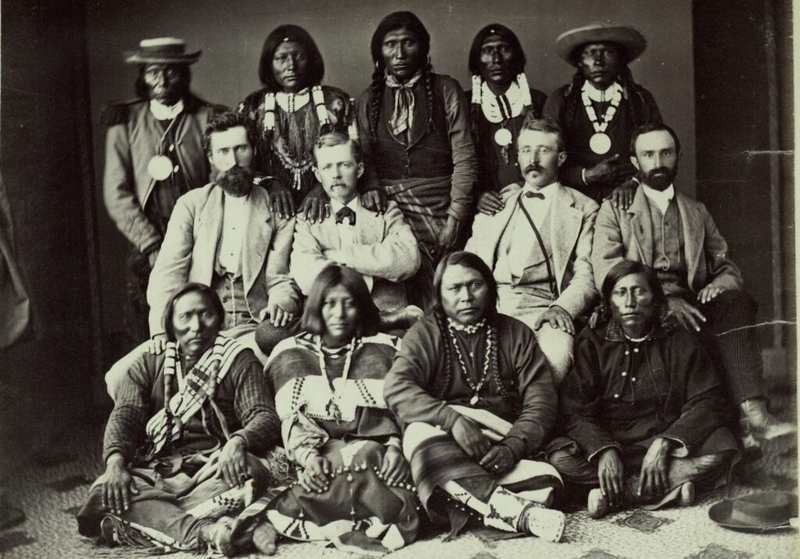
An 1874 photograph taken in Washington, D.C., during a visit by a delegation of Utes from Colorado. (Courtesy of Denver Public Library Special Collections, X-19251)
When Colorado attained statehood in 1876, roughly half of the portion of the new Centennial State that lay west of the Continental Divide was still reserved for the Ute people. Grand Junction, Durango, Aspen, Gunnison and Glenwood Springs were among the many Colorado communities that didn’t yet exist.
An 1868 treaty between the U.S. government and six bands of the Ute tribe reserved nearly the whole Western Slope for their “absolute and undisturbed use and occupation,” and stated that “no persons … shall ever be permitted to pass over, settle upon, or reside in the territory described.”
That agreement lasted just four years.
By 1872, prospectors for gold and silver in the San Juan Mountains were routinely trespassing on Ute lands, and the following year the federal government — under pressure from territorial leaders demanding access to the region’s “large bodies of mineral and agricultural resources” — pushed the Utes to cede a 3.7-million-acre area surrounding the San Juans in what was known as the Brunot Agreement.
The various Ute bands had lived in western Colorado and eastern Utah for hundreds of years. Like the Shoshone, Paiute and Hopi tribes, with whom they share a common linguistic heritage, the Utes are thought to have descended from the Ancestral Puebloan civilization, which emerged from earlier cultures in the Four Corners region dating as far back as the 12th century B.C.
The Southern Ute Indian Tribe says today that the Utes “do not have a migration story” and “have always lived here in the mountains.” Highly nomadic, they moved seasonally within the Rockies, which they called the Shining Mountains.
“They were moving always with nature, and survival was the main thing … summertime they’re high up in the mountains, and wintertime they’re down to the bottom,” Clifford Duncan, a Ute elder, said in a 2010 radio interview. “Their thinking was a little different than how it is for us today. Today, I live in a house and I call this home — whereas in those days, there was no structure that they could call home, but they had that feeling of home everywhere.”
Pressure to further dispossess the Utes of their lands intensified as the San Juan mining boom continued during the 1870s. Three bands of the tribe grouped together as the southern Utes — the Capote, Mouache, and Weenuche — agreed in 1878 to cede all but a small portion of their lands in far southwest Colorado along the New Mexico border.
Three Ute bands remained on the Western Slope: the Tabeguache, also known as the Uncompahgre, who lived in the Gunnison River valley; and the Parianuche and Yampa, who lived in the Colorado and Yampa river valleys, respectively. The latter two bands were grouped together as the White River Utes, for the Indian agency that the federal government established along the White River in the northern half of the reservation.
In his inaugural address in January 1879, Gov. Frederick W. Pitkin, the Centennial State’s second chief executive, declared that there was “no matter of such urgent importance to our people as the immediate extinguishment of the Indian title” to the remaining Ute lands on the Western Slope.
“If this reservation can be extinguished and the land thrown open to settlers, it will furnish homes to thousands of the people of this state who desire homes, will furnish grazing for immense herds of cattle, horses and sheep, and may prove to be exceedingly rich in minerals,” Pitkin said. “The westward march of the white race and of civilization, begun over two centuries ago on the Atlantic coast, can not long be arrested at the boundaries of this immense tract of valuable land by the presence of a tribe of Indians too small in number to constitute a respectable village.”

The remaining northern bands of the Ute, especially, were “fiercely independent” as a result of having relatively little contact with Spanish and New Mexican settlers to the south, wrote historian Charles Marsh.
Nathan Meeker, an Ohio-born journalist and moral crusader who had founded Colorado’s utopian Union Colony, later known as Greeley, sought to bring about a dramatic change in the Utes’ way of life. Despite the fact that his Union Colony experiment had ended in failure and he had no previous experience in dealing with Native American tribes, Meeker was put in charge of the White River agency in 1878, and soon angered the northern bands by withholding treaty supplies in order to coerce them into practicing agriculture.
In what would prove a fateful confrontation in September 1879, Meeker was assaulted by a Ute man — Canávish, or Canalla, known to white people as “Johnson” — whose large horse pasture the agent had ordered to be plowed. In the aftermath, Meeker’s panicked telegrams to Pitkin and federal officials led the Army to order cavalry troops from Wyoming’s Fort Steele to march south to the White River agency.
It was a major escalation against a Ute tribe that had previously had few major conflicts with white settlers or the Army, had been promised no troops would enter their reservation, and was all too aware of the fate of the hundreds of peaceful Cheyenne and Arapaho people who’d been killed by a Colorado militia in the 1864 Sand Creek Massacre.
“Although it was 15 years since Sand Creek, the incident had never been forgotten by the western tribes,” Marsh wrote. “Now a fully armed force of uniformed soldiers was suddenly bearing down on the peaceful White River Ute encampment.”
On Sept. 29, 1879, the Utes simultaneously ambushed the approaching Army unit and attacked the White River agency, killing Meeker and his employees and taking the agent’s family hostage. Two dozen soldiers and agency employees, along with roughly as many Ute combatants, were killed in what became known as the Meeker Massacre and the ensuing six-day White River War. Hostilities ended when Army reinforcements, some of them Buffalo Soldiers from Fort Garland in the San Luis Valley, arrived in early October.
In a state that had already rallied around the slogan “The Utes must go,” the White River War provided all the more justification for Pitkin and other leaders to persuade the federal government to bring about the tribe’s expulsion. After further treaty negotiations, in 1881 the two White River bands were ordered to relocate to the Uintah reservation in eastern Utah, where five other Utah-based bands of the tribe had been grouped since 1861. Despite not having fought in the White River War, the Uncompahgre band, led by the famous Chief Ouray, was also ordered to leave Colorado.
The southern Utes, who’d ceded most of their land in 1878, later split into the Southern Ute Indian Tribe, consisting of the Capote and Mouache bands, and Ute Mountain Ute Tribe, made up of the Weenuche band. Today, the Southern Ute and the Ute Mountain Ute are the only two federally-recognized tribes within Colorado’s borders. The northern Utes, together with the Uintah bands, share the combined Uintah and Ouray Indian Reservation in northeastern Utah.
“Since we’re over here in Utah, most of our relationship is dealing directly with the state of Utah rather than Colorado, and that that separates us because we’re originally from Colorado,” said Duncan, who died in 2014. “We’re Colorado people, but we have no connection whatsoever. Only in memory.”
Denver, CO