Opponents sue state over Morris mega-dairy expansion
Jul 31, 2026 | 8:30 am ET
Description
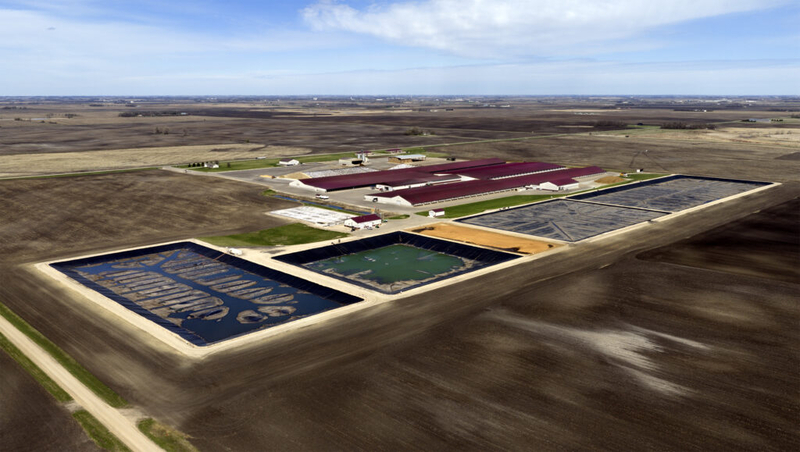
Riverview Dairy is seeking to expand their Morris-based West River Dairy operation from 7,855 cows to almost 19,000 cows. (Drone photo by Rob Levine/Minnesota Reformer)
Food & Water Watch and the Land Stewardship Project sued the state of Minnesota Thursday over a decision to allow a Morris mega-dairy to expand without a more rigorous environmental review.
Riverview wants to expand West River Dairy from 7,855 cows to almost 19,000 cows, making it the biggest dairy in Minnesota.
The new dairy would create roughly the same amount of waste as a city of 750,000, and, according to the plaintiffs, at least 66,000 tons of additional greenhouse gas emissions yearly.
“It is hard to overstate the environmental destruction threatened by Riverview’s proposed West River factory farm expansion,” Food & Water Watch Legal Director Tarah Heinzen said in a press release.
Riverview partner Brady Janzen said that the company would expand West River Dairy responsibly: “Our goal is to always be good neighbors, which includes protecting the environment and supporting the rural communities where we live and work,” he wrote in an email to the Reformer.
The dairy plans to make use of all that waste by spreading it on nearby fields as fertilizer, for instance, Riverview says.
The Minnesota Pollution Control Agency decided last month Riverview does not need to complete what’s known as an Environmental Impact Statement to move forward with the expansion.
Opponents fear the impact of West River Dairy on local water quality, citing potential nitrate pollution; the dairy is next to the Pomme de Terre River and an unnamed creek.
Fertilizer runoff can be a contaminant to drinking water, particularly in rural Minnesota where more people rely on private wells than in urban areas.
Nearly 1 in 5 Americans’ drinking water contains elevated nitrate levels, which are linked to cancer and birth defects, according to Environmental Working Group.
Matthew Sheets, an organizer with the Land Stewardship Project and a Morris resident, said in a statement that the decision forego the EIS “left so many questions unanswered. We deserve to know our community will be safe from any impacts this project will have.”
Before forgoing the EIS, the MPCA prepared and distributed a required Environmental Assessment Worksheet to analyze the potential impacts of the expansion.
State law dictates that when reviewing an EAW, the MPCA must consider environmental effects’ type, extent, reversibility and ability to be controlled.
After reviewing the document, the MPCA concluded that the expansion had no potential for significant economic impacts, and that no EIS was required.
Food & Water Watch and the Land Stewardship Project said that MPCA’s analysis was deficient. Significant environmental impacts from the expansion “are not just possible, but likely,” the two groups wrote. Their petition requests judicial review of MPCA’s decision not to issue an EIS.
MPCA cannot comment on pending or ongoing litigation, said Daniel Strohl, a spokesman,.
Beyond environmental concerns, opponents say the expansion will worsen the concentration of Minnesota’s dairy industry, endangering smaller family dairies that are already struggling to survive.
“Consolidation is reshaping our dairy sector, and the trend has implications for land access, local economies and the next generation of farmers,” said Minnesota Farmers Union Vice President Anne Schwagerl in a press release last month.

Saint Paul, MN