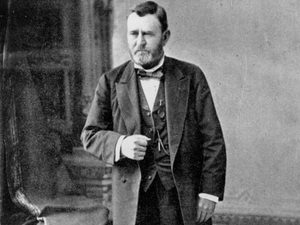
President Ulysses S. Grant proclaimed Colorado a state 150 years ago this week
Jul 31, 2026 | 6:15 am ET
Description
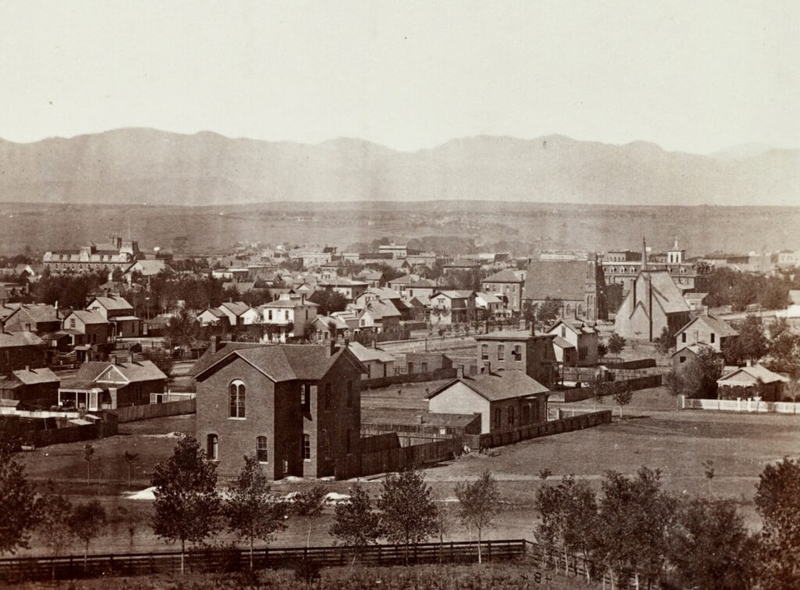
A west-facing view of central Denver in the 1870s. (Courtesy of Denver Public Library Special Collections, X-18618)
The telegraphic dispatch, dated Aug. 1 and sent from Washington, D.C., appeared in newspapers across Colorado and the nation the following day.
“The President, in accordance with the provisions of an act of Congress, approved March 3, 1875, has issued his proclamation declaring and proclaiming the fact that the fundamental conditions imposed by Congress on the state of Colorado to entitle that state to admission to the Union have been ratified and accepted,” the message said, “and the admission of said state into the Union is now complete.”
Though the Rocky Mountain News in Denver reported that “our people are now in the state of Colorado and the state of beatitude,” President Ulysses S. Grant’s proclamation of statehood wasn’t greeted with much pomp and circumstance by the residents of the new Centennial State, compared to the grand parades and fireworks shows the Colorado Territory had held for the nation’s 100th birthday a month earlier.
Colorado was the first state in nine years, after Nebraska in 1867, to be admitted to the union, but the occasion was overshadowed nationally by major developments elsewhere in the centennial summer. Other headlines leading the Rocky Mountain News on Aug. 2 reported the latest news on the aftermath of the Battle of the Little Bighorn, which had shocked the nation just after the Fourth of July, along with impeachment trial of Secretary of War William Belknap and the prosecution of the Whiskey Ring — two of the many corruption scandals that plagued Grant’s administration in its final days.
Plenty of local matters, too, like the descent of the latest swarm of Rocky Mountain locusts in the Platte River farmland surrounding Denver, were more urgent than the news of statehood.
“Those who thought state admission would end the grasshopper plague slipped up on it,” quipped the News.
Public officials, meanwhile, went to work dealing with the legal quirks and complexities of transitioning from territorial to state government — like the fact that the state would temporarily comprise a single judicial district. As provided for by the constitution approved on July 1, the Centennial State’s inaugural elections were to be held on the first Tuesday in October.
“The year is an important political one, and we are early called upon to take part in the events connected therewith,” said the Denver Times. “There are to be elected one Representative to Congress, Governor, Lieutenant Governor, Secretary of State, Auditor of Slate, State Treasurer, Attorney General, Superintendent of Public Instruction, three Supreme Judges, and six Regents of the State University,” along with four district attorneys, four district judges, 26 state senators and 49 state representatives.
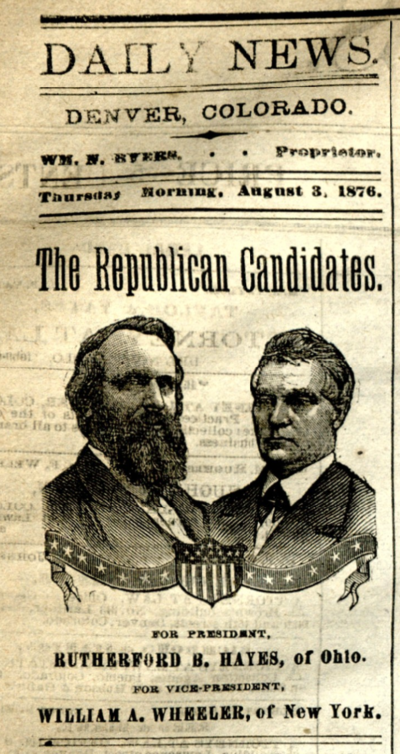
Most importantly of all, a pivotal presidential election loomed in the near future. Colorado’s admission to the union ahead of the 1876 election had been a political ploy by Republicans, who had also inserted into the new state constitution a clause giving the inaugural Colorado General Assembly the power to cast its three electoral votes.
It had been two years since Democrats won control of the House of Representatives for the first time since the Civil War. The Colorado Territory, long a Republican stronghold, had even been swept up in the Democratic wave, electing Democrat Thomas Patterson, an Irish-born Denver lawyer, as the territory’s non-voting delegate to Congress.
With Grant’s popularity souring amid corruption scandals and much of the country still reeling from the Panic of 1873, the opposition party now hoped to return to the White House in the 1876 presidential election. That was a grim prospect for Republicans and northerners to whom the Democratic Party still stood as a symbol of slavery and rebellion. The fate of Reconstruction, under which the federal government had acted to secure Black civil rights in the South, hung in the balance.
Though it judged such a scenario to be “not probable,” the Denver Times presciently raised the possibility that Colorado’s three electoral votes could be decisive in the contest between Republican Ohio Gov. Rutherford B. Hayes and Democratic New York Gov. Samuel Tilden.
“In view of such possible contingency, the two parties will strive their utmost to curry the young State,” said the Times. “It is an extraordinary situation that a people should be called upon so early to decide, by their votes, matters of so great interest, and matters which may exert an overwhelming influence in the country.”
Denver, CO