PTSD and torture claims by Salah Sarsour put under microscope in federal hearing
Jul 30, 2026 | 4:45 am ET
Description
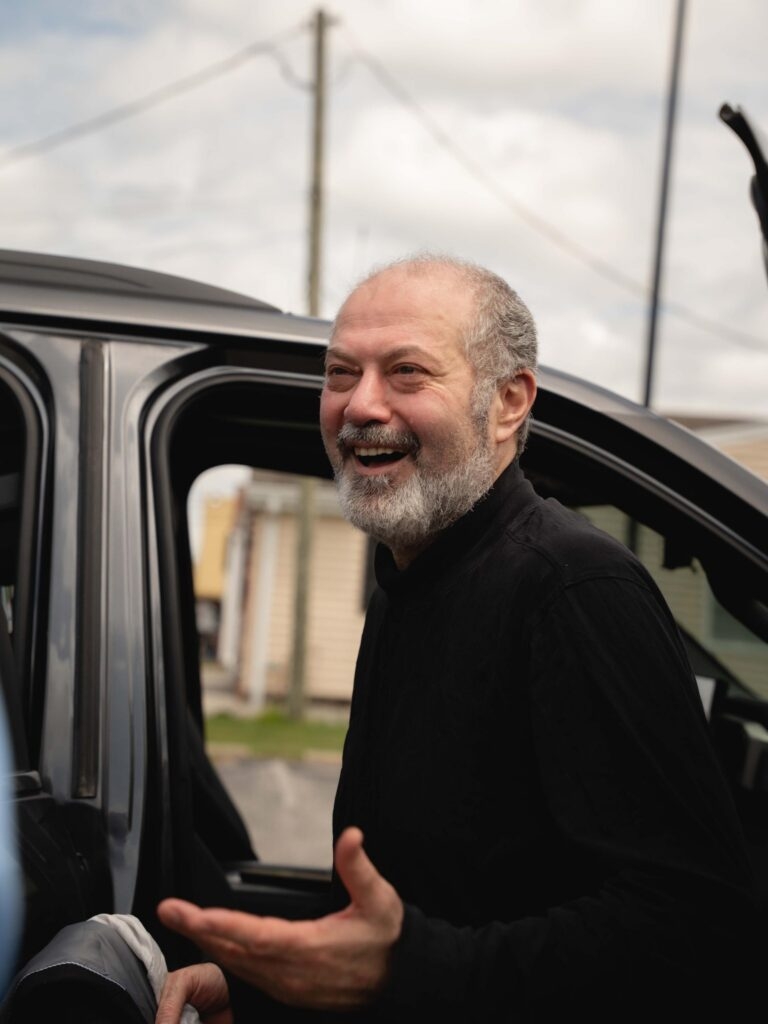
Salah Sarsour being released from immigration detention. (Photo courtesy of Yaseen Najeed)
On the second day of federal immigration court hearings for Salah Sarsour, president of the Islamic Society of Milwaukee, federal prosecutors attempted to cast doubt on Sarsour’s claims that he’d been tortured by Israeli authorities in the 1980s, when he was a teenager living in the occupied West Bank during the First Intifada uprising, and that he suffers from Post Traumatic Stress Disorder as a result.
Sarsour, a legal permanent resident of the U.S., was targeted for deportation earlier this year, after the Trump administration accused him of having lied on his green card application when he came to the United States more than 30 years ago.
Attorneys also argued over the results of a polygraph test Sarsour took while he was asked whether he knowingly voted in an election in 2004 as a non-citizen. Mark Robel, an FBI polygraph examiner, conducted the test which he said Sarsour passed. “If he had tried to register to vote in any election, he would not have passed that test,” Robel testified. Robel charged Sarsour’s attorneys $800 to conduct the test, plus $250 an hour for his court appearance, prosecutors pointed out.
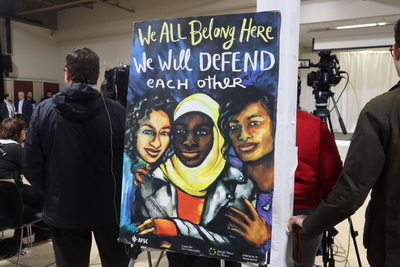
Robel said that the test did not assess Sarsour’s claims of being tortured while being held in Israeli detention, because polygraph tests need to focus on a single topic at a time, and there would be subsequent charges for each test. Robel testified that Sarsour’s attorneys chose to only focus on the voting question, allegations which had not previously come up publicly after Sarsour was arrested in late March and detained in an Indiana detention facility until his release in mid-June.
Defense attorneys also called Amahl Bishara to the stand, a professor at Tufts University where she serves as chair of the Department of Anthropology. Bishara testified as an expert on Palestinian political expression and resistance in the context of Israeli occupation. Bishara described the West Bank in the late 1980s as a place under full military occupation. Soldiers were often the focus of protests and acts of resistance during the First Intifada, Bishara said. Many children also participated in the act of stone throwing, which Bishara framed as a form of political expression rather than a direct act of violence.
Groups of children threw pebbles or stones at fully equipped soldiers in armored trucks parked dozens of meters away, Bishara said. She cited a human rights report, using data from the Israeli Defense Forces, which found that 60% of stone throwing was done by children 13 or younger.
In this environment, Sarsour was detained by Israeli military authorities in 1988, when he was 15. The Department of Homeland Security has said that Israeli officials convicted Sarsour of throwing a Molotov cocktail at the homes of Israeli soldiers. This conviction in an Israeli military court, is what the federal government accuses Sarsour of omitting from his green card application.
Bishara testified that Israeli authorities treated children harshly for throwing stones in the late 1980s. Children were often tortured to give false confessions or implicate other children, she said. Prosecutors attempted to challenge Bishara, asking whether the political assassinations of leaders in Egypt were also political expression, but the judge struck down that line of questioning as not relevant. Prosecutors also brought up Bishara’s participation in protests calling for the release of Palestinian students of her university who were arrested by federal immigration agents after writing opinion pieces for the school newspaper.
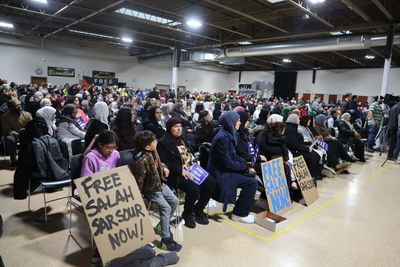
Jackie Bashkoff, a forensic psychologist who met with Sarsour twice testified for the defense about her evaluations she said showed that Sarsour suffers from PTSD, which she attributed to his torture by Israeli forces as a boy in the 1980s and another stint in detention in the 1990s. “He met all the criteria” for PTSD, Bashkoff said. She said Israeli authorities beat Sarsour daily, threatened him with rape, hit him so hard in the chest that he heard something snap and tied him to bars and a chair in stress positions. “He wasn’t given proper food, water,” said Bashkoff, adding that Sarsour described having flashbacks, nightmares, and that he displayed startle responses to guards walking in unexpectedly as they talked.
“He anticipates that if he is deported then he’s likely to be killed by the Israelis if he is sent back to the West Bank,” said Bashkoff.
Prosecutors attempted to discredit Bashkoff by noting that she had charged Sarsour’s attorneys $4,000 so far, not including for her testimony Wednesday. They also pressed her on why Sarsour wouldn’t state on his green card applications that he had been tortured or convicted by Israeli authorities, something about which Bashkoff was unable to offer an opinion. At one point, prosecutors suggested that Sarsour’s diabetes could cause the psychological symptoms Bashkoff attributed to PTSD, or that Sarsour could be faking it. Bashkoff dismissed these suggestions in tense exchanges with the prosecution.
Another hearing is scheduled for Tuesday morning. Defense attorneys say they are still waiting on documents to be provided by the government. The judge said he doesn’t expect to render a final decision on whether Sarsour will be deported until early September.
Madison, WI