Formerly incarcerated people, family members describe Alabama prison violence
Jul 30, 2026 | 6:01 am ET
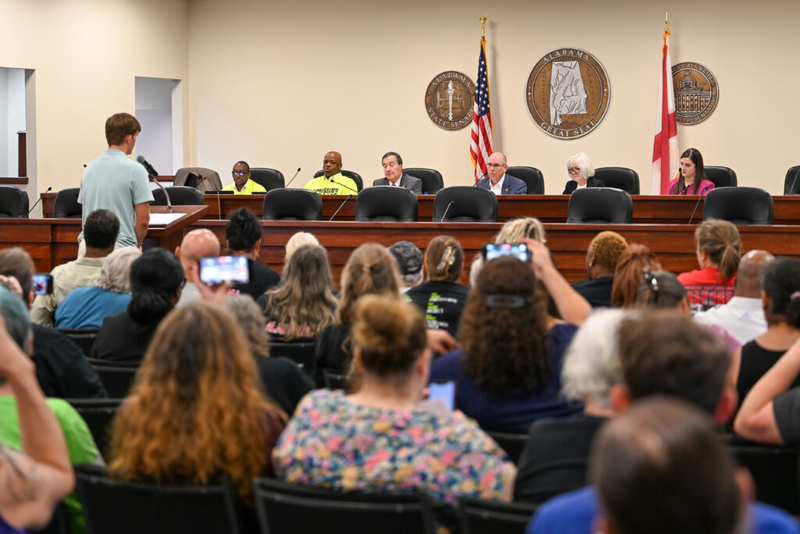
Description
A constituent speaking to members of the Joint Legislative Prison Oversight Committee at its meeting on July 29, 2026, in the Alabama Statehouse in Montgomery, Alabama. The committee heard from formerly incarcerated Alabamians and family members who described violent conditions in state correctional facilities. (Anna Barrett/Alabama Reflector)
People who spent decades incarcerated within Alabama’s prisons Wednesday provided a detailed account of ongoing violence, abuse by corrections staff and lack of adequate healthcare services in the state’s correctional facilities.
“The lack of medical assistance, the lack of security,” said Carl Green, who served 36 years in state prisons for robbery, in an interview following the meeting. “Those are the two main things that have caused so many deaths in the Alabama Department of Corrections.”
It was the fourth time that advocates, former inmates and loved ones of people who remain incarcerated spoke to the Joint Prison Oversight Committee since it was formed. As in previous years, speakers described widespread drug use and overdose deaths, ongoing assaults and murders perpetrated by both corrections officers and the incarcerated, and pervasive neglect of the medical and mental health care needs of those in custody.
Green told lawmakers that he was forced to provide medical care to others in the facility, serving as a de facto “surgeon” despite not being a licensed or credentialed medical provider. Green said he and others had to render aid when he saw people getting stabbed with ice picks and knives, and as they were getting beaten with “all types of weapons,” and said he used modified paperclips as sewing needles.
“My first surgical patient was in 1996 when I had to work on a guy who had been kidnapped, literally held in a cell, for hours, and we worked on this guy for days, making sure he was OK,” Green said. “We couldn’t receive any help at all from any security. Working on these guys became a ritual.”
Marcus Miller, who spent nearly four decades in ADOC custody after he was convicted of robbery, said he witnessed murder, suicide and sexual assault in prison. He said he was one of the “chosen,” individuals assigned to perform duties for corrections staff to secure payment for unsanctioned activities.
“When you are ‘chosen,’ you are the one implementing all the drugs, cell phones, in the prison system,” Miller said. “I didn’t have to implement any violence, it was just I had to make money for the police, that is all.”
Others spoke of the abuse their loved ones experienced while in custody of corrections staff. Among them was Colleen Howell, whose son was incarcerated in Alabama’s prison.
“Officers routinely curse at inmates, demean them and intentionally provoke them,” Howell told the committee. “And then, when the inmate finally reacts, after hours or days, the officer writes them up. This is not discipline. This is entrapment. It is a tactic to use to justify punishment and their extended incarceration.”
She also accused officers of destroying the personal belongings of people they oversee.
Documentation issues
Prior to the public hearing, Rachel Riddle, chief examiner with the Department of Examiners of Public Accounts, told committee members that her staff is having trouble obtaining documents from ADOC. Riddle did not specify the documents the department was seeking.
“We have got the Attorney General’s Office involved in trying to get through that,” Riddle told lawmakers. “I have never had a state agency not give me documents, even confidential ones, and so this is new territory for me.”
Riddle said she may issue subpoenas if her staff cannot obtain the documents as part of the audit.
Riddle and the examiner’s office are supposed to complete an audit of the ADOC after Sen. Larry Stutts, R-Tuscumbia, filed a bill to have the examiner’s office investigate the treatment and living conditions of people incarcerated in the state’s prisons. However, both agencies reached an agreement regarding the audit and the bill became moot.
Riddle said the plan was to audit one facility, but instead the examiners’ office will review the ADOC first before investigating the conditions in one unnamed facility. She and her staff have been gathering documents and conducting interviews throughout the summer.
She also told members of the committee that the examiner’s office traveled to Virginia to meet with officials in the commonwealth’s Department of Corrections to get an understanding of the agency’s audit process.
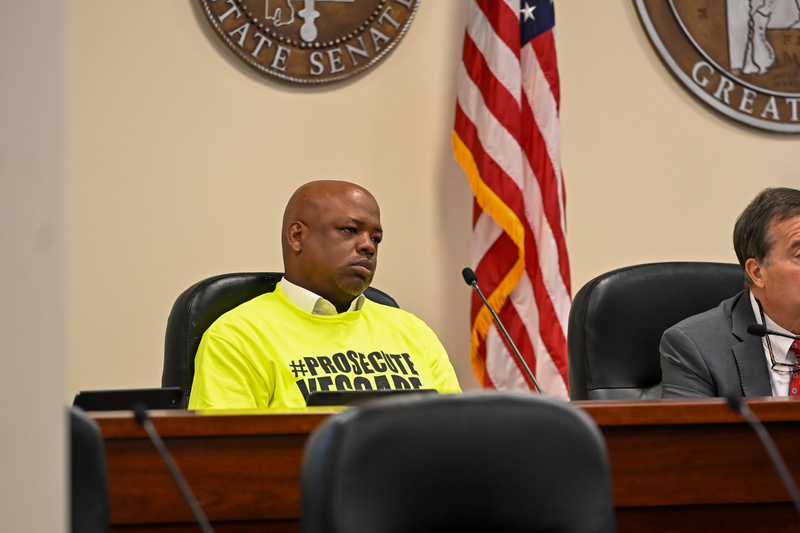
“I hope that once that is done, it will compel us to go ahead and ask for, first, a forensic audit of the entire Department of Corrections,” said Rep. Chris England, D-Tuscaloosa, in an interview with media following the meeting. “But not just for the Department of Corrections, honestly. We need a forensic audit done periodically for every government agency to make sure people are not, flat-out, stealing money.”
The results of the audit “are going to give us the momentum, and the evidence necessary, to overhaul the Department of Corrections,” England said.
It will give them the spring shot to create an ombudsman to further investigate ADOC, according to England.
Both England and Senate Minority Leader Bobby Singleton, D-Greensboro, wore shirts that called for the prosecution of YesCare, the Tennessee-based prison healthcare provider that lost its contract with ADOC for breach of contract. England earlier this month accused the healthcare provider of fraud.

Montgomery