Sing it loud, New Hampshire: ‘We’re No. 1! We’re No. 1!’ Oh, wait, we’re not?
Jul 29, 2026 | 3:12 pm ET
Description
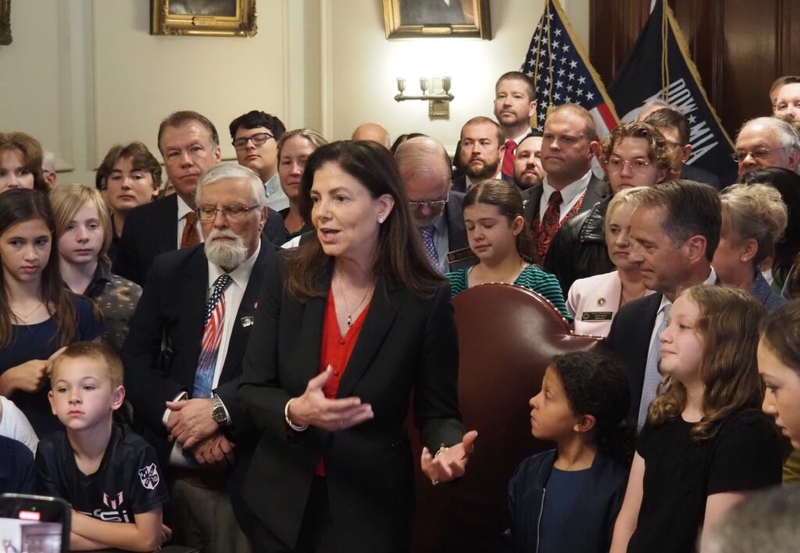
Gov. Kelly Ayotte celebrates the signing of a pair of bills at the State House in June 2025, one to broaden "parental rights" and the other to expand the voucher-like education freedom accounts program. (Photo by William Skipworth/New Hampshire Bulletin)
Over the past three decades, New Hampshire Republicans have held trifecta power over the State House — or simultaneous control of the governor’s office, House, and Senate — for 11 years, including the past six. Democrats, meanwhile, have held trifecta power for just four years in that span.
And while Democrats had a decade-long run of success winning the governor’s seat starting in 2005, since 1995 Republicans have held majority control of both branches of the state Legislature at the same time for a staggering 22 years.
So, for better or worse, it’s fair to say the state of the state belongs to the Republican Party.
That’s why they get so excited when the U.S. News and World Report “Best States” rankings come out every year. The great thing about rankings as far as a Republican politician is concerned (and you may remember that I’ve written about their love of WalletHub lists, too) is that they can cherry-pick the good categories, deliver the news to voters without defining context or methodology, and essentially suggest that the ranking is more real than the reality of personal experience.
As Gov. Kelly Ayotte and other state Republicans proved this week, it can be a politically dangerous game to play.
In separate press releases about the U.S. News and World Report rankings, Ayotte touted the state’s top rankings in a pair of subcategories, safety and economic opportunity. She did not, however, mention that on her watch New Hampshire dropped in the overall rankings from No. 2 in 2025 to No. 6 this year, most likely dragged down by a No. 41 ranking for affordability, No. 40 ranking for higher education, No. 39 ranking for fiscal stability, and a No. 32 ranking for the state’s economy (which also includes a No. 49 subcategory ranking for growth).
Even when you discount the latest lists and rankings, and we probably all should, July as a whole hasn’t been particularly kind to Republicans. A couple of weeks ago, the New Hampshire Fiscal Policy Institute released a report outlining the toll of $51 million in back-of-the-budget cuts for the state Department of Health and Human Services in the 2026-2027 biennium. Among the programs most affected are: community mental health services, family intervention and prevention-related services, food assistance programs, and child and maternal health services.
Importantly, Health and Human Services was just one of 11 state departments hit with such cuts.
“Policymakers faced significant expenditure needs, potential costs and federal policy shifts, and decreases in State revenue due in part to the previous choices of legislators,” wrote report author Jessica Williams, a senior policy analyst, “which resulted in more difficult funding tradeoffs for State Fiscal Years (SFYs) 2026 and 2027 than in the prior four budget cycles.”
So purposeful self-sabotage, in other words.
The timing of the NHFPI report wasn’t great for Republicans. Days earlier Ayotte had vetoed the 10-year state transportation plan, upsetting lawmakers in both parties. The governor’s big beef was with a proposed toll increase aimed at out-of-state drivers, which was meant to help address a $400 million funding shortfall. See a pattern?
“You want your roads, we’ve got to do something about it,” said Republican Rep. David Milz, who called the toll increase “almost a no-brainer.”
That’s an important, and too rare, lightbulb for the state’s majority party. You see, if you want the things that make everybody’s life better, like roads, public education, childcare, healthcare, Social Security, Medicare, Medicaid, etc., you do have to pay for them. And for that you need revenue.
But the pattern keeps repeating. New Hampshire cuts off, reduces, or claws back funding for needed services and investments, calls it fiscal responsibility, and life gets a little harder not just for low-income residents but a middle class that can’t keep up with a deluge of higher prices, from gas and groceries to healthcare and housing.
I suspect that part of the slide under Republicans’ watch is due to the elevation of fringe voices with disparate axes to grind, with targets ranging from immigrants and LGBTQ+ people to vaccines and literature that offends them. But there has to be some responsibility taken by the Republican traditionalists who have not only embraced the anti-government dreams of the many Free Staters in their ranks but continue to peddle the idea that we don’t actually owe anything to each other. Low (or no) taxes, small government, and an unrestrained free market are all we need, and the resulting tide will raise all boats, they argue.
Except it hasn’t, and it won’t. What has happened is that more and more boats sink every day, and just so a few more rich guys can buy super yachts. When you hear economists fret over the historic levels of wealth inequality, that’s precisely what they’re talking about.
Should a majority of the Republican Party ever come to disavow the presidency of Donald Trump, my guess is that they will try to paint him and his Cabinet as accidents of their movement, as outliers. The perfect crime was committed in broad daylight by a sitting president, they’ll say, and fully at the expense of the poor, innocent people he was elected to serve. If only we had had the ability then, they will lament, to see his actions for what they really were.
To that end, they could easily cite the obscene profits he and his family have collected while in power, or the way he greedily sabotaged the nation’s post-pandemic economic recovery through a thoughtless war, misguided tariffs, a violent and destabilizing mass deportation campaign, Elon Musk’s DOGE rampage, and the One Big Beautiful Bill Act, which primarily exists to reward the rich at the expense of those below them on the wealth ladder.
But if you look at what’s happening in New Hampshire, in every red chamber in every red state, it’s clear that Trump was no accident, and he certainly is not an outlier. He is the fulfillment of what the right’s movement has long held as its primary, but often unspoken, tenet: The only way forward is to leave many behind.
Maybe that sounds just fine to a lot of Republican and independent voters in New Hampshire, as they peer back at the abandoned rabble in their dust. But what they’ll realize when they at last turn around is that the caravan has left without them, too.
They will see that they were always among the “others” meant to be culled.
Concord, NH