A Department of Corrections policy is quietly reshaping how long people are incarcerated in Vermont
Jul 27, 2026 | 7:38 am ET

Description
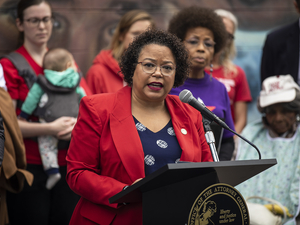
Burlington Police Chief Jon Murad speaks at a press conference where he and Burlington Mayor Emma Mulvaney-Stanak discussed the city’s response to several recent violent incidents on Monday, August 26, 2024. Photo by Glenn Russell/VTDigger
When the man signed a plea deal from a Vermont prison in May 2025, he thought he knew what he was agreeing to.
He was already incarcerated when he pleaded guilty to fentanyl trafficking, burglary and carrying a weapon during the commission of a felony, agreeing to serve a minimum of three years and a maximum of 10 years incarcerated. While his full name appears in court documents, VTDigger is identifying him only as “G.” because he is not a public figure and could not be reached while he’s incarcerated to discuss the story.
Because G. could get credit for some of the time he’d already spent in prison, his minimum release date was in early October 2025, less than six months after he signed his plea.
What G. didn’t know was that there was a new Department of Corrections policy, one that would change what he thought he’d agreed to.
After his sentencing, G. learned that the department was reviewing him under a new policy known as risk containment. Under the policy, the department can use a risk containment classification to incarcerate a person past their minimum release date because of concerns that the person poses a risk to others if they are released.
If he was risk contained, G. would be ineligible for furlough — the mechanism through which many incarcerated Vermonters leave prison — until the department chose to lift the classification. Parole would remain technically available, but the department likely would not recommend him for it.
“I took my plea agreement on the grounds of being released on my minimum release date,” G. wrote to the court in August 2025. He asked the judge to change his sentence to five and a half years of incarceration, a plea deal that had previously been on the table and that would give him more certainty about when he would be released.
“If I had known (about risk containment) prior to sentencing I would have never taken anything other than the 5 year to 5 year 6 months,” he later wrote in a letter to the court.
If he is risk contained, G. might end up staying incarcerated until the end of his maximum sentence — in 2032, more than six years away.
G. is one of dozens of people incarcerated in Vermont’s prison system who have been impacted by the new policy. As of July 8, G. had been waiting for over a year for the department to decide whether to risk contain him. Like other people who are awaiting review under the policy, he has not been allowed to participate in required risk intervention services while he waits for the department to decide whether to risk contain him. And if he ends up risk contained, he will face the uncertainty of not knowing when he might be released or how to get the classification lifted.
The internal Department of Corrections policy, quietly introduced in July 2024, has expanded the criteria it uses to keep people imprisoned past their minimum sentence — and prosecutors and defense attorneys say it is reshaping sentencing across the state. Some incarcerated Vermonters, including G., are challenging the policy in court on the grounds that it changes the meaning of their sentence.
Vermont uses an indeterminate sentencing structure, meaning people are sentenced to a minimum and a maximum sentence. The department has long had the power to incarcerate people past the minimum, but the norm largely was to release most people at or near their minimum onto community supervision once they completed required programs, prosecutors and defense attorneys said. Those programs include educational, job-skills and emotional regulation training; some people are required to complete such programs to be eligible for furlough.
Other common reasons that the department incarcerates people past their minimum sentence include not having DOC-approved housing or being reincarcerated after a violation of furlough, according to DOC data.
Under the new risk containment policy introduced under former DOC Commissioner Nicholas Deml, more people are being held past their minimum, prompting concerns from advocates about due process and from prosecutors about new uncertainty in sentencing.
Impetus from the Governor
The policy grew out of direction from Gov. Phil Scott, according to court testimony from Jordan Pasha, a DOC employee who helped write it. Pasha testified in Vermont Superior Court as part of a case in which an incarcerated person asked the court to reconsider their sentence because of the risk containment policy.
“We had received direction from the Governor’s office to look at mechanisms that the department had to slow down releases in the interest of public and victim safety,” Pasha testified in December 2025, according to a hearing transcript obtained by VTDigger.
The governor’s office referred questions about the origins of the policy to the DOC. The department did not make Pasha available for an interview.
Jon Murad, who became commissioner after Deml stepped down in August 2025, said he was not familiar with the origins of the policy but that the change may reflect rising community concern about crime.
“It’s my responsibility to ensure that people leaving our custody are both safe for the community and are as best positioned as possible to be successful in the community,” Murad said in an interview, adding that the policy only applies to people with certain convictions whom the department determines would pose a threat if released.
People with convictions for sex offenses, listed offenses (a category that includes some of the most serious crimes, such as murder and manslaughter), or felonies can be considered for risk containment. In Vermont, a felony is any crime for which the maximum punishment is more than two years of incarceration.
Falko Schilling, who directs advocacy at the ACLU of Vermont, said in an interview that keeping people locked up for longer wasn’t likely to reduce their risk of committing new crimes when released.
“Generally, the research shows that longer incarcerative sentences don’t reduce the risk of recidivism,” Schilling said in an interview.
In a period when the department has struggled with overcrowding, Schilling also raised concerns that the policy adds to pressure on an already strained system.
Expanding criteria
What’s changed is not the department’s power to hold people past their minimum, but who it chooses to hold.
Under the previous policy, in effect for over 20 years, people convicted of a listed offense whose crime was deemed “egregious” and who posed a moderate-to-high reoffending risk were typically incarcerated past their minimum. These individuals, classified as “Level C,” had to show long-term stability and completion of treatment goals before release. In June 2023, there were eight people incarcerated past their minimum sentence under the Level C policy, according to DOC data.
Other people –– even those convicted of listed offenses –– were released at their minimum onto community supervision, provided they finished required programming and had somewhere to live outside of prison that met DOC standards. Risk containment changed that.
Now anyone convicted of a sex offense, listed offense or felony can be reviewed for risk containment. To be designated risk contained the department must find the person poses “a threat to the life, safety, or physical or mental well-being of others.” A committee of DOC employees makes that call, weighing past charges, behavior inside, supervision history and other factors, Pasha testified.
Someone who is risk contained gets no furlough and no positive parole recommendation from the DOC, Pasha testified. The expected release date vanishes. The only guarantee left is the maximum, sometimes years away.
The parole board can still choose to grant parole for someone who is risk contained, and it is not bound by the department’s recommendation. But parole board director Mary Jane Ainsworth said the board does not track how often it approves release in cases where DOC has not recommended it, and couldn’t say whether anyone classified as risk contained has been paroled.
Whatever the theoretical path to release, it does not appear to be functioning. Sixty-three of the roughly 75 people classified as risk contained are currently incarcerated past their minimum sentence, according to the department.
Tim Burgess, an advocate for incarcerated Vermonters who spent several years incarcerated in the early 2000s, said in an interview that the uncertainty takes a toll.
“It’s your every focus,” Burgess said of a release date. “When you’re an inmate in an incarcerative setting, you’re working, hopefully, to do everything you can to make that date.”
“Your mindset changes,” Burgess said of the uncertain release date. “You’re now all of a sudden in a posture of trying to say, ‘Well, what am I going to do now? Because I’ve made other plans based on what I’ve been told.’“
Just waiting for a risk containment decision can itself keep people incarcerated past their minimum –– even those the committee ultimately doesn’t classify. G. remains incarcerated more than nine months after his minimum sentence passed in October 2025. As of early July, the department had still not made a final decision about whether to risk contain him, one of his lawyers said in court.
It is not uncommon for the DOC committee to take more than 6 months to make a final decision on whether to risk contain someone, Pasha testified.
Fifty-three people were awaiting a risk containment decision as of early July.
‘It’s very unclear’
While the policy lays out a process through which a person can challenge a risk containment classification, advocates questioned whether that process is adequate.
“The lack of transparency around the decisions or substantive opportunities to challenge those decisions is one of the most concerning aspects of how we’re hearing about this policy being implemented,” said Schilling, the ACLU advocate.
Murad pushed back on concerns about transparency in how the department decides who meets the threshold.
“It’s a fair process,” he said. “It is a thorough-going process. It is not a process that has a foregone conclusion in either direction.”
A risk-contained person can challenge the decision through the prison’s grievance system. Burgess, the formerly incarcerated advocate, said that process can be grindingly slow, and the court challenges that often follow can take years. A state auditor’s report in 2022 found significant issues with the DOC’s grievance process; the department undertook some changes in response to the report.
A risk-contained person can petition once a year for a change if they show “substantive evidence that they have addressed one or more of the factors that contributed to their risk,” according to the policy. But the prisons have added no new programming for risk-contained people, Pasha testified, leaving advocates and at least one judge to wonder how anyone demonstrates change.
Vermont Superior Court Judge John Pacht pressed the point during the hearing in which Pasha testified.
“It’s very unclear that you folks have, and I don’t say this judgmentally, it’s just a brand new program, have developed a really clear set of just how much it will take to get off the risk containment policy once you’re on it,” Pacht said. “You could just, by virtue of history, no matter how well you do, just remain risk contained.”
Pasha replied that “the department is hesitant to very clearly say you need to do this and this and this and risk containment will be removed.”
“We’re looking for meaningful change,” he added.
An impossible uncertainty for defense attorneys
For longtime defense attorney David Sleigh, the policy undercuts the intent of sentences imposed before it existed. He argued that judges and prosecutors already take risk factors into account when they impose or agree to a sentence.
“It’s like, wait a second, you know, the judge knew about all this stuff, that’s what he or she sentenced me to. Who are you, head of programming at DOC, to make this decision on your own?” Sleigh said in an interview.
Pacht, for his part, wrote in one case that the policy “had the likely effect of significantly increasing the length of the in-prison incarcerative portion of a to-serve sentence that a person with [the defendant’s] criminal history would serve.” That case has yet to be resolved.
Murad disputed that risk containment decisions rest solely on information that’s available when a person is sentenced, saying the decisions take into account a person’s behavior while incarcerated.
“The idea that this is entirely predicated on things that happen prior to sentencing is erroneous,” he said.
Four top prosecutors from different counties said sentencing has shifted over the past year, driven by uncertainty about who the policy will impact.
“Policies that don’t have clear guidelines are impossible for defense attorneys to give adequate legal advice on,” Sarah George, the top prosecutor for Chittenden County, said in an interview.
Prosecutors said that prior to risk containment, they often used sentences with low minimums and high maximums, assuming that the person would serve the minimum inside and the rest on supervision.
“The idea behind those types of sentences is to get a little bit of time on the front end, and then allow corrections to furlough, parole somebody out near or close to their minimum,” Steven Brown, the lead prosecutor for Windham County, said in an interview.
Furlough and parole are forms of community supervision more intensive than probation, with reincarceration a possible consequence of violations.
“The reason why we’d want to have that type of sentence structure is to provide supervision of an individual for a set amount of time,” Brown added. “Usually we would do that in cases where probation no longer provided the level of supervision that we wanted to have.”
Now, because no one knows at sentencing whether a defendant will be risk contained, fewer will accept a low-minimum, high-maximum deal for fear of serving the whole thing.
“You had a whole class of people, dozens, who made these sort of low minimum, high maximum deals with the understanding if they did the programming that they’d be eligible for parole,” said Sleigh, the defense attorney.
“I won’t agree to that kind of sentence structure as a general rule these days,” he said.
The result, prosecutors said, is more “split” sentences — a fixed term inside, then probation. That worries George, who says some of those defendants are too high-risk for probation.
“I think it’s actually doing the exact opposite of what it’s claiming to do,” George said of the policy’s public-safety impact.
“We’re experiencing maybe some … unintended effects, in that it’s making it harder for us to negotiate cases with a furlough sentence involved,” Bram Kranichfeld, the lead prosecutor for Franklin County, said in an interview.
George and Kranichfeld are both running to be top prosecutor in Chittenden County, a role George has held since 2017.
Jared Bianchi, a prosecutor in Bennington County, disagreed that the policy has impacted sentencing.
“From my perspective, I think that there’s a lot of hand-wringing over what I don’t perceive to be a substantial change,” Bianchi said in an interview, noting DOC always had the power to hold people past their minimum.
Broad authority
Sleigh said the department’s broad authority to incarcerate people past their minimum may limit legal challenges to the policy, though a defendant might argue they lacked full information at their plea, or that the policy substantively changed the length of confinement.
Several cases that attempt to challenge the policy are currently moving through the courts, including G.’s case.
Meanwhile, George and Kranichfeld said they are exploring whether DOC could screen people for risk containment before sentencing, so everyone knows the odds up front.
While Murad said he is willing to engage with prosecutors about their concerns, he said pre-sentencing screening isn’t possible because behavior in prison is part of the calculus.
“When we become soothsayers, and when we become fortune tellers, perhaps that would make sense,” Murad said.
Read the story on VTDigger here: A Department of Corrections policy is quietly reshaping how long people are incarcerated in Vermont.

Montpelier, VT