He fled gang violence. Now this ICE detainee in Aurora tries to avoid deportation.
Jul 27, 2026 | 6:10 am ET
Description
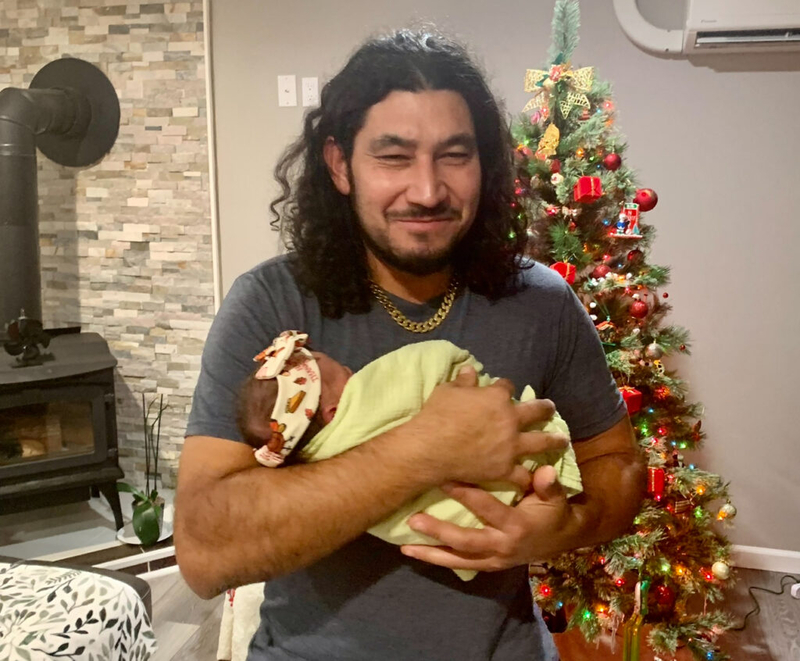
Rudy Villeda Mejía, pictured holding his granddaughter, fears deportation back to his native Honduras due to violence he faced in the country. He has lived in the U.S. since 2010. (Photo courtesy of Mabel Shaffer)
Rudy Villeda Mejía has his own roofing business, a wife and three stepchildren in Washington, near the state’s border with Canada.
He has never been charged with a crime. He entered the U.S. without authorization for a second time in 2010 after he was kidnapped by a violent cartel in Mexico, and has been in the U.S. since then, according to a notarized personal statement Villeda Mejía submitted with his visa application, which Newsline reviewed.
Villeda Mejía attended routine check-ins with immigration officials in Seattle for more than a decade. But U.S. Immigration and Customs Enforcement arrested Villeda Mejía at the Denver International Airport on March 30, and he has since been in custody at the ICE detention center in Aurora.
“They just took him in. They didn’t tell him why. They didn’t say he’d done anything wrong. He has no criminal history. They just took him and they detained him,” Henry Hollithron, Villeda Mejía’s attorney, said.
ICE has “a lot of discretion” when it comes to taking people under its supervision back into custody, but there are certain rules they must follow, and Hollithron said those procedures were not followed when ICE arrested Villeda Mejía.
“It’s not that they didn’t have the legal authority to detain him, it’s that the way they did it didn’t follow the right procedures,” Hollithron said.
Courts have denied multiple attempts to get Villeda Mejía released from custody, and his application for a T visa, which is designated for victims of human trafficking, is pending with U.S. Citizenship and Immigration Services. To get approved for a T visa, the applicant has to physically be in the U.S., Hollithron said, so if Villeda Mejía is deported, the process is cut short.
“The T visa is really his only lawful pathway to … stay with his family. There’s really nothing else,” Hollithron said. “And he can’t do anything through his family unless he stays outside the U.S. for 10 years.”
Previous attorneys Villeda Mejía worked with never advised that he should apply for a T visa and made several mistakes while filing paperwork in his case, according to Hollithron and Villeda Mejía’s family members. Hollithron, who took on his case after he had already been detained earlier this year, filed an application for a T visa for Villeda Mejía at the start of July.
Villeda Mejía has attested to immigration authorities that he was kidnapped and held hostage. Court records acknowledge that after two men in Mexico helped him cross the border he was held for ransom for six months in the U.S. and that his family reported this to police in Washington.
They just took him in. They didn't tell him why. They didn't say he'd done anything wrong. He has no criminal history. They just took him and they detained him.
A May court order from California blocked ICE from detaining immigrants with pending T visa applications, along with other visas for crime victims. But Villeda Mejía is still in ICE custody, and the Department of Homeland Security said he will remain in ICE custody pending his deportation.
“He has received full due process,” an unnamed department spokesperson said in an email to Newsline. The Denver ICE Field Office did not answer questions about Villeda Mejía’s arrest, his visa application or plans to release him from detention or deport him.
Family and business struggling
Mabel Shaffer, Villeda Mejía’s wife, has hip displacement, and he takes care of her full time. Since he has been in ICE custody, she has worked to keep their business afloat, while doing her best to care for herself with the help of loved ones. Walking for too long causes extreme pain for her, and she struggles to put on socks and shoes by herself.
“There’s a lot of things that Rudy does, and he takes care of me, but it’s been very hard on me,” Shaffer said. “Our family is completely stressed out. I’m a mess.”
Shaffer met Villeda Mejía through a mutual friend in 2011 and they started dating shortly after in 2012. They got married in 2014, and she said “he’s been a really good stepfather to my children.”
“My kids basically grew up with no other figure, so he was a good example to them,” Shaffer said.
Shaffer came to Colorado to visit her husband over the Fourth of July, and she said “he’s a wreck. I’ve never seen him so badly.” He was moved to a newer part of the ICE detention facility in Aurora, and Shaffer said he isn’t able to go outside for fresh air frequently. He’s concerned about contracting illnesses in the detention center, and Shaffer said he’s lost weight because there are not enough food options.
Villeda Mejía calls Shaffer to speak with her several times a day, she said. Those calls cost money, but Shaffer said he tries to give her advice to help her manage their business on her own. She’s worried about telling customers that her husband is in ICE custody, too, because she has had negative reactions from some people who she told.
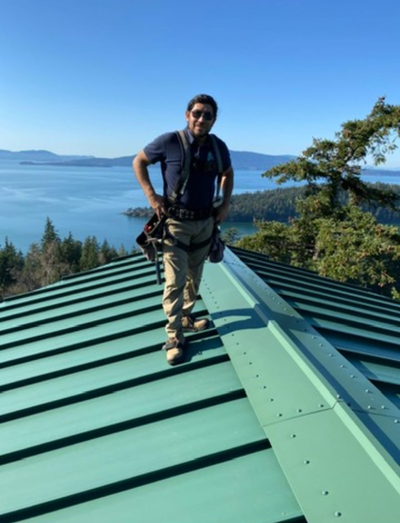
Villeda Mejía builds custom metal roofs, and he is the only person at this company with the specialized skills to manage certain parts of their jobs, Shaffer said. The company has not been able to complete many of the jobs they otherwise would with Villeda Mejía leading them, Shaffer said.
“Nobody can replace Rudy,” Shaffer said.
The business is struggling to repay loans for new equipment the company purchased, Shaffer said. Her husband is not a flight risk because of how much he has invested into his family, business and community, she said.
“Since he’s been incarcerated, the business has been hurting a lot,” Shaffer said. “I’m trying to keep the employees with their job, but it really is getting more challenging as the time goes by because he’s been incarcerated for going on four months.”
History of violence
Court orders related to his case, the notarized personal statement from Villeda Mejía, Hollithron and family members offered details of his immigration history and why he left his native Honduras.
Villeda Mejía grew up surrounded by gang violence in Honduras. He remembers walking by the house of one of his school teachers when he was about 10 years old and seeing the teacher’s severed head. Gangs repeatedly tried to recruit him, and they threatened him as he continued to refuse. He ultimately decided that his “life would not be safe” if he stayed in Honduras and he left in 2007.
Colorado health officials still unable to investigate tuberculosis case at ICE detention facility
When Villeda Mejía first entered the U.S. in 2007, after traveling from Honduras through Guatemala and Mexico, he was sick, dehydrated and malnourished from the trip. Border Patrol agents detained him and ordered he be removed from the country.
Villeda Mejía expressed fear of returning to Honduras and awaited a conversation with an asylum officer for a “credible fear” interview. That interview never happened, and Homeland Security officials pressured Villeda Mejía to sign a request to end the credible fear process, though he later testified that he did not know what he signed at the time.
Signing that document resulted in a final order of removal that prohibited Villeda Mejía from returning to the U.S. for five years. He went back to Honduras and received emergency medical treatment.
He attempted to reestablish himself in Honduras, but violence continued to follow him. Villeda Mejía worked at a computer repair shop, and in October 2009, gang members came in and demanded he repair their phones. While repairing the phones, Villeda Mejía found and unintentionally deleted videos of the gang members “killing and hurting people while dressed like officers from the Honduran authorities,” according to his personal statement. The gang members threatened him at gunpoint and demanded he restore the videos, which he did.
Villeda Mejía and his cousin attempted to relocate to a different part of the country, but gang members found and beat them. He left the country again, traveling through Guatemala to Mexico.
In the summer in 2010 in Mexico, two armed men approached Villeda Mejía and told him they could help him get documents to work legally in the U.S. He followed them to a car and they drove him to an unknown location, and soon after demanded Villeda Mejía share contact information for his family. When his family did not answer after two phone calls, they beat Villeda Mejía.
“The third time, they got through and shouted down the line, ‘We took him yesterday, and if you don’t pay, we’ll send him back in pieces!’” Villeda Mejía said in his personal statement. “I suffered many indignities at their hands, though they did receive some money from my family.”
After “endless days” in captivity, Villeda Mejía got into a car with a driver and the two men who initially approached him. The car drove for several hours, and they eventually reached the southern border of the U.S. A Border Patrol official waved the car through.
“That was how I last entered the United States — I have not left this country since then,” Villeda Mejía said.
Hollithron said Los Zetas cartel members trafficked Villeda Mejía into the U.S. before they held him for ransom, making him a victim of human trafficking and eligible for a T visa. The men brought Villeda Mejía to an abandoned house and continued to beat him and hold him captive after his family did not answer requests for money.
“The mistreatment continued every day. I could not sleep for the sounds of women weeping and men crying out in pain that never seemed to fade,” Villeda Mejía said. “Since I was constantly held in the dark, I have no idea how long I spent there.”
Eventually, they blindfolded Villeda Mejía and put him in another car. He thought they were going to kill him. The car drove for a long time, and then they told him to get out of the car and “not to speak of what had happened.”
“They warned me that they would keep track of me always,” Villeda Mejía said. “Then, they told me to walk straight forward and not to go left or right, else they would shoot me.”
He kept walking and ended up at a mall. A family gave him some coins so he could call his family, and Villeda Mejía’s family told him that they paid the Los Zetas cartel $3,000. His father reported what happened with the cartel to police in Washington, who sent the information to Homeland Security.
“To this day, I am still experiencing the after-effects of my ordeal with Los Zetas,” Villeda Mejía said. “I find it very difficult to trust anyone, cannot be in a room with the lights off, and have a lot of nightmares. I have also been diagnosed with Bell’s Palsy as a result of what I went through.”
Attended every check-in
Villeda Mejía moved to Washington and began to build a life. He met and married his wife. He started a business. In 2014, ICE detained him and reinstated the initial removal order against him. He was held in ICE detention for about six months and was released on a $5,000 bond.
Certain options for Villeda Mejía, like legal residency through his wife, who is a U.S. citizen, are off the table because of the paper he signed the first time he came into the U.S.
“Because he was ordered removed and he came back, even if involuntarily, he came back without permission, so that pathway is cut off,” Hollithron said.
An immigration judge denied Villeda Mejía’s requests for protection in 2016, and his appeal of that decision was also denied in 2017. ICE ultimately released Villeda Mejía from custody and required that he check in at the Seattle Field Office periodically. Subsequent motions to reopen his case were all denied. He attended every check-in from August 2018 until April 2025. He did not make his next scheduled check in April after he was detained at the Denver International Airport, where he had a layover flying home from a trip visiting family on the East Coast.
The next step is for Hollithron to file a motion asking Judge Regina Rodriguez with the U.S. District Court of Colorado to reconsider her denial of Villeda Mejía’s habeas corpus petition — a legal mechanism that challenges wrongful detention — because she did not consider the legality of how ICE arrested and detained him in the first place. Some judges have issued orders that say ICE’s noncompliance with rules around detaining someone justify the person’s immediate release, Hollithron said.
“Separately from whether he can be removed to Honduras or not, is ICE, they didn’t follow the procedures. If they want to detain and deport him, they have to follow the rules, just like they expect the people they are targeting to follow the rules,” Hollithron said. “And if they don’t, then they should not benefit from their breaking of the rules.”
Rodriguez on July 17 denied a separate request to pause Villeda Mejía’s deportation while his attorney appealed her denial of his habeas corpus petition. That means he could still be deported at any time.
Denver, CO