Lack of access to adequate healthcare impacts Alabama infant mortality rates
Jul 27, 2026 | 6:01 am ET

Description
Sierra Edgio talks about her birth experience as Ramona crawls on the carpet at the Alabama Birth Center Wednesday, April 15, 2026 in Huntsville, Ala. One reproductive health provider said that birth centers, and access to them, is one way to reduce Alabama's infant mortality rate. (Eric Schultz for Alabama Reflector)
Alabama’s infant mortality rate improved in 2024, but access to adequate healthcare impacts outcomes for babies in their first year of life.
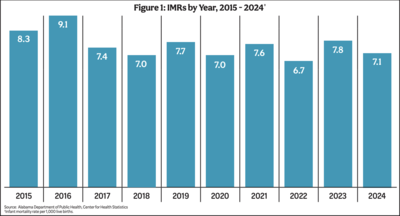
According to data from the Alabama Department of Public Health, the state’s infant mortality rate was 7.1 babies per 1,000 live births in 2024, reflecting the rate of infants who died within their first year of life. That was down from 7.8 deaths per 1,000 births in 2023, which was a seven-year high.
State Health Officer Dr. Scott Harris wrote in a letter to state lawmakers in the Fiscal Year 2025 Perinatal Report that the maternal and infant health crisis is not unique to Alabama.
“Lack of access to care, closure of labor and delivery services, poverty, poor nutrition and chronic disease play significant roles in the health of mothers and infants,” he wrote. “With the purpose to improve, promote and protect health, it is essential that we address the factors that contribute to maternal and infant poor health outcomes.”
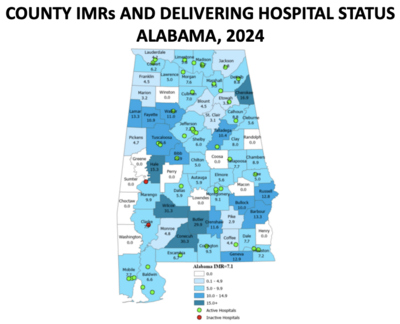
Some of the counties with the highest infant mortality rates do not have an active delivering hospital, according to the ADPH data. There were 41 counties in Alabama without an active delivering hospital in 2024, and there were 42 active delivering hospitals elsewhere in the state.
According to the University of North Carolina’s Sheps Center, nine rural hospitals have closed in Alabama since 2009. Only 30% of the state’s rural hospitals have labor and delivery units, leaving many expectant parents to drive long distances for care. Providence Hospital in Mobile closed its labor and delivery services at the end of June.
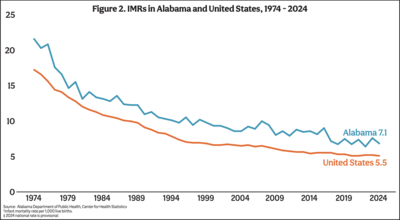
While the infant mortality rate has been on a downward trend nationwide over the past 50 years, it has been more mixed in Alabama. Harris said reducing infant mortality is challenging, but important work, in an interview after the report was released earlier this month.
“We want legislators and then their constituents to understand the importance of the work we do around infant mortality and keeping moms and babies safe. Alabama consistently ranks low nationally in how well we do with that, but it’s not because we aren’t trying,” Harris said. “We have a lot of tremendous people who are doing great work, but it’s really difficult to overcome a lot of the barriers that people have in our state, and we just want our legislature to understand that.”
The leading causes of death for infants in 2024 were congenital anomalies, preterm births and low birth weight (LBW), and bacterial sepsis. The three accounted for 42.5% of infant deaths in 2024. Racial disparities were observed in the top two leading causes of infant death, according to the report. About 74% of babies who died from congenital anomalies were white, and about 65% of babies who died from preterm and LBW were Black.
Robin Marty, executive director of WAWC Healthcare, said in an interview that losing access to labor and delivery services means losing access to prenatal care.
“We are not getting the follow-up care that babies need in their first year in order to make sure that they have healthy lives,” Marty said. “That’s the inherent problem: when you lose hospitals, you lose those doctors as well. Once you increase the burden of a mother being able to get to a pediatrician, a mother being able to get into an OB/GYN for their prenatal care, a mother being able to get the follow-up care that they need and get all of those appointments that they need, that’s how you get low birth rates. That’s how you get people who go into premature labor, and that’s how you get infants that are dying at birth or within just a year of their birth.”
WAWC used to provide abortion services, but now it provides prenatal and pregnancy services, contraceptives, STI/STD testing, gender-affirming care and annual exams.
In western Alabama, there were two inactive delivering hospitals in 2024 in Greene and Clarke counties. The infant mortality rates in the region range from 4.8 deaths per 1,000 births in Monroe County to 31.1 deaths per 1,000 births in Wilcox County. Some counties in the region did not report data.
A 2023 report from March of Dimes, a nonprofit, identified 22 Alabama counties as “maternity care deserts,” most of which were in the western part of the state.
“We have moms who have difficulty with transportation to get care. We have many counties that just don’t have providers that are available,” Harris said. “We have a lot of people who can’t afford to get the care they need. We have people who just haven’t been educated on how to keep themselves healthy, and how to have a healthy pregnancy and how to take care of their baby very well.”
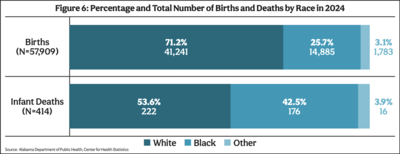
Infant mortality rates for Black Alabamians remain disproportionately high. The infant mortality rate among white Alabamians was 5.4 deaths per 1,000 live births in 2024. For Black Alabamians, the rate was 11.8 per 1,000. In 2023, the rates were 5.7 and 13.1 deaths per 1,000 births, respectively.
Rep. Marilyn Lands, D-Huntsville, said in an interview that Alabama should consider a different approach when caring for pregnant patients.
“I think there’s a lot that can be done with looking at the role of doulas and midwives and the scope of practice for nurse practitioners,” she said. “I’m really encouraged by the community health model.”
Huntsville Hospital, a non-profit community hospital, in June awarded $600,000 total to 11 local non-profits that aim to improve overall health outcomes across the region, according to a press release.
According to the Perinatal report, incorporating “evidence-based efforts will help address factors impacting health outcomes such as access to healthcare, geographical disparities, lack of quality education, poverty and unemployment.”
“The big difference I think is that we’re when you have a low birth weight or a preemie, and this is a population that, because of lack of prenatal care, but also lack of preventative healthcare and all of the other isms – lack of food, lack of clean water – that is why we are seeing lower lower birth weights and also early early births,” Marty said.
Solutions
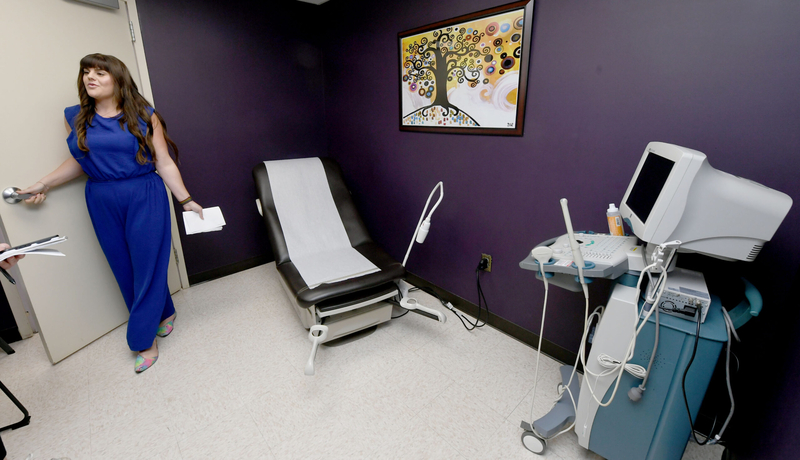
The report also included suggestions for the Legislature for the future, like continuing the Perinatal Report program and increasing the number of autopsies performed on maternal deaths. The last Maternal Mortality Review done by ADPH was released in 2021. It found that 78% of the reviewed deaths were preventable.
Marty said that the Legislature and ADPH should do more, including “get over whatever their issue is with birth centers.”
“That is the number one thing that they can do. And once that is released, then that would allow the opportunity to be able to open up the whole area, quite frankly, to being able to have more access to healthcare,” Marty said.
ADPH and birth centers in the state have been in a legal battle for years because the department wants to regulate the centers – which provide an option between home and hospital birth – as it does hospitals.
A Montgomery County judge ruled last week that the centers can keep operating despite a ruling earlier this year subjecting them to the regulation after Harris sent the centers cease-and-desist letters in June.
Alabama birth center licenses still valid despite appellate court ruling, says Montgomery judge
Lands, who often sponsors reproductive care-related legislation, said in an interview that incorporating midwifery and doula care, and community-based care could help close the care gap in rural areas.
“I think we really have to get creative and rethink the way we’re delivering prenatal care and taking care of pregnancy and newborns,” Lands said. “I think we need a new model. This one size fits all that we’ve been offering here is not working for us.”
Lands sponsored the House version of a 2025 law that allows pregnant people to be eligible for Medicaid, which sunsets in 2028. Marty said she was frustrated that the access to health insurance was not mentioned in the report.
According to a 2025 memo sent to Alabama providers and hospitals from the Alabama Medicaid Agency, providers and insurance determiners have to complete a training and sign a waiver with the agency in order to become a “qualified determiner” of presumptive eligibility for pregnancy. A message seeking comment from the Alabama Medicaid Agency was left Friday.
“There is no mention of the fact that actually training doctors to recognize or training healthcare providers to recognize that this is a person who could be qualified be able to get them their care as quickly as possible and get them into Medicaid as quickly as possible,” Marty said. “That would save lives, and that is not mentioned at all.”
Montgomery