The lingering question: Who’s behind the indictment of AG Liz Murrill?
Jul 17, 2026 | 8:25 pm ET
Description
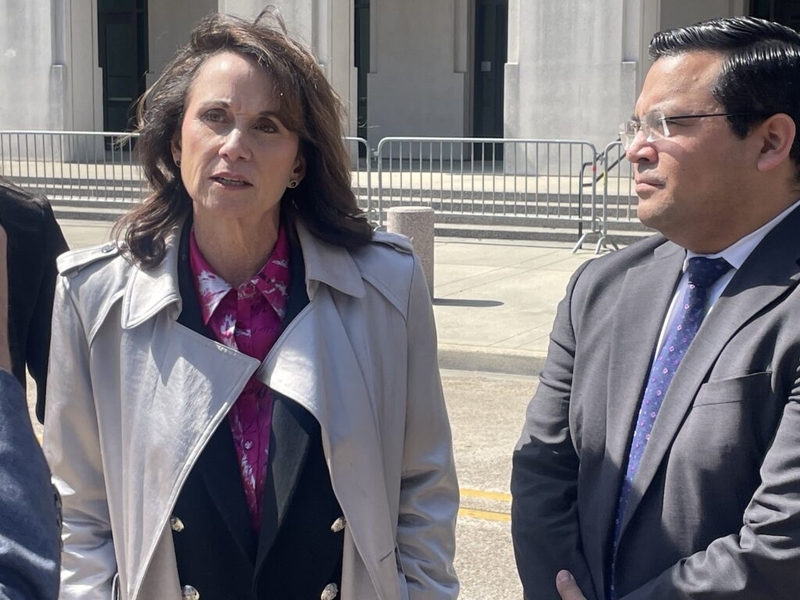
Louisiana Attorney General Liz Murrill and Solicitor General Benjamin Aguiñaga speak with reporters Tuesday, Feb. 24, 2026, after asking a federal judge in Lafayette to force the U.S. Food and Drug Administration to end telehealth prescriptions for the abortion medication mifepristone. (Photo by Greg LaRose/Louisiana Illuminator)
Attorney General Liz Murrill’s indictment by a New Orleans grand jury has been the top political news story in Louisiana for the past two weeks. But in spite of all the attention, there are still some basic questions that haven’t been answered about the case, such as:
Who made this happen?
Orleans Parish District Attorney Jason Williams said Thursday his office has been “fully recused” since the grand jury launched an inquiry into Murrill. New Orleans Mayor Helena Moreno has also publicly said she wasn’t involved in initiating the probe.
Legal experts say the public may never know who initiated the investigation, in part because of the secrecy surrounding the grand jury process. The identities of the 12 jurors, witnesses called to give the jury testimony and questions asked during the proceedings are supposed to remain confidential.
“I don’t know if we will ever know how this thing kicked off,” said Will Snowden, a law professor at Loyola University in New Orleans. “Grand jury proceedings are highly confidential, and it isn’t something that can just be asked and answered.”
Typically, grand juries launch probes into alleged criminal activity — which can lead them to vote for indictments — at the direction of a prosecutor. But Louisiana law also gives grand juries a lesser-known authority to initiate investigations into potential crimes on their own.
“The whole thing is unique,” New Orleans defense lawyer Chris Carbine said of a grand jury’s powers. “They can unilaterally charge you with a crime.”
Most of the 13 former prosecutors and criminal defense attorneys the Illuminator interviewed said they had never heard of a grand jury launching an investigation into a matter independent of a prosecutor’s request. The handful who know of such cases called it highly unusual.
“It’s rare, but it’s not like it never happens,” said James Boren, a Baton Rouge criminal defense attorney who estimated he has represented between 30 and 40 Louisiana public officials facing indictments during his 50-year legal career.
Under Louisiana law, state prosecutors are required to secure an indictment from a grand jury in order to charge someone with a criminal offense punishable by death or life imprisonment.
But grand juries can also be used to charge a person with a less-severe crime, such as the allegations of public intimidation and malfeasance in office Murrill is facing.
Murrill’s charges stem from letters she sent to Williams, Moreno and five New Orleans City Council members, all Democrats, in May warning they could be removed from office if they pursued a special election for a newly combined clerk of court office in Orleans Parish.
At the time, elected officials in New Orleans were upset that Gov. Jeff Landry and the Republican-controlled Louisiana Legislature had consolidated Orleans’ two elected court clerk offices into one position and blocked Calvin Duncan, a formerly incarcerated man who was exonerated and had won election to one of the jobs, from taking office.
After receiving the letters, Moreno and council members suggested on social media that Murrill might have broken a law that makes it illegal to intimidate elected officials by threatening them in writing.
A few weeks later, the grand jury brought the indictment against the attorney general.
What has complicated matters is that the prosecutor whose staff normally would have been advising the grand jury on how to proceed is Williams, one of the victims of Murrill’s alleged crimes.
Given WIlliams’ conflict of interest, a special prosecutor, former Orleans Parish Judge Laurie White, was named by Judge Leon Roche to advise the grand jury.
Williams has also said he turned over documents to the attorney general in response to a subpoena that makes it clear he was not involved in bringing the charges.
“The materials produced confirm that neither District Attorney Williams nor his office initiated or handled this indictment,” he said in a written statement. “The response includes the motion to recuse, as well as a record reflecting no communications between the District Attorney’s Office and the mayor or members of the City Council regarding this indictment.”
White asked the court to block a similar subpoena sent to her, according to a copy of the motion she filed Friday. She accused Murrill of using the subpoena in a campaign to “intimidate and harass” her and Williams, according to the filing. She said Murrill and her lawyer, Laura Cannizzaro Rodrigue, are spreading “false statements” to try to discredit the prosecution, according to the motion.
“I stand by my pleadings and look forward to offering sworn testimony if called to testify in court,” White said in a brief phone interview Friday.
White would not discuss the origins of the grand jury indictment against Murrill.
New Orleans grand jury indicts AG Liz Murrill for threats to remove mayor, DA, council members
Political allies of the attorney general with experience as prosecutors said they found it hard to believe the grand jury launched an investigation into Murrill without any outside influence.
“‘Far-fetched’ would be a good word for it,” said state Rep. Debbie Villio, R-Kenner, who spent decades working as an assistant district attorney and is closely aligned with Murrill. “It’s just really implausible.”
Article 438 of the Louisiana Code of Criminal Procedure states that if a grand juror “knows or has reason to believe that an offense … has been committed” in their parish, the juror must inform his fellow grand jurors, “who may investigate it.” Similar authority is included in the oath grand jurors recite when being sworn in at the beginning of their service.
The oath, which is prescribed in state law, requires the grand jurors to swear to “diligently inquire into” and consider “all indictable offenses” that are presented to them or that “otherwise come to [their] knowledge.”
Prosecutors often bring politically sensitive matters to grand juries as a way to insulate themselves from public criticism. Villio said a grand jury can be used to make the indictment appear less political than it actually is.
Boren, the criminal defense attorney, agreed with Villio’s assessment. He said prosecutors often use grand juries as cover when indicting public officials specifically. Bringing the decision to indict to the grand jury means the prosecutor, alone, will not be responsible for pursuing criminal charges against a local official in their community, he said.
Indictments of public officials are not uncommon in Louisiana, even if Murrill’s situation has gotten a lot of attention, Boren added.
“I bet you in [all of the] judicial districts in Louisiana, there is at least one charge related to malfeasance in public office right now,” he said.
Still, part of what also makes Murrill’s indictment unusual, several criminal defense attorneys said in interviews this week, was the Louisiana Supreme Court’s reaction.
Hours after her indictment was returned July 2, the Louisiana Supreme Court granted a request from Murrill to halt the prosecution. That matter would have had to go through a lower court hearing, where the prosecution is allowed to make their case for the indictment, before going to the state’s highest court.
“The fact that a grand jury has indicted a public official is not rare. What is rare is that a defendant bypasses all existing rules and procedures,” Boren said. “That, I would venture to say, has never happened in the state of Louisiana.”
Without initial lower court hearings, John “Garry” Jordan, a criminal defense attorney and former assistant district attorney for Orleans Parish, said, “there is no record to review,” at the Supreme Court level.
Louisiana Supreme Court Chief Justice John Weimer, a political independent, made the same point in his dissent from the court’s majority opinion, which favored Murrill. He suggested the court’s ruling showed favoritism toward the attorney general by allowing her to skip “many steps” in the process, “potentially based solely on the title” she holds as attorney general.
Associate Justice Michael Guidry, a Democrat, was more pointed, criticizing his colleagues for giving preference to Murrill’s arguments unsupported by evidence, while refusing to hear the cases of private citizens who are “languishing behind bars” awaiting lower court hearings on their indictments.
“Today, the majority’s action gives the public the perception that the scales of justice can be tilted to favor the position of one criminally accused person, but not others,” Guidry wrote. “That erodes public confidence in the judiciary, undermines the rule of law, and makes a mockery of the ideal of blind justice.”
But the court’s majority opinion also cited some irregularities surrounding Murrill’s indictment, including Judge Roche’s decision to close the courtroom to the public while the indictment was read. Several journalists were barred from the proceedings, and one was temporarily handcuffed even though state law requires indictments to be read in “open court.”
News of the grand jury’s investigation of Murrill was also leaked to the news media ahead of the indictment.
“While the record before this court is undeveloped, there is considerable support for the view that the attorney general is likely to succeed on the merits of a motion to quash this indictment on either a legal basis or due to apparent procedural irregularities,” reads the justices’ majority opinion. “She obviously also suffers irreparable harm by allowing this matter to proceed without these important issues being addressed.”
The governor has also directed Louisiana State Police to investigate potential misconduct surrounding the secret grand jury proceedings.
Baton Rouge, LA